RC2009/2/08/02
- Credit Line
- Auckland Art Gallery Toi o Tamaki, E H McCormick Research Library Collection
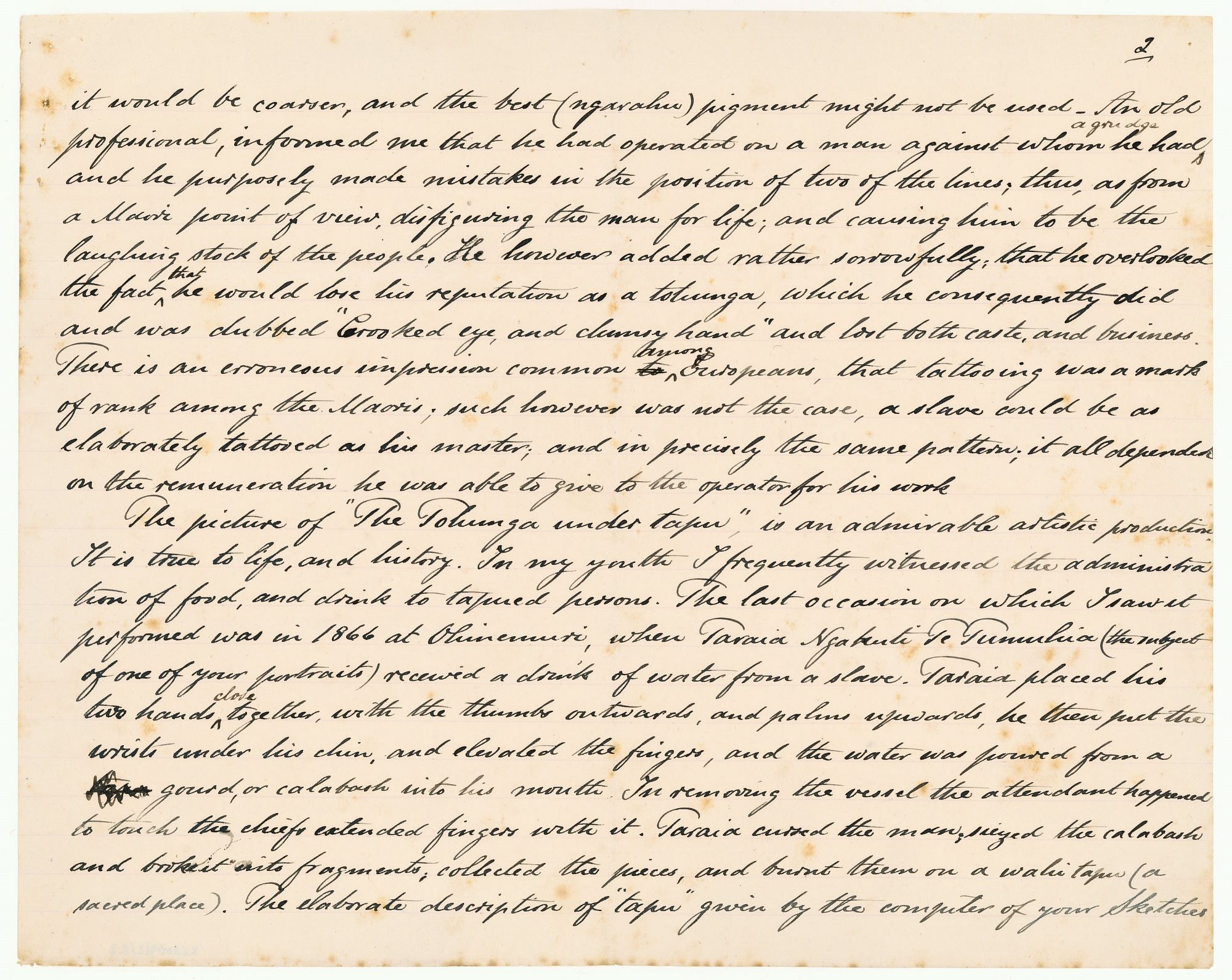
[...] it would be coarser, and the best (ngarahu) pigment might
not be used. An old professional informed me that he had operated
on a man against whom he had a grudge, and he purposefully made
mistakes in the position of two of the lines; thus, as from a Maori
point of view, disfiguring the man for life; and causing him to be
the laughing stock of the people. He however added rather
sorrowfully, that he overlooked the fact that he would lose his
reputation as a tohunga, which he consequently did and was dubbed
"Crooked eye, and clumsy hand" and lost both caste, and
business.
There is an erroneous impression common among Europeans, that
tattooing was a mark of rank among the Maoris; such however was not
the case, a slave could be as elaborately tattooed as his master;
and in precisely the same pattern; it all depended on the
remuneration he was able to give to the operator for his work.
The picture of "The Tohunga under tapu", is an admirable artistic production. It is true to life, and history. In my youth I frequently witnessed the administration of food, and drink to tapued persons. The last occasion on which I saw it performed was in 1866 at Ohineumuri [Ohinemuri], when Taraia Ngahuti Te Tumuhia [Taraia Ngakuti Te Taumuhia] (the subject of one of your portraits) received a drink of water from a slave. Taraia placed his two hands close together, with the thumbs outwards, and palms upwards, he then put the wrists under his chin, and elevated the fingers, and the water was poured from a gourd, or calabash into his mouth. In removing the vessel the attendant happened to touch the chiefs extended fingers with it. Taraia cursed the man, seized the calabash and broke it into fragments, collected the pieces, and burnt them on a wahi tapu (a sacred place). The elaborate description of "tapu" given by the computer of your Sketches [...]