Lindauer: The Man, the Myth and his Mana
Dr Jane Davidson-Ladd, Curator, Historical New Zealand Art | Kairauhī, Toi puri mahara nō Aotearoa
Auckland Art Gallery Toi o Tāmaki
Gottfried Lindauer is increasingly well known for his Māori portraits, but many myths persist. His portraits of Pākehā are often thought rare and his photographic practice entirely unknown. There is speculation about his use of photography as a source, with many believing he painted from life. The 100th anniversary of Lindauer’s death on 13 June 2026 offered an opportunity to reflect on his legacy and interrogate these myths, in ‘the land of his adoption which he loved so well’.1
Immigrating to New Zealand
Born in Pilsen, Bohemia, Lindauer arrived in Wellington in August 1874, aged 35. The reasons behind his departure from Europe have been the subject of much mythologising. Obituaries record that he came across ‘an account of the beauties of New Zealand ... [his] fancy was engaged and … he took passage from Hamburg’.2 Another explanation is that he was inspired by Māori taonga at the 1873 World Fair in Vienna.3 The most colourful reason is that on being drafted back into the Austrian army, he quitted Europe: ‘saying, “Fly Austrian Eagle!” as he threw his passport to the winds’.4 Curators Aleš Filip and Roman Musil comment that his lack of success as a portraitist in Pilsen may have also prompted the move. They explain that the waning demand for painted portraits probably resulted from the availability of photography, the economic ‘Panic of 1873’ and the few patrons for oil portraits.5
Many of these factors plausibly shaped Lindauer’s departure. Another much more pragmatic explanation has recently come to light. The passenger manifest for the Reichstag lists Lindauer as one of 293 ‘Assisted Passengers’ with his occupation recorded as ‘gardener’.6 Just under a month after arriving, the gardener Lindauer was ‘forwarded to New Plymouth’ with 23 other men from the Reichstag.7
They were part of a scheme for assisted migration from Europe championed by Premier Julius Vogel, and promised to clear bush and build roads in Taranaki.8 Dr Mark Dunick notes they were not obliged to stay where they were sent, only to repay their fare. Agents were instructed ‘to prioritise certain categories of migrant’, he adds. ‘A gardener had more chance of being accepted than an artist’.9 Lindauer did not stay gardening in Taranaki, however. He next appears in Nelson, in February 1875, advertising himself as a portrait painter.10
Meeting Henry Partridge
According to Henry Partridge’s daughter Eileen Clayton, Lindauer first encountered his future patron in Auckland in 1874.11 This meeting was to be career-defining as Partridge ultimately commissioned 62 Māori portraits and eight genre paintings from Lindauer, gifting his collection to Auckland Art Gallery in 1915. Knowledge of Lindauer’s movements from ‘shipping intelligence’ however makes this early encounter highly improbable.12 It seems much more likely that they met in late 1875 or early 1876, when Lindauer moved from Nelson to Auckland.
This early meeting has not been questioned, partly due to four works in the collection dated 1874.13 Examinations of these paintings point to their subsequent backdating. The dates are more thickly painted than the signatures, offering the possibility they were painted at different times. Additionally, the dates on Te Hira Te Kawau and Huria Matenga show signs of amendment on the front, with a splotch of canvas-coloured paint beneath the last two digits on the back. Conservator Ingrid Ford confirms this; based on her analysis, the date of Te Kawau appears to have originally been 1887 or 1897, and Huria Matenga 1896.14
We can only speculate as to why these portraits were backdated by Lindauer. Possibly to memorialise his arrival in New Zealand but more likely at Partridge’s request as commissioner, so that he owned Lindauer’s ‘first’ Māori portraits.
Lindauer’s method
There is a long-held and ultimately mistaken belief that Lindauer painted at least some of his portraits from life, reinforced by the 1901 Partridge collection catalogue which states Lindauer ‘sketched and painted from life more people of the native race than any other man living’.15
The idea that Lindauer painted from life has also been widely reinforced by family anecdotes. Son Victor wrote of Heeni Hirini and child, ‘Papa espied Hana [as Lindauer referred to her]’ in Thames in 1878. Continuing, he ‘approached Hana, and she consented to be painted.’16 The Foy Brothers photograph of Heeni Hirini and child, clearly the painting’s source, suggests otherwise.
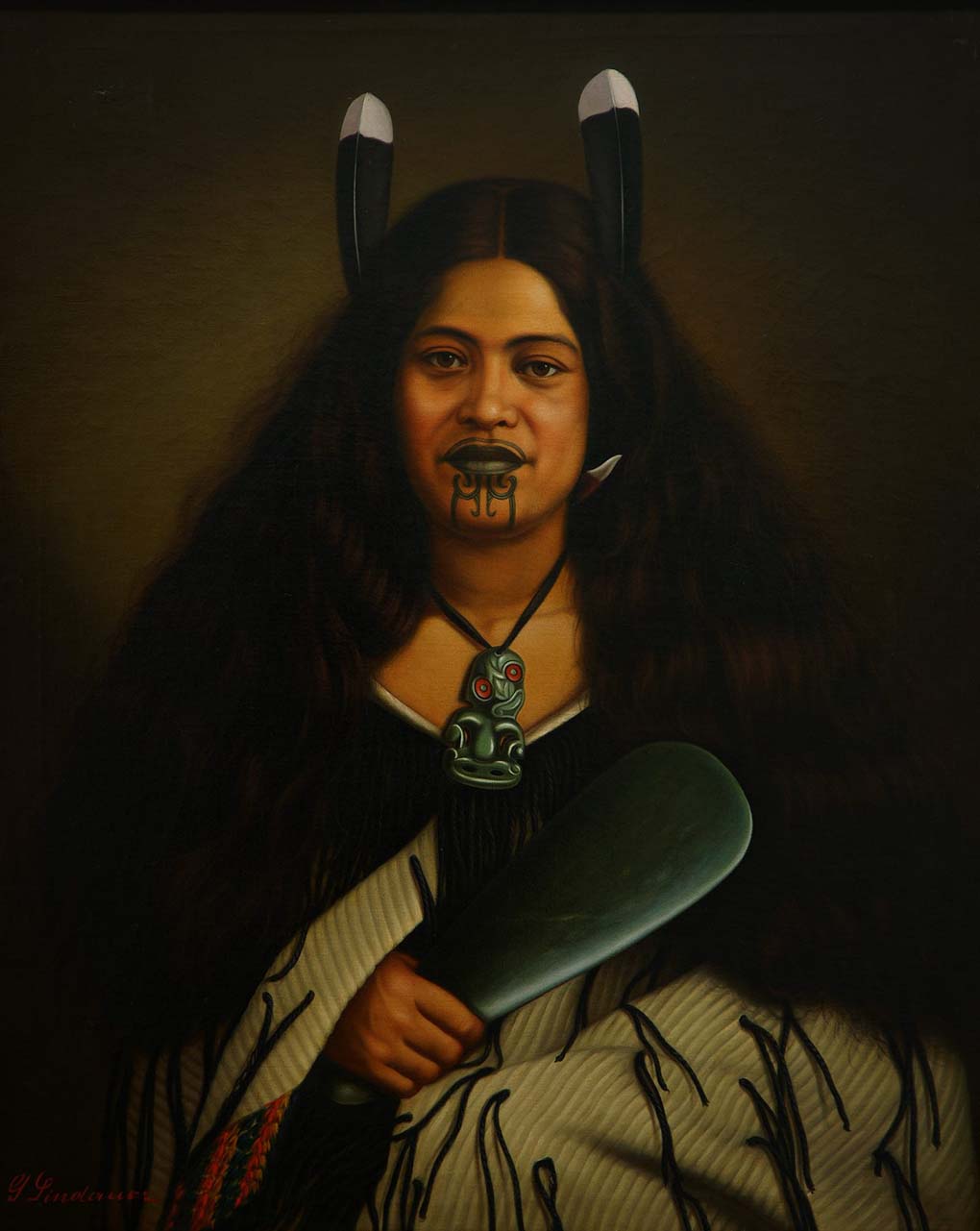
Gottfried Lindauer, Pare Wātene [Ngāti Maru], 1878, oil on canvas, Auckland Art Gallery Toi o Tāmaki, gift of Mr H E Partridge, 1915/2/22
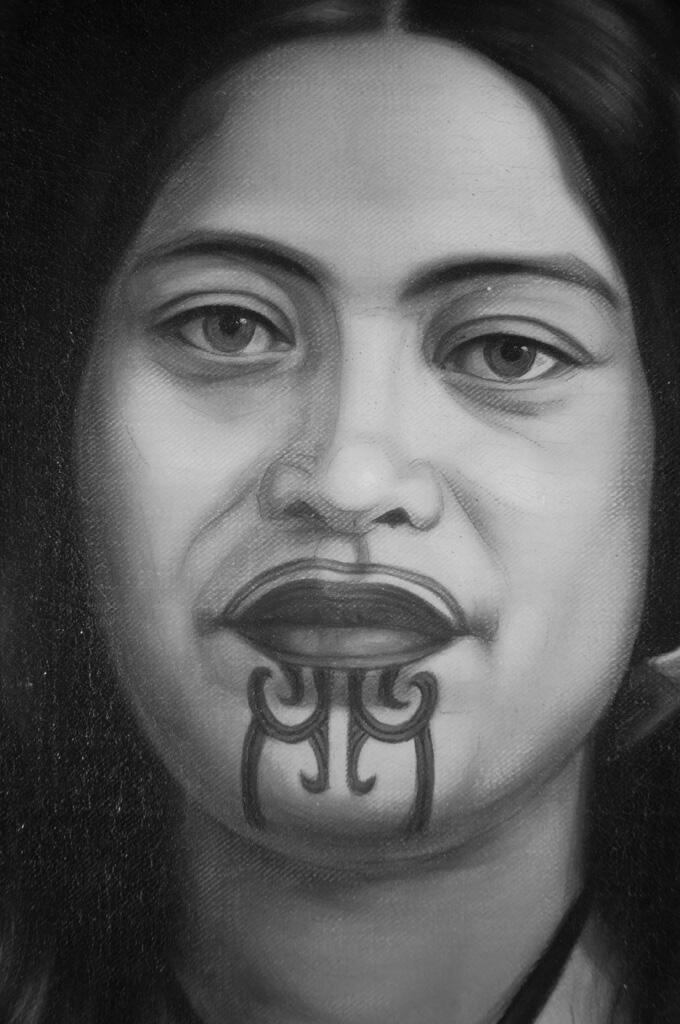
Infrared detail of Pare Wātene, 1878, oil on canvas, Auckland Art Gallery Toi o Tāmaki, gift of Mr H E Partridge, 1915/2/22
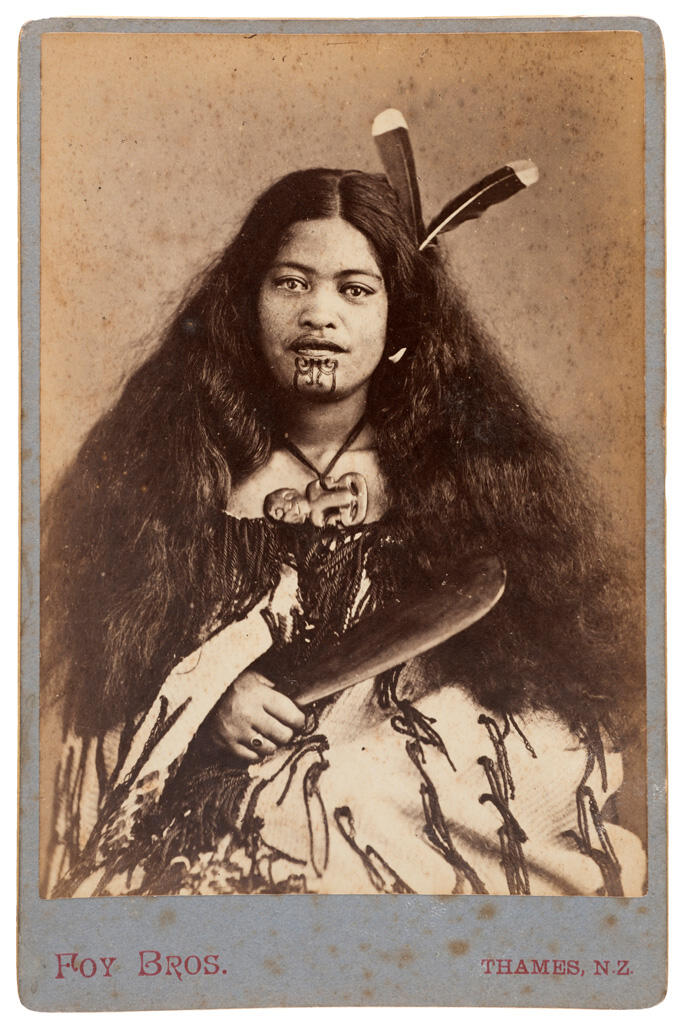
Foy Brothers, Pare Whakerongomai (Pare Wātene), between 1872–78, cabinet card, Auckland Art Gallery Toi o Tāmaki, on loan from Peter, Frances, Mark and Paul Langdon, whose father John Marshall (Jack) Langdon was the son of Louisa Langdon, one of the seven children of James Joseph Foy, L2016/9/22
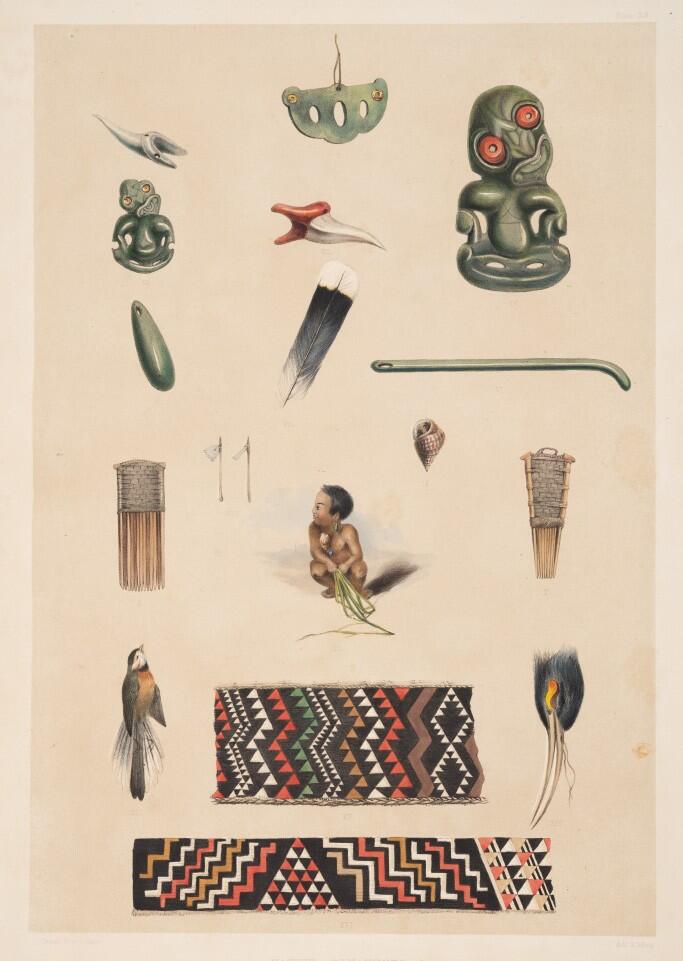
George French Angas, plate 39, Native Ornaments, lithograph in The New Zealanders Illustrated, 1847, Auckland Art Gallery Toi o Tāmaki, 2009/16/17/1
Technical analysis of Lindauer’s portraits shows that he consistently painted from photographs throughout his career. The Gallery’s retired Principal Conservator Sarah Hillary has examined numerous portraits using infrared photography, revealing firm pencil underdrawing. These lines are unusually definitive – indicative of tracing – drawing around shadows and contours rather than sketching in form.17 See, for example, the way the line around the tip of Pare Wātene’s nose indicates where shadow falls, likewise above the bow of her lip. A gift to the Gallery in 2024 confirmed that Lindauer also used this process in his Māori-commissioned portraits.18 From this evidence, along with the numerous near identical source photographs, the consistency of Lindauer’s production across his career and the portraits’ highly photographic appearance, Hillary concludes that Lindauer used photographs – rather than sittings from life – as the source for all of his oil portraits.
Lindauer probably used the ‘negative outline’ method to project a glass plate photographic negative onto the canvas.19 As Tate conservator Luz Vanasco explains, dark lines are white or light on a negative, making them easier to trace in a dark room.20 Lindauer’s descendants still own glass plate negatives that he took of other photographers’ carte-de-visites pinned to the wall.
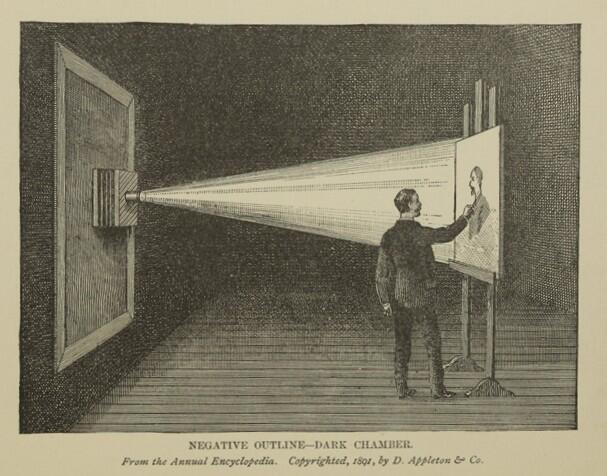
Lindauer must have been upfront with his sitters about his method because a photograph was essential to the process. In fact, it probably suited them as it removed the bothersome requirement of ‘sitting’ immobile for long periods – and significantly reduced the time and cost of making a portrait.
Earlier art historians dismissed Lindauer for his use of photography as if it was morally repugnant or dishonest.21 However, his method should no more undermine the value of his paintings than it does the many other artists who have used photography, ranging from Pablo Picasso to Shane Cotton.
Lindauer as a photographer
Another possibility which deserves further examination – and may explain family anecdotes – is that some of Lindauer’s subjects did sit in life for photographic portraits. Knowledge of Lindauer as a photographer has all but been forgotten.22 Josef Kořenský, a Czech explorer, however documented that ‘Initially Mr Lindauer was involved in the art of photography in New Zealand, but then exchanged negatives for painting’.23
In Nelson, Lindauer appears to have worked for photographer William Brown. Anna Dierks recorded on 29 July 1875: ‘I have seen new photographs of August [her brother]. They turned out real nicely. I asked Carl to tell Mr Lindauer to mount the pictures as soon as possible.’24 Lindauer also painted portraits of Brown and wife Frances which are on long loan to the Gallery.25 Brown in turn photographed Lindauer, while his colleague William Davis took three photographs of the artist in Nelson.
Similarly at Thames, Lindauer associated with photographers the Foy Brothers, exhibiting the portrait commissioned by Ngāti Whātua rangatira Pāora Tūhaere, as well as that of local chief Hōri Ngakapa Te Whanaunga, in the Foys’ window.26 One wonders could Lindauer also have been an employee? The studio took the photograph that Heeni Hirini is based on. Remembering Victor’s recollection that his father asked Heeni to sit for him, perhaps it was for the original photograph.
Bromides
From the early 1890s, when he settled in Woodville, Lindauer offered customers an alternative portrait-making process which he called a ‘bromide’. These were effectively large-scale highly sophisticated painted photographs. He charged a more affordable £5 to £7-10, roughly a quarter of the £25 to £30 price of oil paintings.27
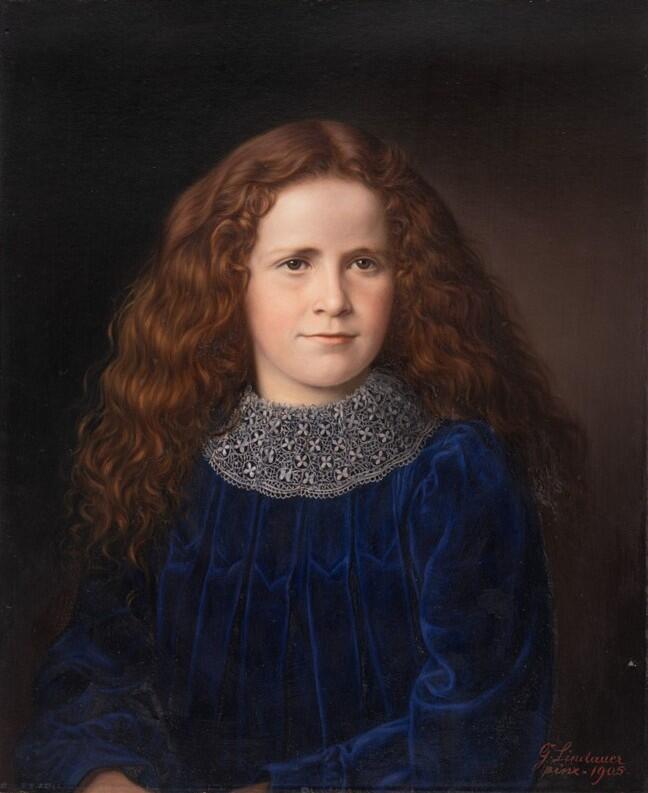
In 2025 the Gallery was gifted a stunning bromide portrait of Beatrix Bolton. At first glance it is hard to differentiate from a conventional oil painting, however there are telltale signs. It is painted on card and the grey tones of the black and white photographic image of her face are visible through the paint, particularly in the shadows around her eyes, nose and mouth.28 To date no bromides of Māori sitters have been uncovered, but they may well exist.
Pākehā commissioners
Kořenský stated in 1903 that Lindauer had painted about 1000 portraits, around one-fifth of which were of Māori subjects.29 This number surprises most people – both for its large size and the relatively small proportion of Māori portraits. Pākehā portraits were Lindauer’s bread and butter but have all but been forgotten – few are in public collections and they are not frequently exhibited – leading to the popular idea they are rare.30
Was Kořenský’s number an overstatement? Possibly, but Lindauer was prolific. In Auckland in 1876 alone, 22 Pākehā portraits are mentioned or traced.31 Commissioners included the parents of Isa Watson, a four-year old who had recently died. And Sarah and James Rutherford, Irish immigrants who farmed on Ōhinerau Mt Hobson. Portrait commissions were outward demonstrations of prosperity for settlers. With Lindauer’s restrained palette and lifelike realism, they signalled success, but in a modest manner in line with the reserved norms of colonial society. Lindauer also undertook more traditional commissions of ‘the great and the good’, including Bishop George Augustus Selwyn and the Reverend Dr John Kinder.32
Māori commissioners
Māori were themselves an important source of commissions. Art historian Roger Blackley argues that while ‘Henry Partridge and Walter Buller are consistently cited as Lindauer’s “greatest patrons” . . . in reality Lindauer’s most important patron was the Māori world at large’.33 Focusing only on the Māori portraits in these collections overlooks the agency of Lindauer’s Māori commissioners. As with other customers they had a say in their depiction, attire, adornment items, hairstyle, removal of imperfections and so on. Karaitiana Te Rango’s portrait is an example of this – the Samuel Carnell source photograph does not include the kaitaka or earring he is wearing in the painting, nor the mere pounamu he is holding. To attribute these changes solely to the artist is presumptuous when we know Te Rango paid £30 for the portrait.34 Until relatively recently the intentions of Indigenous sitters have not been sufficiently considered by Pākehā art historians. Thinking about their roles as active subjects who chose how to be depicted adds much to our understanding.
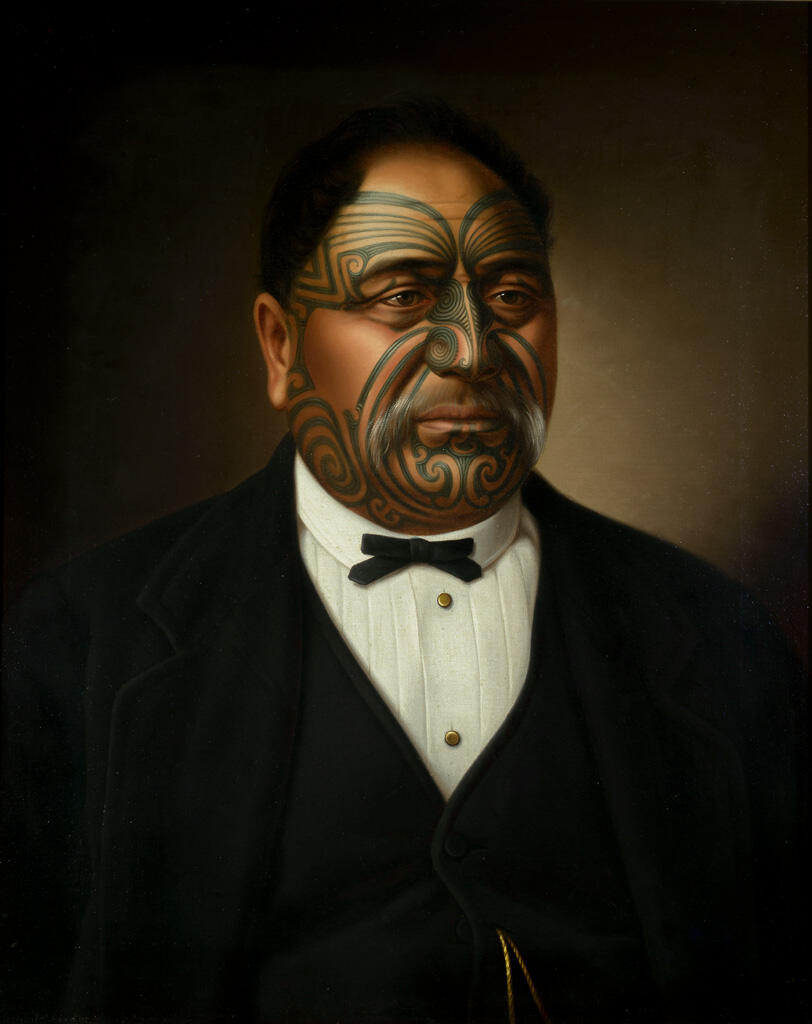
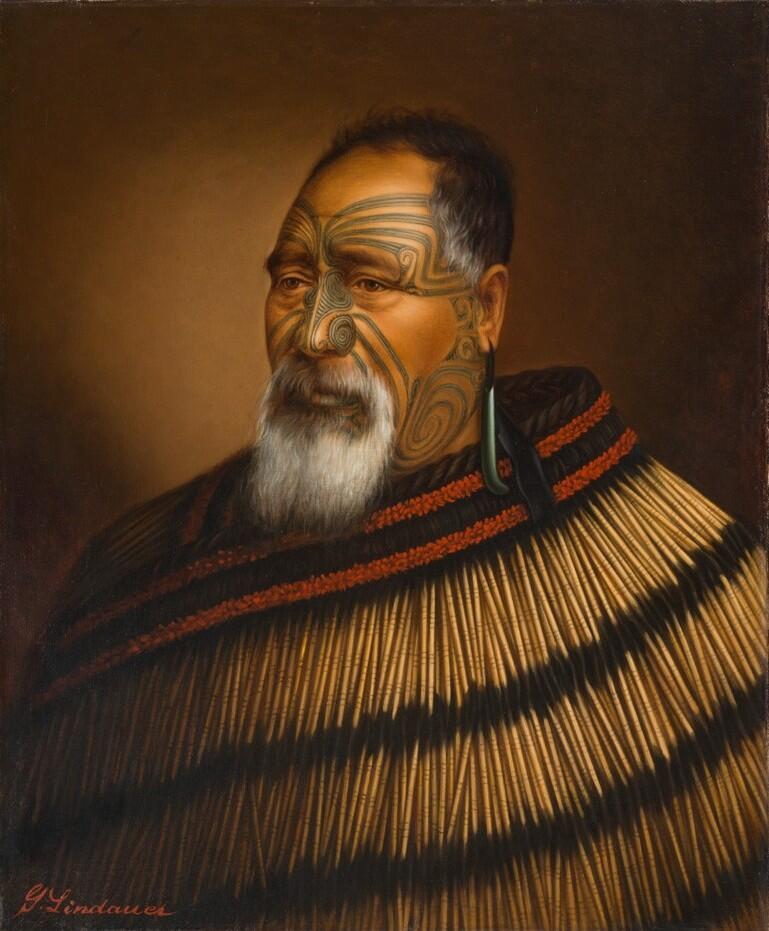
Two portraits of Pāora Tūhaere further challenge assumptions. The first, commissioned by Tūhaere himself, shows him wearing a black three-piece suit and bowtie. That Tūhaere chose to be depicted in impeccable European attire demonstrates an understanding of European portrait conventions, revealing a leader who skilfully navigated across te ao Māori and te ao Pākehā throughout his life.35 In the second posthumous portrait commissioned by Partridge, Tūhaere sports a piupiu and pounamu earring. The customary dress historicises him as a Māori ‘celebrity’ while conspicuously putting his ‘Māori culture on display’.36
Details were also depicted differently depending on the commissioner. Examining Pare Wātene’s heitiki, for example, the taonga does not resemble the source photograph – it is copied from plate 39 in George French Angas’ The New Zealanders Illustrated.37 By comparison the lifelike realism of such objects in Māori commissioned portraits suggests Lindauer closely inspected the taonga tuku iho represented.38 There is no negative judgement in this observation, rather it reflects his process and source material. The photographs he was working from were tiny: cabinet cards, the source for Pare Wātene, are a little smaller than A6 greeting cards; carte-de-visites are roughly the size of playing cards.
Legacy
The embrace of Lindauer by te ao Māori both in his lifetime and posthumously has been critical to his legacy. Visiting Partridge’s Lindauer Art Gallery from 1901, many Māori viewers, including Apirana Ngata, Maui Pōmare, Tureiti Te Heuheu Tukino and Mahuta Tawhiao, recorded their heartfelt appreciation for Lindauer and Partridge.39 Despite this reverence, Lindauer was overlooked by the Pākehā artworld for much of the 20th century. It was the response from Māori, who encountered portraits of their ancestors in a gallery used to welcome visiting iwi during Te Maori: Te Hokinga Mai The Return Home in 1987, that spearheaded his broader reappraisal.40 Today the Partridge Collection, along with Lindauer’s other works, are among the Gallery’s most treasured taonga.
Epilogue
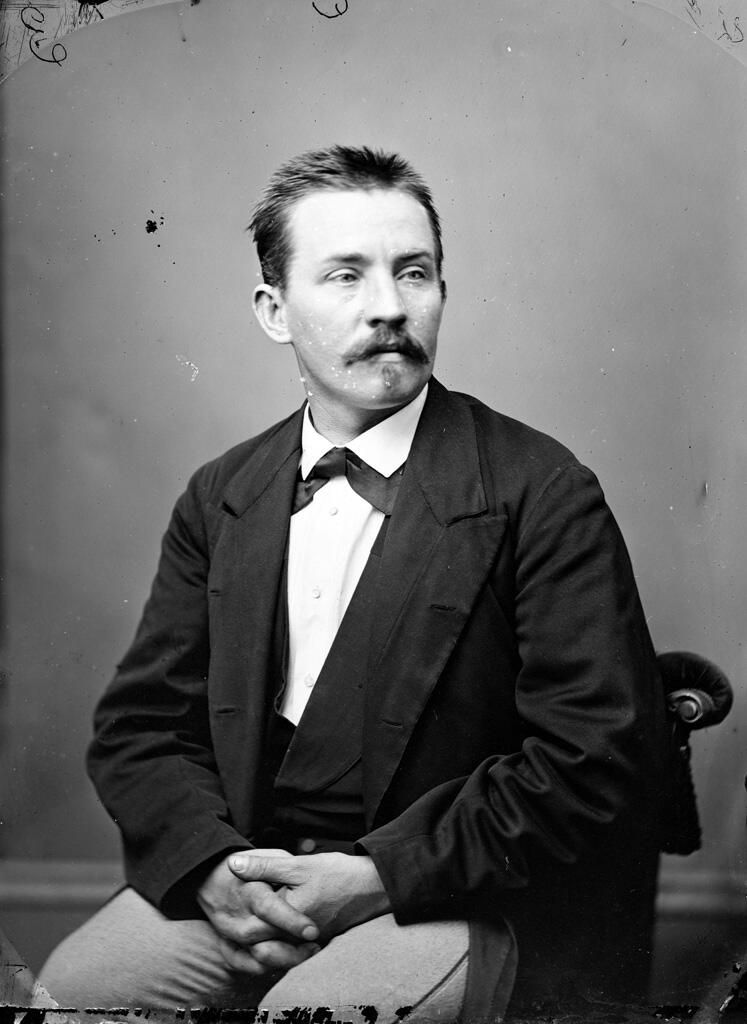
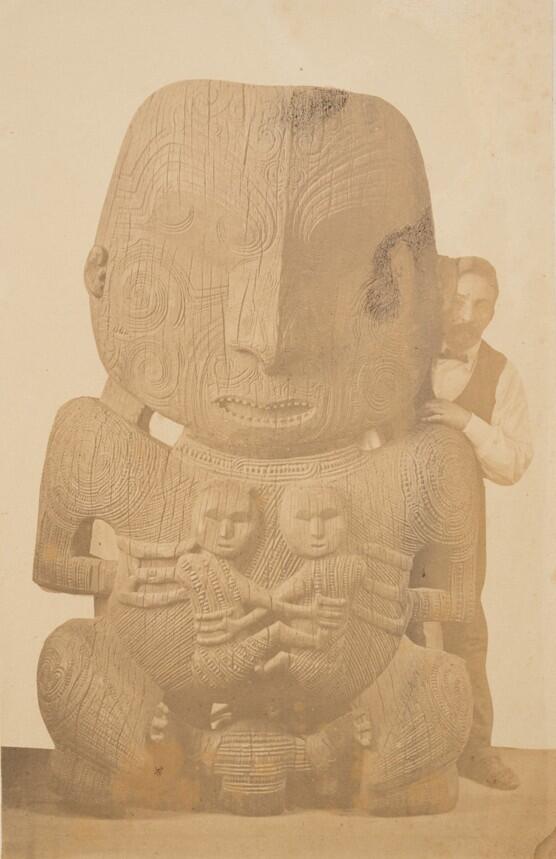
The Gallery holds a photograph of the famous whakairo and Ngāti Whakaue ancestor Pūkaki with an unidentified man. Comparison with photographs of Lindauer, along with his biography, the history of the carving and consultation with colleagues have led me to identify the man as Lindauer. This recent discovery highlights that we still have so much to learn about Lindauer, his practice in New Zealand and interactions with te ao Māori – and that some discoveries may even be hiding in plain sight. But also, it demonstrates the need to question pervasive myths and dismissive judgements of Lindauer. By doing so a much richer picture of the man and his mana emerges. We gain a deeper understanding of his contribution to Aotearoa, ‘the land of his adoption which he loved so well’.41
First published Art Toi 19, September 2026
Unattributed biography, likely Victor Lindauer, ‘The Late Mr Lindauer’, Lindauer artist file 1, EHM Research Library, Auckland Art Gallery Toi o Tāmaki (AAGTOT), p 2.
‘Mr Gottfried Lindauer’, obituary, New Zealand Herald, 16 June 1926, p 12. A similar account is also found in ‘Death of Lindauer’, Auckland Star, 15 June 1926, p 8.
Leonard Bell, ‘Pilsen, New Zealand, Berlin: The Travels of Gottfried Lindauer’, Whakamīharo Lindauer Online, first published 2010, https://www.lindaueronline.co.nz/artist/pilsen-new-zealand-berlin-the-travels-of-gottfried-lindauer, accessed 5 Jun 2026.
Likely Victor Lindauer, ‘The Late Mr Lindauer’, p 2.
Aleš Filip and Roman Musil, ‘Lindauer’s Presence in Central Europe Before His Departure for New Zealand’, in Aleš Filip and Roman Musil, eds, Gottfried Lindauer 1839–1926: Pilsen Painter of the New Zealand Māori, Arbor vitae in Řevnice and the Gallery of West Bohemia, Pilsen, 2015, p 56.
Reichstag passenger list, Archives New Zealand References: Passenger List IM15/132, transcribed on https://freepages.rootsweb.com/~ourstuff/genealogy/Reichstag.htm, accessed 5 June 2026. He did in fact start his working life as a gardener, apprenticed to his father. Filip and Musil, ‘Gottfried Lindauer [Chronology]’, in Filip and Musil, eds, Gottfried Lindauer 1839–1926, p 19.
‘Immigrants Per ‘Reichstag’’, Taranaki Herald, 2 September 1874, p 2.
Mark Dunick, ‘Continental European Assisted Immigrants in 1870s New Zealand’, unpublished PhD thesis, Victoria University of Wellington, 2022, pp 232–3.
Mark Dunick to Jane Davidson-Ladd, emails, 17 and 25 April 2026. Sharing this information with Lindauer descendants, Ruth Hamon commented she had seen an advertisement for gardeners held by relatives in the Czech Republic, which she believes Lindauer responded to, conversations with the author, 21 June and 6 July 2026.
‘Portrait Painting’, Nelson Evening Mail, 13 February 1875, p 2.
Eileen Clayton, ‘A History of the Partridge Collection of Lindauer Pictures at Auckland Art Gallery’, [c.1965], Archives New Zealand, R1926411, p 1.
‘Immigrants Per “Reichstag”’, Taranaki Herald, 2 September 1874, p 2; ‘Shipping’, NZ Times, 5 September 1874, p 2; ‘New Plymouth: Arrivals’, Taranaki Herald, 9 September 1874, p 2.
Eruera Maihi Patuone, 1915/2/24; Huria Matenga Ngarongoa (Julia Martin), 1915/2/15; Taraia Ngakuti Te Tumuhuia 1915/2/41; Te Hira Te Kawau 1915/2/69; all Partridge Collection, AAGTOT.
For a much fuller discussion see: ‘Gottfried Lindauer: The Man and The Myth’, members lecture, AAGTOT, 13 Jun 2026; and ‘Commissioning Gottfried Lindauer: Collector Henry Partridge as Collaborator’, paper at ‘“A difficult and intricate history”: Reckoning with the legacies of colonial material collections in Aotearoa New Zealand’ workshop, University of Auckland, 25 Jun 2026. See also: Clayton, ‘A History of the Partridge Collection’, p 1; and Victor Lindauer, ‘How Papa Painted His First Maori Picture’, undated, Alexander Turnbull Library (ATL), MS-Papers-4369, p 1.
James Cowan, Sketches of Old New Zealand: Descriptive Catalogue of Maori Portraits Painted by Herr G. Lindauer, H E Partridge, Auckland, 1901, p 2.
Victor Lindauer, ‘How Papa painted his first Maori Picture’, p 1.
Sarah Hillary, ‘Lindauer: Painting Materials and Techniques’, in Ngahiraka Mason and Zara Stanhope, eds, Gottfried Lindauer’s New Zealand: The Māori Portraits, AAGTOT and Auckland University Press, Auckland, 2016, pp 231, 234.
Jane Davidson-Ladd, acquisition proposal, Gottfried Lindauer, Karaitiana Te Rango, 1885, AAGTOT, 2024/2.
J A Barhydt, Crayon Portraiture: Complete Instructions for Making Crayon Portraits on Crayon Paper and on Platinum, Silver and Bromide Enlargements, The Baker and Taylor Co, New York, 1892, p 39.
A solar camera may well have been used to project the image. Luz Vanasco, ‘The Technical Development of Oil Painted Photographs on Canvas in the United Kingdom Between 1850 and 1890, with a Case Study of Paintings by Georg Koberwein from the Royal Collection’, Studies in Conservation 68: 2, December 2021, pp 157–8.
Hamish Keith, ‘Review: J C Graham, Maori Paintings: Pictures from the Partridge Collection by Gottfried Lindauer’, Journal of Polynesian Studies 75, no 3, 1966, pp 390–2; Gil Docking, Two Hundred Years of New Zealand Painting, Lansdowne Press, Melbourne, 1971, pp 84–6; Michael Dunn, ‘Some Aspects of Maori Portraiture’, in Face Value: A Study in Maori Portraiture, Dunedin Public Art Gallery, Dunedin, 1975, unpaginated.
Ute Larsen and Jane Davidson-Ladd, ‘Under the Lens – Gottfried Lindauer the Photographer-Painter’, in Mason and Stanhope, eds, Gottfried Lindauer’s New Zealand, p 228.
Josef Kořenský, 1901, quoted in Filip and Musil, ‘Lindauer’s Presence’, pp 55, 57.
Anna Dierks, née Heine, diary, ATL, MS-Papers-2326, excerpted in Joan and Kevin McIntyre, Gottfried Lindauer 1839–1926: Life of the Artist & His Works, self-published, Woodville, 2018, p 48. The portrait of ‘August’ is: ‘Mr A Heine’, glass plate negative, W E Brown collection, Nelson Provincial Museum, 12490 https://collection.nelsonmuseum.co.nz/objects/6802/heine-mr-a, accessed 16 July 2026.
On loan to AAGTOT, L2016/3/1 and 2.
Thames Star, 22 June 1878, p 2; and John Grainger, The Amazing Thames: The Story of the Town and Famous Goldfield from which it Grew, Cadsonbury Publications, Christchurch, 2005, repub; A H & A W Reed, Wellington, 1951, p 113.
Page headed ‘Rev J C Eccles’, Lindauer’s notebook, ATL, MSX-3092.
Sarah Hillary and Jane Davidson-Ladd, technical examination of Beatrix Bolton, 1905, AAGTOT, Conservation report ptg3635, 25 July 2024.
Kořenský, 1903, quoted in Filip and Musil, ‘Lindauer’s Presence’, p 59.
Jane Davidson-Ladd ‘The “Speaking Likeness’” Gottfried Lindauer’s Pākehā Portraits’, in Mason and Stanhope, eds, Gottfried Lindauer’s New Zealand, p 251.
Jane Davidson-Ladd ‘The “Speaking Likeness’” Gottfried Lindauer’s Pākehā Portraits’, in Mason and Stanhope, eds, Gottfried Lindauer’s New Zealand, p 256.
Jane Davidson-Ladd ‘The “Speaking Likeness’” Gottfried Lindauer’s Pākehā Portraits’, in Mason and Stanhope, eds, Gottfried Lindauer’s New Zealand, p 257.
Roger Blackley, ‘Taku Āhua I te Rākau Koura: Gottfried Lindauer’s Māori Portrait Commissions’, in Conal McCarthy and Mark Stocker, eds, Colonial Gothic to Māori Renaissance: Essays in Memory of Jonathan Mane-Wheoki , Victoria University Press, Wellington, 2017, p 189.
Under heading ‘In Hastings, 1885’, listed as portrait 9. Lindauer’s notebook, ATL, MSX-3092.
Ngarimu Blair on Pāora Tūahere, ‘Talks with Descendants and Relations’, Lindauer’s Legacy: 100 Years On | Kotahi Rau Tau public programme AAGTOT, 13 June 2026.
Blackley, Galleries of Maoriland: Artists, Collectors and the Māori World, 1880–1910, Auckland University Press, Auckland, 2018, p 93.
There are other examples of this substitution in the Partridge collection including the hei tiki of Te Rangi Topeora, c1910, 1915/2/53 and the pekapeka of Raiha Reretu, 1877, 1915/2/28.
See for example Mrs Ngahui Te Rangitakaiwaho, 1880, ATL, G-515.
Pukapuka mo nga Manuhiri Tangata Matakit[a]ki [Visitors Book Lindauer Art Gallery], 1901–1918, EHM Research Library, AAGTOT, RC2006/3.
Ngahuia Te Awekotuku, ‘Lindauer Gallery of Memories’, Whakamīharo Lindauer Online, https://www.lindaueronline.co.nz/background/lindauer-gallery-of-memories- accessed 6 June 2026.
Likely Victor Lindauer, ‘The Late Mr Lindauer’, p 2.