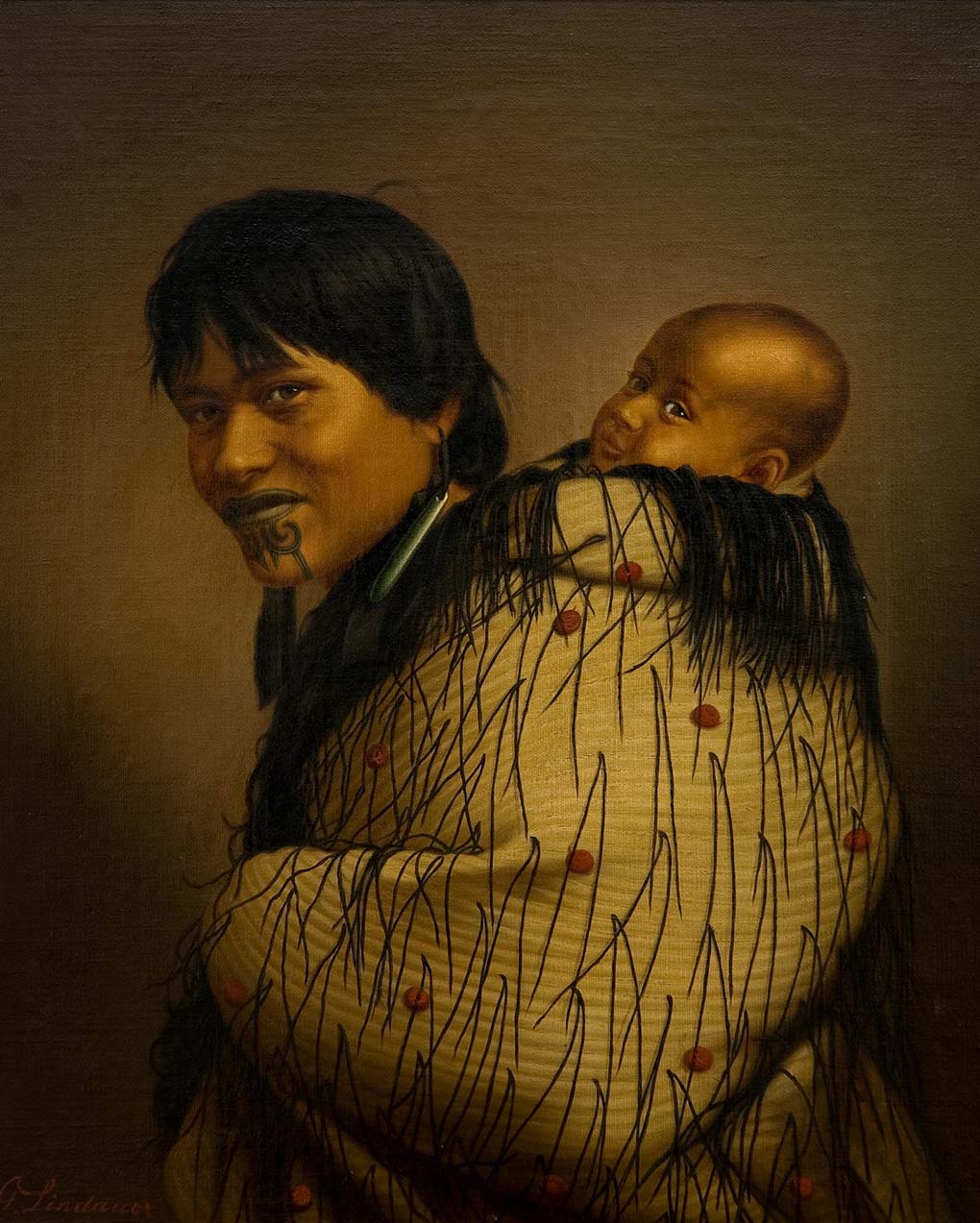
Heeni Hirini and child
Ngāti Maru
- Date
- 1878
- Medium
- oil on canvas
- Measurements
- 680 x 560 mm
- Other titles
- Heeni Hirini and child [previously known as Ana Rupene and child][title, 2026]Ana Rupene and Child, [1930 catalogue]Ana Rupene and Child, [Deed of gift, 1915]Ana Rupene and Child, [1901 catalogue]
- Inscriptions
- Front, LL: G. Lindauer 1878
- Takiwā / region
- Waikato-Maniapoto
- Credit line
- Auckland Art Gallery Toi o Tāmaki, gift of Mr H E Partridge, 1915
- Accession no.
- 1915/2/1
Heeni Hirini – also known as Ana Rupene, Ana Reupene Whetuki and Heeni Phillips – a she was a woman of mana derived from her Ngāti Maru whakapapa and though her life dates are not recorded she lived and died at Manaia on the Coromandel Peninsula.
Lindauer’s original portrait named its subject as ‘Ana Rupene' and it was known by this name at Auckland Art Gallery Toi o Tamaki until 2011. It was renamed Heeni Hirini and Child following advice from some of her descendants. Christchurch Art Gallery Te Puna o Waiwhetū’s version previously known as Henne Rupene and her daughter Huria was retitled Ana Reupene Whetuki and Child in 2007 following information from a different line of descendants. Each institution honours the relationship they hold with descendants through the different names used. In this text about the Auckland version the sitter is consequently referred to as Heeni Hirini.
The child on her back is remembered to have lived to be about 14–18 years old. Hirini’s descendants have reported that he had a prodigious ability to recite his whakapapa.
Heeni Hirini is buried at Parakau, Manaia, in an unmarked grave in the Anglican churchyard.
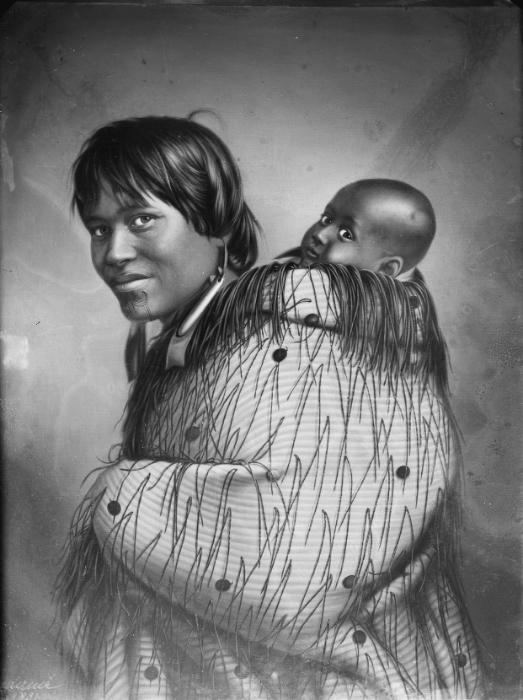
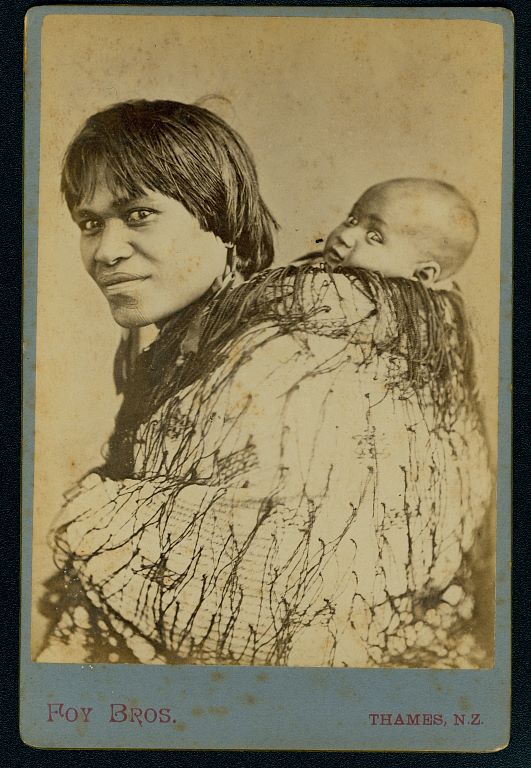
Lindauer’s portrait of Hirini, based on a photograph from the Foy Brothers studio in Thames, is a seminal work and unquestionably the most popular of all Lindauer’s Māori portraits. As many as 30 versions are believed to exist, the earliest painted in 1878 (the year Lindauer was based in Thames) and the latest in 1920. This version, painted in 1878, was one of the 10 Lindauer paintings loaned by Henry Partridge for exhibition at the 1904 Louisiana Purchase Exposition. It was awarded a gold medal by an international jurors committee. Lindauer’s painting differs slightly from the Foys’ photograph. The slightly reserved expression seen in the original image has been rendered more engagingly in the painting. In curving the shadow across the right side of Hirini’s face and emphasising the cheekbone, Lindauer suggests a smile. The same treatment is given to the child, with light shaping the scalp, nose and cheeks to impressive effect. The woven garment wrapped around the child was a conventional Māori way for mothers to carry their children securely.
Hirini’s hair appears dark, even glossy, and is cropped shorter around the left ear, revealing a piercing, from which a pounamu pendant is suspended on a thick black ribbon. The pendant sits atop the hukahuka of her korowai. Hirini’s moko kauae appears a little darker and more prominent in the painting.
- Te Ahukaramū Charles Royal, 'Waikato - The King movement', Te Ara - the Encyclopedia of New Zealand, updated 4 March 2009, accessed 28 January 2010.
- Te Ahukaramū Charles Royal, 'Marutūahu tribes - Resources of the Hauraki region', Te Ara - the Encyclopedia of New Zealand, updated 4 March 2009, accessed 28 January 2010.
- ‘Louisiana Purchase Exposition’, Wikipedia – the Free Encyclopedia, accessed 28 January 2010.
- Personal communication with Toko Renata, 11 December 2009.