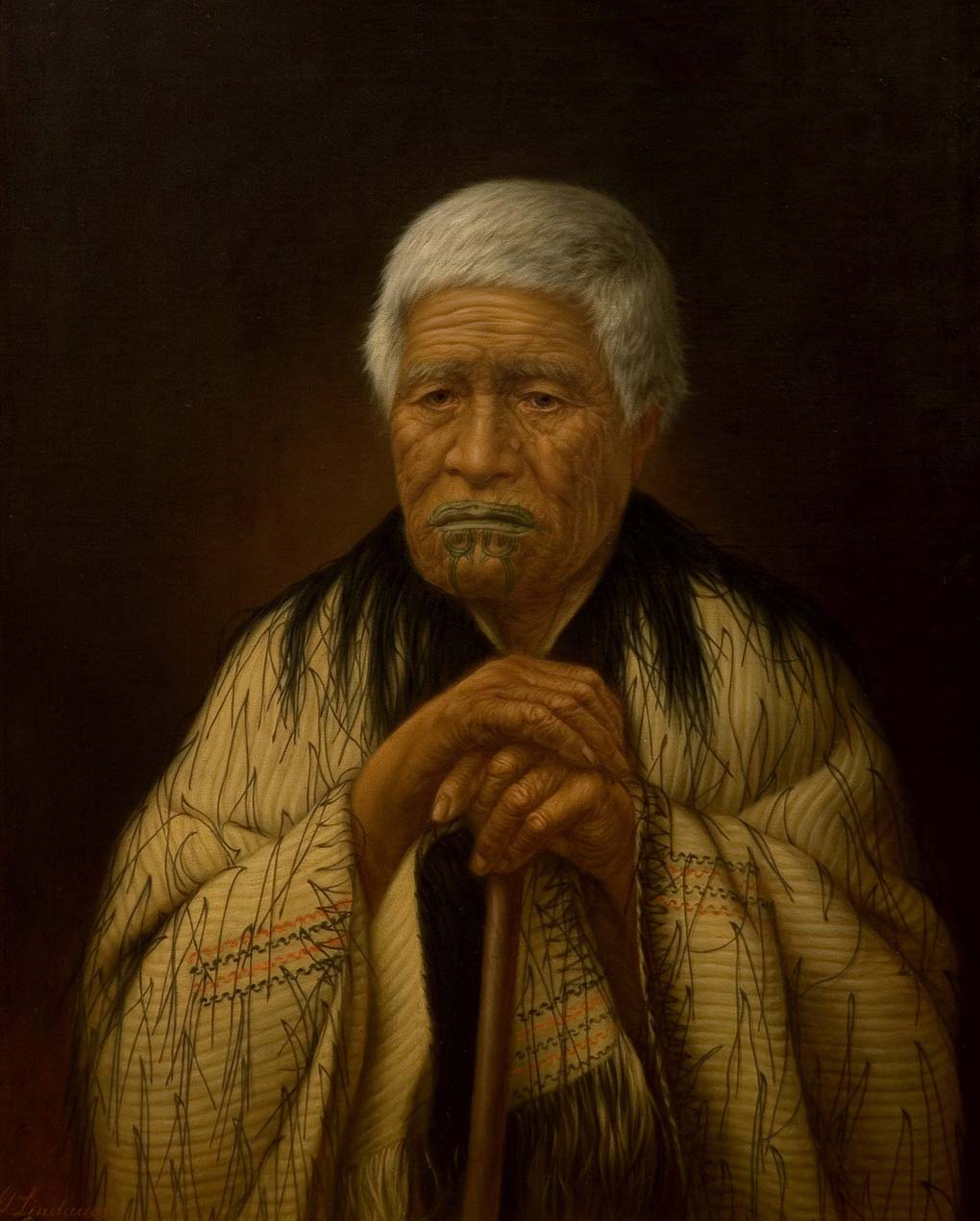
Mere Kuru Te Kati
1815 – 1905Ngāti Tamaterā
- Date
- 1903
- Medium
- oil on canvas
- Measurements
- 764 x 613 mm
- Other titles
- Mere Kuru Te Kati, [title, 2026]Mere Kuru te Kati, [1930 catalogue]Mere Kuru, [Deed of gift, 1915]Oil Painting of Mere Kuru Te Kati Head Chieftainess if the Ngatitamatera Tribe / Ohinemuri, [copyright certificate, 1905]
- Inscriptions
- Front, LL: G. Lindauer 1903
- Takiwā / region
- Waikato-Maniapoto
- Credit line
- Auckland Art Gallery Toi o Tāmaki, gift of Mr H E Partridge, 1915
- Accession no.
- 1915/2/65
Ariki tapairu Mere Kuru Te Kati has been written into history as a proud woman. A leader of the Ngāti Tamaterā iwi based at Ōhinemuri (near present-day Paeroa), Te Kati was resolutely opposed to European settlement and, particularly, prospecting for gold.
The discovery of gold in the Kauaeranga Valley near present-day Thames in 1867 prompted an influx of prospectors to the area, from Europe, Australia and Canada. The pressure of numbers, combined with news that gold could be found at Ōhinemuri, forced the issue of exploration in Ngāti Tamaterā land. European prospectors were met with strong resistance from Te Kati – she is recorded to have removed surveyors’ pegs and set prospectors’ boats loose from their moorings, and was variously described in reports from the time as ‘impracticable’, an ‘Amazon’ and an ‘old witch’. She showed great determination and was not intimidated by Pākehā authority: on one instance with two other women, brandishing mere over the heads of Native Land Court judges at Paeroa; on another, leading 20 wāhine in protest against surveyors.
Government administrator James Mackay eventually persuaded Te Kati and others within Ngāti Tamaterā to part with their land opening Ōhinemuri to gold prospecting from February 1875.1
Te Kati disliked the idea of being sketched or photographed by Pākehā artists. According to James Cowan she finally agreed to sit for a photograph by Lindauer on the condition that a copy of the resulting portrait be given to hang in her wharenui.. The painting closely records the unique woollen detailing near the edges of her korowai hukahuka with her hands resting on a tokotoko. The artist paid great attention to Te Kati’s time-worn features, rendering with great delicacy the intricate network of wrinkles. The stern, solemn expression on Te Kati’s face perhaps reflects the pressures of spending much of her later life fighting for her land and her people.
James Mackay, ‘Mere Kuru Te Kati’, biography written for Henry Partridge, 24 Aug 1905, E H McCormick Research Library, Auckland Art Gallery Toi o Tāmaki, RC2009/2/7/11.