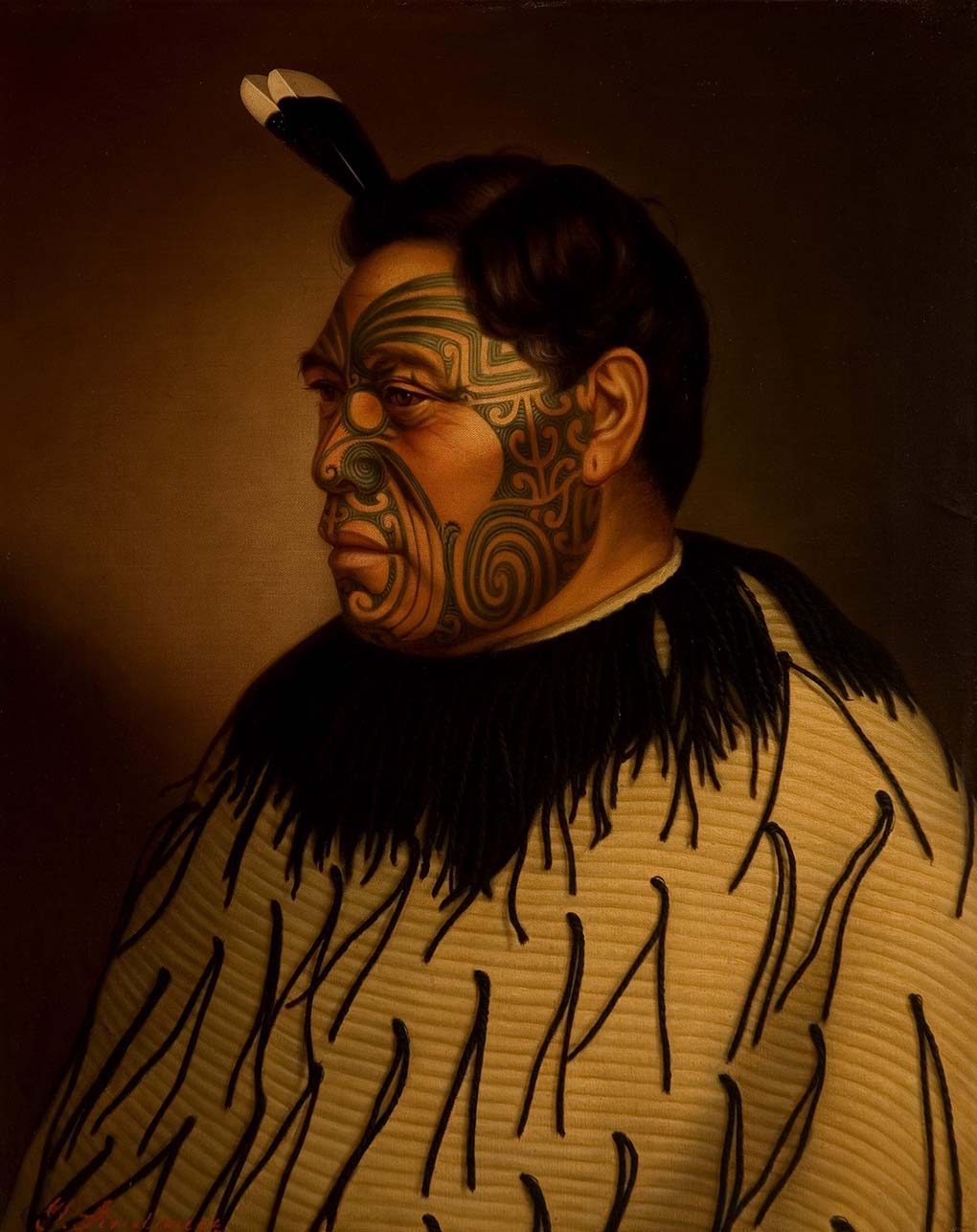
Tāmati Wāka Te Puhi
? – 1904Ngāti Maru
- Date
- 1878
- Medium
- oil on canvas
- Measurements
- 675 x 545 mm
- Other titles
- Tamati Waka Te Puhi, [title, 2026]Tamati Waka te Puhi, [1930 catalogue]Tamati Waka te Puhi, [Deed of gift, 1915]Tamati Waka Te Puhi, [1901 catalogue]Oil Painting. Portrait of Tamati Waka Te Puhi (Chief of the ?Wringahu Hapu of Ngatimaru Thames) Hauraki, [copyright certificate, 1898]Tamati Waka te Puhi, Chief of the Ngatimaru Manaia pa (Hauraki district), [Lindauer's inscribed title]
- Inscriptions
- Front, LL: G. LindauerBack, LC: Tamati Waka te Puhi, Chief of the / "Ngatimaru" Manaia pa (Hauraki district)Back, LR: G. Lindauer Pinx 1878.
- Takiwā / region
- Waikato-Maniapoto
- Credit line
- Auckland Art Gallery Toi o Tāmaki, gift of Mr H E Partridge, 1915
- Accession no.
- 1915/2/39
Tāmati Wāka Te Puhi lived at Manaia, on the Coromandel Peninsula. He was married to Rangitehau, also from Ngāti Maru. Te Puhi is believed to have been one of the few survivors of a surprise 1821 attack on Te Tōtara Pā, near present-day Thames, by Ngāpuhi warriors led by Hongi Hika.
Te Puhi was active in protecting his tribe’s land at Poihākena Port Jackson on the western tip of the Coromandel. In 1869, he protested the purchase of the Hauraki foreshore by the Crown, who wanted it as an endowment for Thames. Te Puhi claimed that Ngāti Maru had not extinguished title to any of the foreshore.1 As late as 1886, he wrote to the Thames County Council to complain that a road had been constructed over a tapu site north of the pā.
In this portrait, Te Puhi is shown in three-quarter profile with two huia tail feathers in his hair and his striking mataora in full view. He wears a korowai hukahuka woven from muka featuring a wide fringe at the neckline.
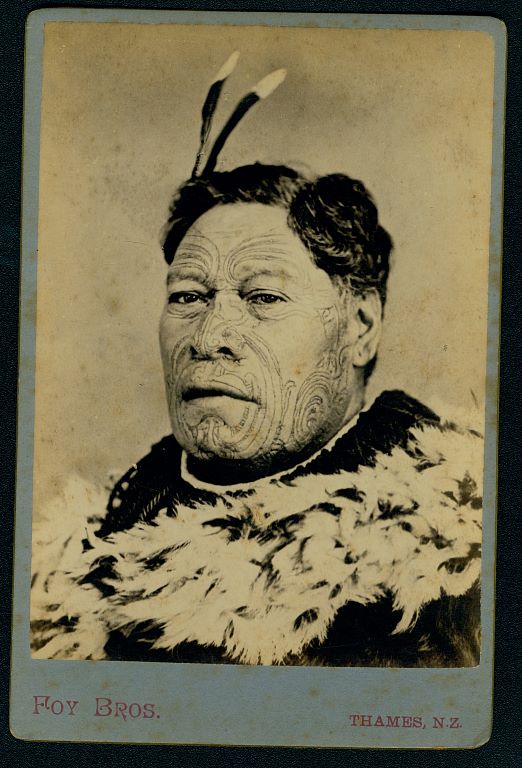
Lindauer modelled his portrait of Te Puhi on a photograph taken by the Foy Brothers, a studio active in Thames from 1872 to 1886, precisely repeating the composition from its pose to the cloak and huia feathers in his hair. Another photograph apparently from the same sitting seems to clearly show Te Puhi’s mataora, but on closer examination his markings appears to have been drawn onto the plate, reflecting the difficulty of capturing tā moko with the photographic processes available at this time.
According to descendant Craig Solomon, the moko under Te Puhi’s ear conveys the mana of land and sea. Lindauer added two marks under the eyebrows, though these do not appear in the Foy Brothers’ photographs.
‘The Thames Municipality Petition. Kauaeranga (part of Hauraki), October 26, 1869’, Daily Southern Cross, 2 November 1869, p 4.