Te Rangi Topeora
? – circa 1865-1873Ngāti Toa, Ngāti Raukawa
- Date
- c 1910
- Medium
- oil on canvas
- Measurements
- 625 x 525 mm
- Other titles
- Rangi Topeora, [title, 2026]Topeora, [1930 catalogue]Rangi Topeora (sister of Rangihaeata and Te Rauparaha's niece), [Deed of gift, 1915]Painting Portrait of Chieftainess Rangi Topeora, [copyright certificate, 1913]Topeora, Sister of Rangihaeata / (Te Rauparaha's niece), [Lindauer's inscribed title]
- Inscriptions
- Front, LR: G. LindauerBack, LL: Topeora, Sister of Rangihaeata / (Te Rauparaha's niece)
- Takiwā / region
- Te Tai Hauāuru
- Credit line
- Auckland Art Gallery Toi o Tāmaki, gift of Mr H E Partridge, 1915
- Accession no.
- 1915/2/53
Born in Kāwhia, Rangi Topeora was a chiefly woman from Ngāti Toa. In about 1820 she joined the southern migration of Ngāti Toa and other iwi to Kāpiti Island and the nearby Cook Strait coast, which was led by her uncle, the chief Te Rauparaha. During the journey Topeora established a reputation as a proud and resourceful woman a spirited leader and a formidable adversary.
She was a direct descendant of Hoturoa, rangatira of the Tainui waka, which came to Aotearoa New Zealand from Hawaiki. Her mother was Waitohi, Te Rauparaha’s sister, and her father, Te Rākaherea.
Known to have had four marriages and many other relationships, she had one son, Mātene Te Whiwhi, who became chief of both Ngāti Toa and Ngāti Raukawa, and one daughter, Rākapa Kahoki, who was a ‘notable composer’, taking after her mother, whose waiata are still sung today.1 As well as love songs and waiata referring to history, Topeora composed ‘perfectly diabolical cursing songs’ directed at her enemies.2 She fought in many battles and was a noted orator who sought and was given the right to speak at hui.
Topeora called herself Kuini Wikitōria (Queen Victoria) and her husband Arapeta (Albert) after being christened by Bishop Selwyn in 1847.3 Indeed, in later life, Topeora was often referred to as ‘Queen of the South’ – an epithet that no doubt pleased her. It is a measure of her importance that Topeora was one of only a small number of women to sign Te Tiriti o Waitangi, at Kāpiti, on 14 May 1840.
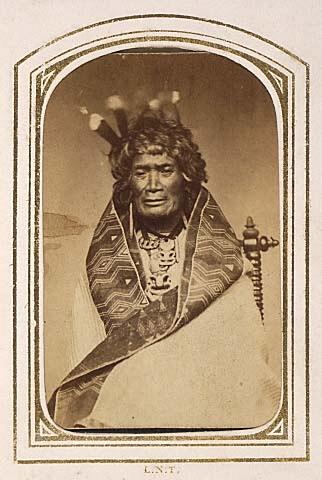
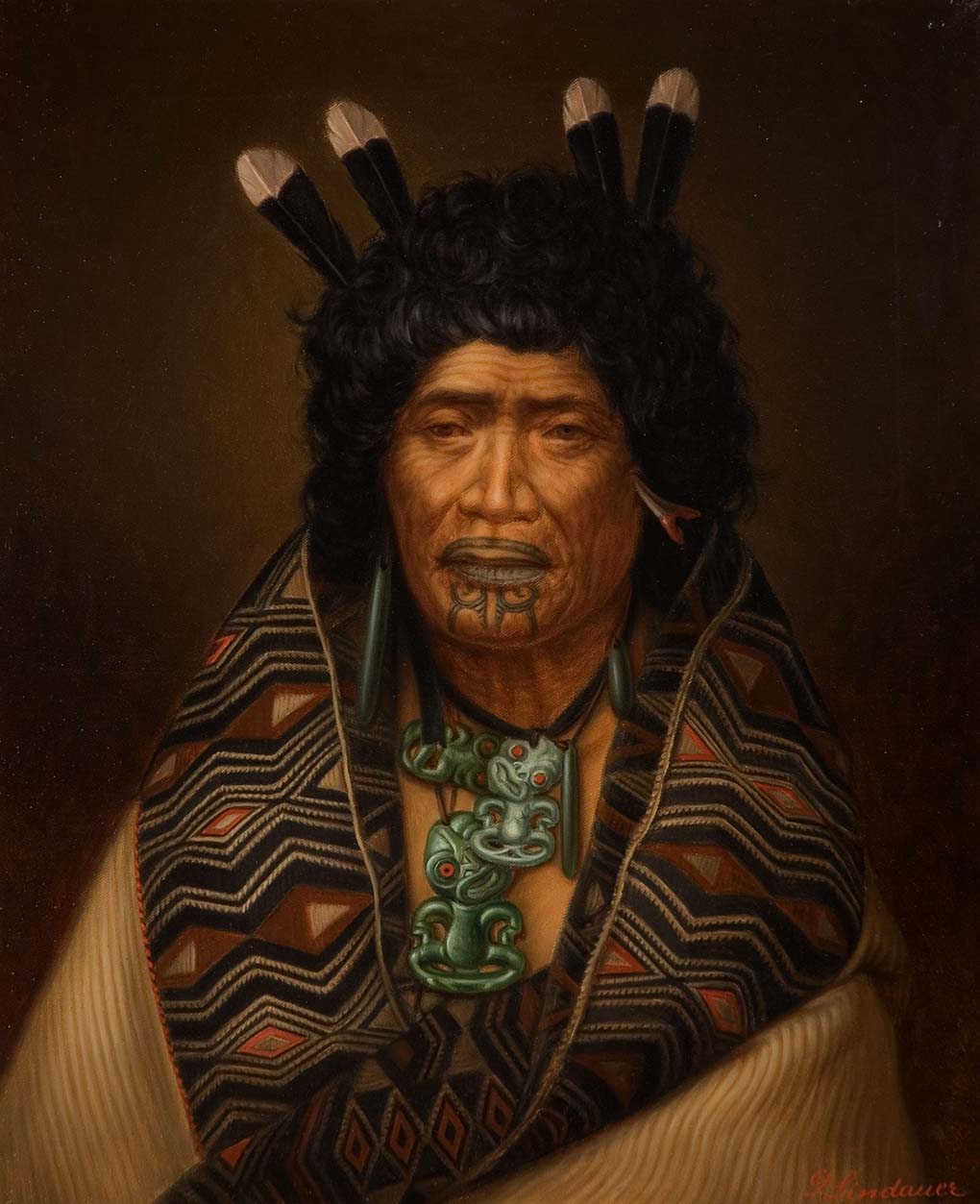
This portrait was based on a photograph by the Wellington photographer E.S. Richards. Topeora was originally recorded in a kaitaka huaki, worn upside-down to better show the woven tāniko.
Lindauer altered the shape and presentation of the three large heitiki pounamu worn around Topeora’s neck. A shark’s tooth in the painting may be a misinterpretation of a well-lit curl of hair in the photograph. It is not possible to discern a moko kauae in Richards’ photograph but Lindauer included one, as well as ngutu pūrua.
In addition to the multiple taonga pounamu with which she is adorned, Topeora wears no fewer than four tail feathers from the highly prized huia, indicating the significant standing she held within her iwi.
Lindauer inscribed the reverse of the portrait, ‘Topeora, Sister of Rangihaeata (Te Rauparaha’s niece)’.
Teremoana Sparks and W H Oliver, ‘Te Rangitopeora’, Dictionary of New Zealand Biography, first published in 1990, updated April 2012, Te Ara – the Encyclopedia of New Zealand, https://teara.govt.nz/en/biographies/1t103/topeora-rangi-te-kuini, accessed 12 July 2023.
MS-Papers-7888, Folder 026, p 183, Elsdon Craig Papers, Alexander Turnbull Library, Wellington.
Warren E Limbrick, ‘Selwyn, George Augustus’, Dictionary of New Zealand Biography, first published in 1990, Te Ara – the Encyclopedia of New Zealand, https://teara.govt.nz/en/biographies/1s5/selwyn-george-augustus, accessed 12 July 2023.