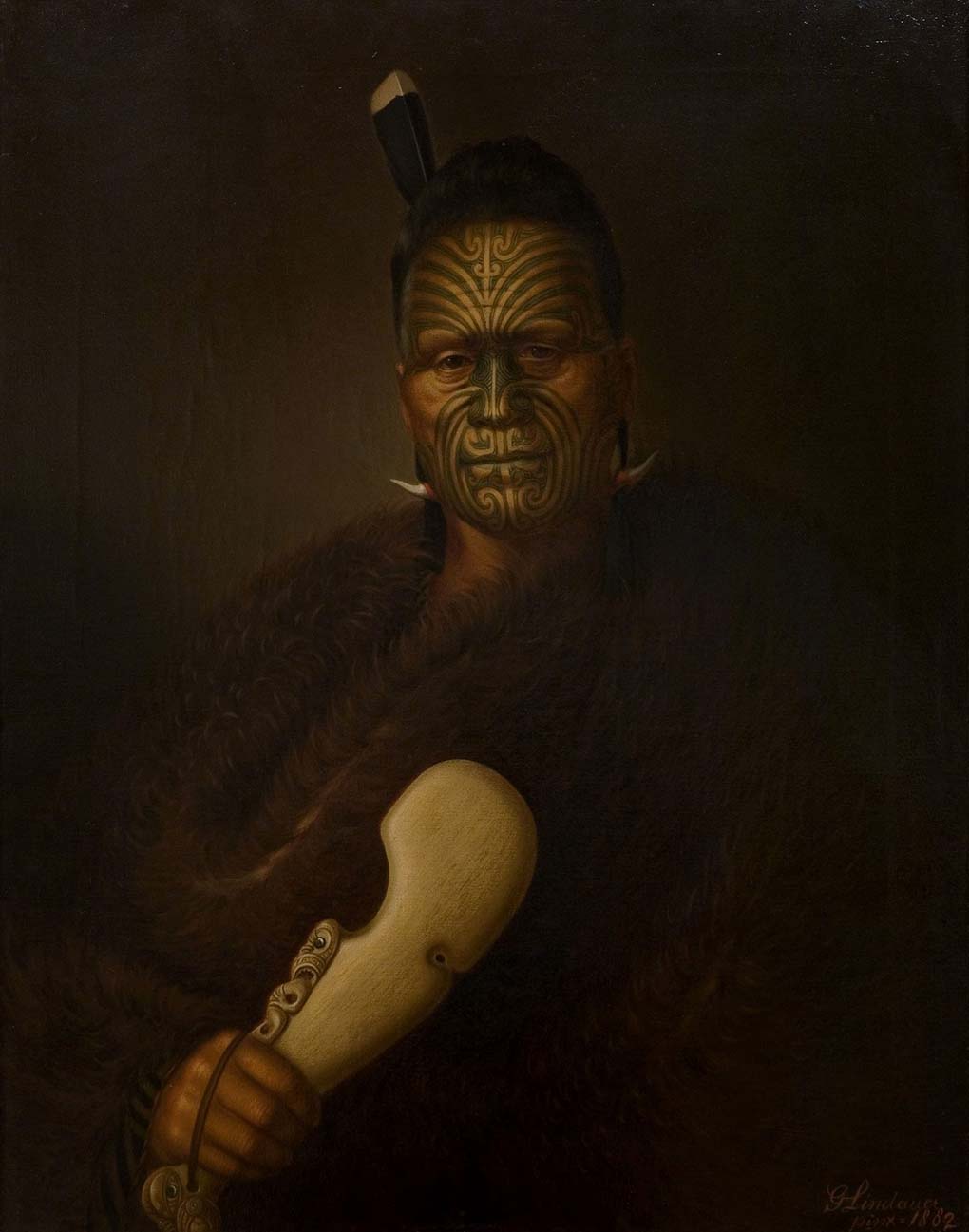
Tūkāroto Matutaera Pōtatau Te Wherowhero Tāwhiao
? – 1894Ngāti Mahuta
- Date
- 1882
- Medium
- oil on canvas
- Measurements
- 880 x 700 mm
- Other titles
- Tawhiao Matutaera Potatau Te Wherowhero, [title, 2026]King Tawhiao, [1930 catalogue]Tawhiao, Maori King, [Deed of gift, 1915]The Late King Tawhiao, [1901 catalogue]Oil Painting. Portrait of Tawhiao (Late Maori King), [copyright certificate, 1898]The Maori King Tawhiao Potatau , [Lindauer's inscribed title]
- Inscriptions
- Front, (l.r.) G. Lindauer Pinx 1882
- Takiwā / region
- Waikato-Maniapoto
- Credit line
- Auckland Art Gallery Toi o Tāmaki, gift of Mr H E Partridge, 1915
- Accession no.
- 1915/2/18
The second Māori king, Tūkāroto Matutaera Pōtatau Te Wherowhero Tāwhiao of Ngāti Mahuta, was the paramount chief of the Tainui tribes of the Waikato. He was known as a man of peace and a visionary whose goal was economic self-sufficiency and stability for Māori.
Tāwhiao was descended from rangatira of both the Tainui and Te Arawa canoes. He was born at Ōrongokoekoeā, on the upper Mōkau River in northern Taranaki – his father being Pōtatau Te Wherowhero, the first Māori king.1
Tāwhiao’s children with his principal wife, Hera, were Tiahuia, who was the mother of Te Puea, famed for her leadership in forming the Tūrangawaewae Marae at Ngāruawāhia; Mahuta, who succeeded Tāwhiao as king and whose comments appear in the Māori Visitors’ Book; and Te Wherowhero. Tāwhiao’s other wives were Rangiaho (with whom he had two children, Pokaia and Haunui) and Aotea, mother of his child Puahaere.
Tāwhiao reigned from 1860 until his death in 1894 at Pārāwera. The Kīngitanga had begun in the 1850s, with the purpose of halting the sale of land and promoting Māori sovereignty.2 The colonial government resisted it strongly and, in 1863, Tāwhiao led the Waikato tribes against the invading British forces. Conflict did not formally cease until 1881 and, during that long period, Tāwhiao’s people stayed in exile in the King Country area, near Te Kūiti. While peace was ultimately agreed between Tāwhiao and the government, the confiscation of vast tracts of land – approximately 1,235,000 acres (500,000 hectares) – remained a bitter legacy for the Kīngitanga iwi.
Continuing to push for an end to land seizures, Tāwhiao regularly corresponded with Sir George Grey on the matter, and in 1884 led a delegation of chiefs to Britain where he hoped to petition Queen Victoria in person. Meeting instead the secretary of state for the colonies, Tāwhiao was told that Te Tiriti o Waitangi and land confiscation were matters for the New Zealand government. The British government disclaimed any responsibility for events before 1863.
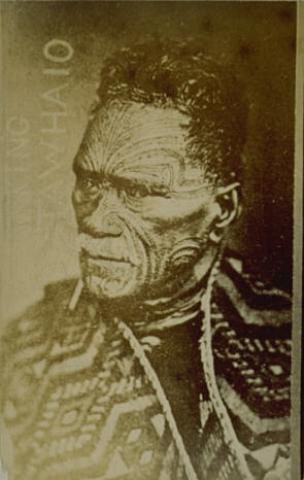
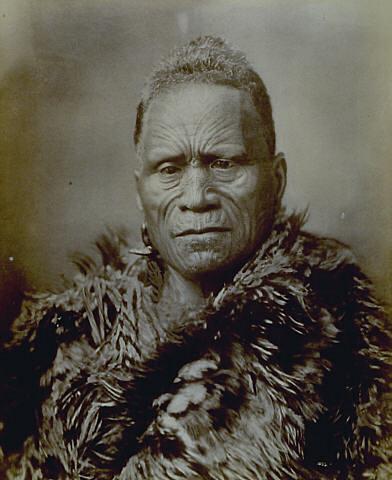
In notes on how the Māori portraits came to be painted by his father, Victor Lindauer wrote that the artist photographed Tāwhiao when he visited him at Whatiwhatihoe Pā, accompanied by Walter Buller in 1882.3 The portrait of Tāwhiao in the collection of Christchurch Art Gallery Te Puna o Waiwhetū appears to be from Lindauer’s photograph, but the one in the Partridge Collection draws on a photograph taken by Josiah Martin, around 1885, itself a copy of an image taken by John Mayall in London in 1884. The Partridge Collection painting portrays Tāwhiao resplendent with symbols of chiefly dignity – he has a striking mataora, is clad in an exquisite kahu kiwi and clasps a large whalebone wahaika. From his earlobes, two shark’s teeth set in red sealing wax are suspended from ribbons, and a tail feather of the prized huia decorates his hair. Combined, these symbols add to the majesty of Tāwhiao’s image.
Steven Oliver, ‘Te Wherowhero, Pōtatau’, Dictionary of New Zealand Biography, first published in 1990, Te Ara – the Encyclopedia of New Zealand, https://teara.govt.nz/en/biographies/1t88/te-wherowhero-potatau, accessed 3 July 2023.
Nancy Swarbrick, ‘Waikato region – Te Kīngitanga, 1880 onwards’, Te Ara – the Encyclopedia of New Zealand, http://www.TeAra.govt.nz/en/waikato-region/page-13, accessed 3 July 2023.
Victor Wilhelm Lindauer, ‘How papa painted his first Maori picture in 1876’, MS-Papers-4369, Lindauer Family Papers, Alexander Turnbull Library, Wellington.