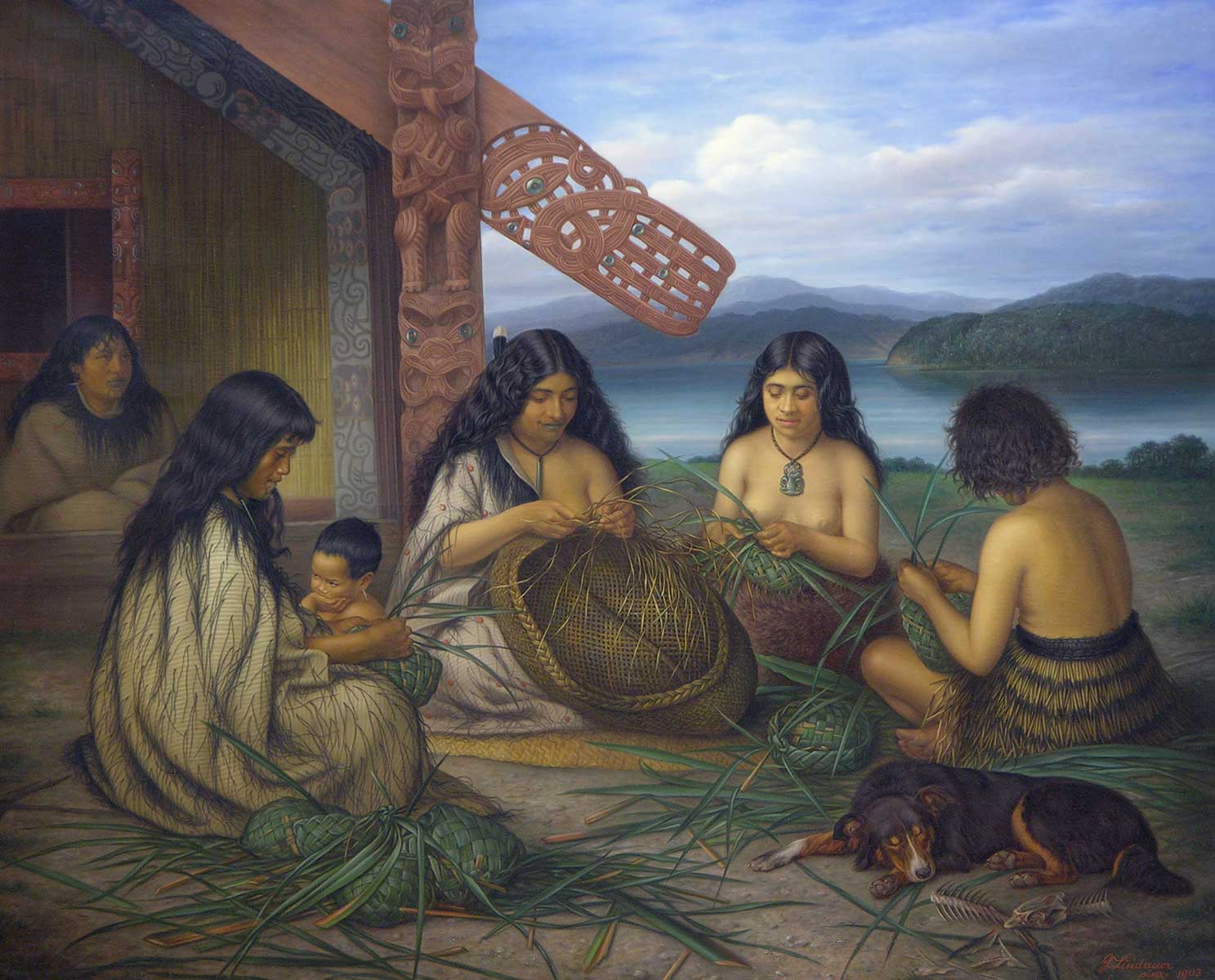
Wāhine and Kōhine Making Kete
- Date
- 1903
- Medium
- oil on canvas
- Measurements
- 2175 x 2650 mm
- Other titles
- Maoris Plaiting Flax Baskets, [title, pre-Sep 2026]Maoris Plaiting Flax Baskets, [catalogue 1930]Wahines and Koninis [kōhine] Kit Making, [Deed of gift, 1915]Oil Painting of Maori Women Girls "Kit Making", [copyright certificate, 1903]
- Inscriptions
- Front, G. Lindauer
- Credit line
- Auckland Art Gallery Toi o Tāmaki, gift of Mr H E Partridge, 1915
- Accession no.
- 1915/2/63
A group of young women seated in front of a whare whakairo are busily weaving kono out of harakeke. These kono were generally produced for large events such as hākari, or the harvesting and distributing of seasonal food crops, which required communal effort. The young women would have been given the task of making these elementary food baskets as a form of apprenticeship: simple kono are one of the first items young aspiring weavers would be expected to grasp.
The young woman at the centre of the group is distinct as she has a huia feather in her hair and a korowai draped diagonally across the chest, hallmarks of chiefly lineage and position. She appears to be slightly older than the other weavers and is finishing the plaited rim of a large kete used for harvesting crops of rīwai and kūmara. Another chiefly woman with moko kauae and draped in a korowai sits in the mahau, slightly removed from the others. It is interesting to think what the message might be here. Is she supervising the group? Or perhaps she is set apart because of her rank and status. Lindauer’s composition creates shifts in tone and mood in the one image.
An analysis of the carved maihi and amo) of the meeting house tells us that they are of Ngāti Kahungunu tribal origin and were copied from photographs of Heretaunga, a whare whakairo at Taradale, taken by Samuel Carnell. In this painting the carvings are presented with kōkōwai staining. The angle of the maihi cuts into the blue sky, inserting a dynamic form into the picture plane. The activities of the weavers in the foreground are in contrast to a sleeping kurī in the bottom right corner of the painting, complete with a fish skeleton at its feet.
- Patrick Parsons, Gottfried Lindauer: Te Renitawa — The Shadow Maker, Hastings: Hawke’s Bay Cultural Trust, 2005.