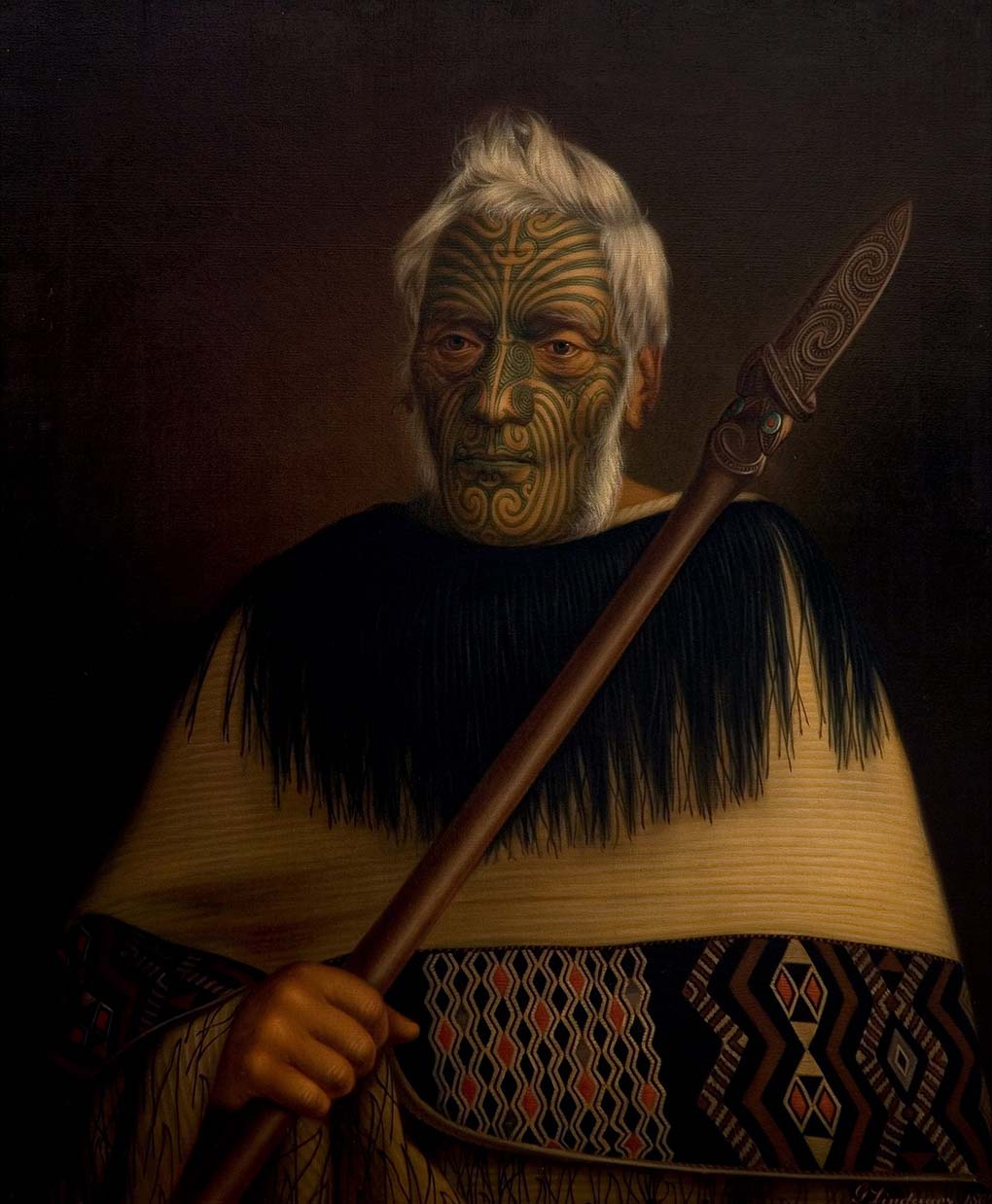
Anehana
Ngāti Kahu, Ngāti Whātua
- Date
- 1897
- Medium
- oil on canvas
- Measurements
- 838 x 692 mm
- Other titles
- Anehana, [title, 2026]Anehana, [1930 catalogue]Anehana, [Deed of gift, 1915]Anehana, [1901 catalogue]Oil Painting. Portrait of the Chief Anehana (Wade), [copyright certificate, 1898]Chief Anehana, [Lindauer's inscribed title]
- Inscriptions
- Front, LR: G. Lindauer 1897Back, C: Chief AnehanaBack, LR: G. Lindauer Pinx 1897
- Takiwā / region
- Tāmaki Makaurau
- Credit line
- Auckland Art Gallery Toi o Tāmaki, gift of Mr H E Partridge, 1915
- Accession no.
- 1915/2/2
Anehana was chief of Te Wēiti (Wade), now known as Silverdale and located north of Auckland on the Whangaparāoa Peninsula. Anehana and his Ngāti Kahu iwi had a kāinga on the banks of the Te Wēiti River at Rarowhara and their main settlement was at Te Haruhi.
Te Wēiti was of strategic importance to Māori as it was the entranceway for all canoes navigating up the river, with easy access to an overland walkway to the eastern side of the peninsula.
In the early 19th century, Ngāti Kahu were defeated by Ngāti Whātua and several Marutūāhu tribes, who subsequently sold Te Wēiti to European settler Henry Taylor. Ngāti Kahu retreated to Auckland and the Waikato and the surviving Ngāti Kahu people – presumably including Anehana – sold remaining tribal land between Silverdale and Ōrewa to the Crown and to individual settlers.
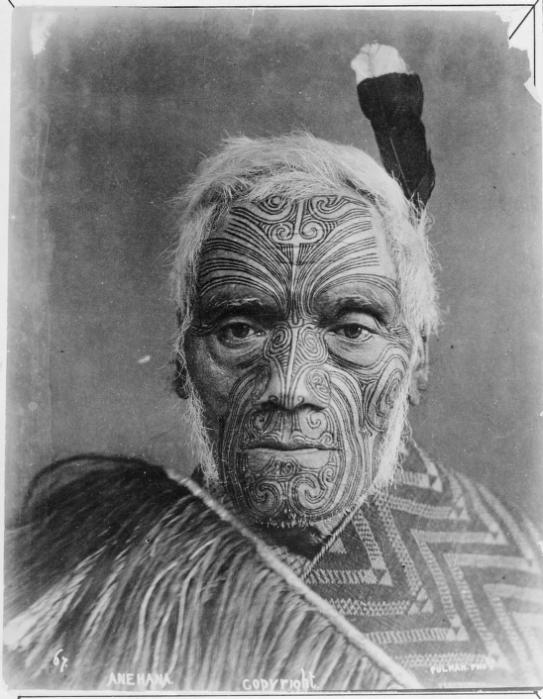
Lindauer’s portrait of Anehana was derived from a photograph – one of three taken at the same sitting by George and Elizabeth Pulman. It is not known when the Pulmans took Anehana’s portrait, but it was most likely between 1867 and 1871, before George died.
While the sitter’s physical features have been re-presented with considerable accuracy, Lindauer altered the appearance of his dress. In the Pulman photographs he is seen adorned with a huia feather in his hair. In two of these photographs the tāniko borders of two kaitaka are draped over his shoulders, showing the geometric pattern that usually ornaments the lower edge. In the third photograph a kākahu with a coarse fringe sits over his right shoulder. Lindauer’s portrait excludes the huia feather and reorients the kaitaka so that the tāniko falls at Anehana’s waist, also adding a fine fringe at the neck. Beneath this cloak he introduces a korowai hukahuka . And while the Pulman photograph is only bust length, Lindauer’s portrait of Anehana is half-length, showing him clutching a taiaha. It should also be noted that early photographic processes were not able to record tā moko. Consequently, the lines of Anehana’s mataora was drawn directly onto the glass plate negative which Lindauer closely followed.
- ‘Contents of Volume II’, New Zealand Illustrated Magazine, vol 1, issue 7, 1 April 1900, p 2, Papers Past, accessed 28 February 2010.
- Jenny Litchfield, ed. From the Wade to Silverdale: A Local History of the District and its School (Auckland: Institute Press, 1996, Auckland).
- Phillip D. Jackson, 'Pulman, Elizabeth 1836 - 1900', Dictionary of New Zealand Biography, updated 22 June 2007, accessed 28 February 2010.