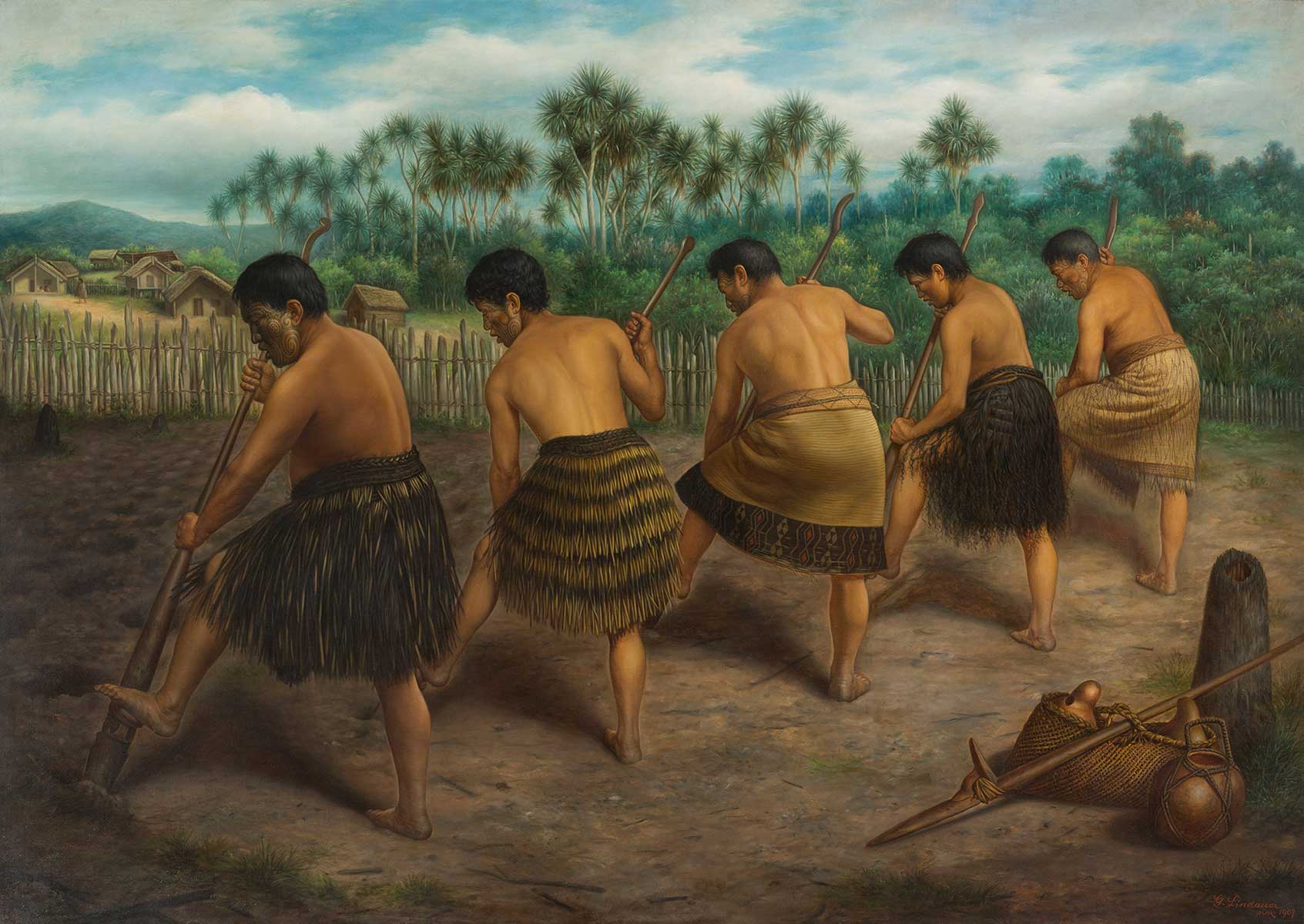
Digging with the Kō
- Date
- 1907
- Medium
- oil on canvas
- Measurements
- 1778 x 2489 mm
- Other titles
- Digging with the Ko, [title, pre-Sep 2026]Digging with the Ko, [catalogue 1930]As Cook Found Them, [Deed of gift, 1915]Oil Painting "As Cook found them" / Five Maoris in foreground digging with the old time -ko- preparing the ground for planting kumara, [copyright certificate, 1907]
- Inscriptions
- Front, G. Lindauer pinx 1907 (l.r.)
- Credit line
- Auckland Art Gallery Toi o Tāmaki, gift of Mr H E Partridge, 1915
- Accession no.
- 1915/2/46
Preparing the land for kūmara planting started with breaking the soil with a kō, a digging stick with a footrest lashed to its base. Kūmara were traditionally planted in diagonal lines to allow the sun to reach between the rows. This was a physically demanding and skilled task, one that was crucial in securing a successful harvest. Early visitors to Aotearoa New Zealand were impressed by Māori cultivation, and entrepreneurial tribes grew crops both for local settlers, and for export to Australia and California.
In Digging with the Kō, Lindauer portrays how the cultivation of food crops and horticulture, more generally, was a vital undertaking. Mahinga kai were important spaces that were fenced off within the pā site. In the painting the main meeting-house structures are some distance away. The lush green bushline running along from the right is highlighted by a line of tī kōuka that puncture the skyline and suggest that the land is fertile and rich. The growing of kūmara was an especially sacred practice and for many tribes was dedicated to the deity Rongo-mā-Tāne, the atua of the kūmara. Stone effigies of Rongo-mā-Tāne or other tribal kaitiaki figures were placed in the gardens to guard the crops and ensure fertility. This ritual included incantations offered for a successful harvest.
Lindauer depicts the men involved in the physical task of tending and turning the soil in an array of the finest garments: for example, full-length dress cloaks such as the kaitaka on the central figure and a korowai worn by the man at the extreme right. Both cloaks have been folded and layered around the waist and held in place by plaited and woven tātua. Why would these men wear their most treasured garments when working in the field? They would not, of course. Lindauer utilised photographs as references and in this case he directly follows Augustus Hamilton’s 1898 photograph, also titled Digging with the Kō, which is a compelling example of the colonial practice of staging images of Māori at work and in other contexts. Further, this painting was originally titled by Lindauer and Henry Partridge, the commissioner, ‘As Cook Found Them’. It was clearly intended to offer an insight into pre-colonial Māori life at the time James Cook and his crew on the Endeavour first encountered Māori. Inaccurate details such as the dress of the gardeners suggests lack of research, poor understanding te ao Māori and embellishment of customary practice.