'In days gone by' Fire-Making
- Date
- 1910
- Medium
- oil on canvas
- Measurements
- 2140 x 1940 mm
- Other titles
- Fire making, [title, pre-Sep 2026]Fire-Making, [catalogue 1930]New or Sacred Fire-making, [Deed of gift, 1915]Oil painting "In days gone by" New or Sacred Fire Making, [copyright certificate, 1913]
- Inscriptions
- Front, G. Lindauer 1910 (l.l.)
- Credit line
- Auckland Art Gallery Toi o Tāmaki, gift of Mr H E Partridge, 1915
- Accession no.
- 1915/2/23
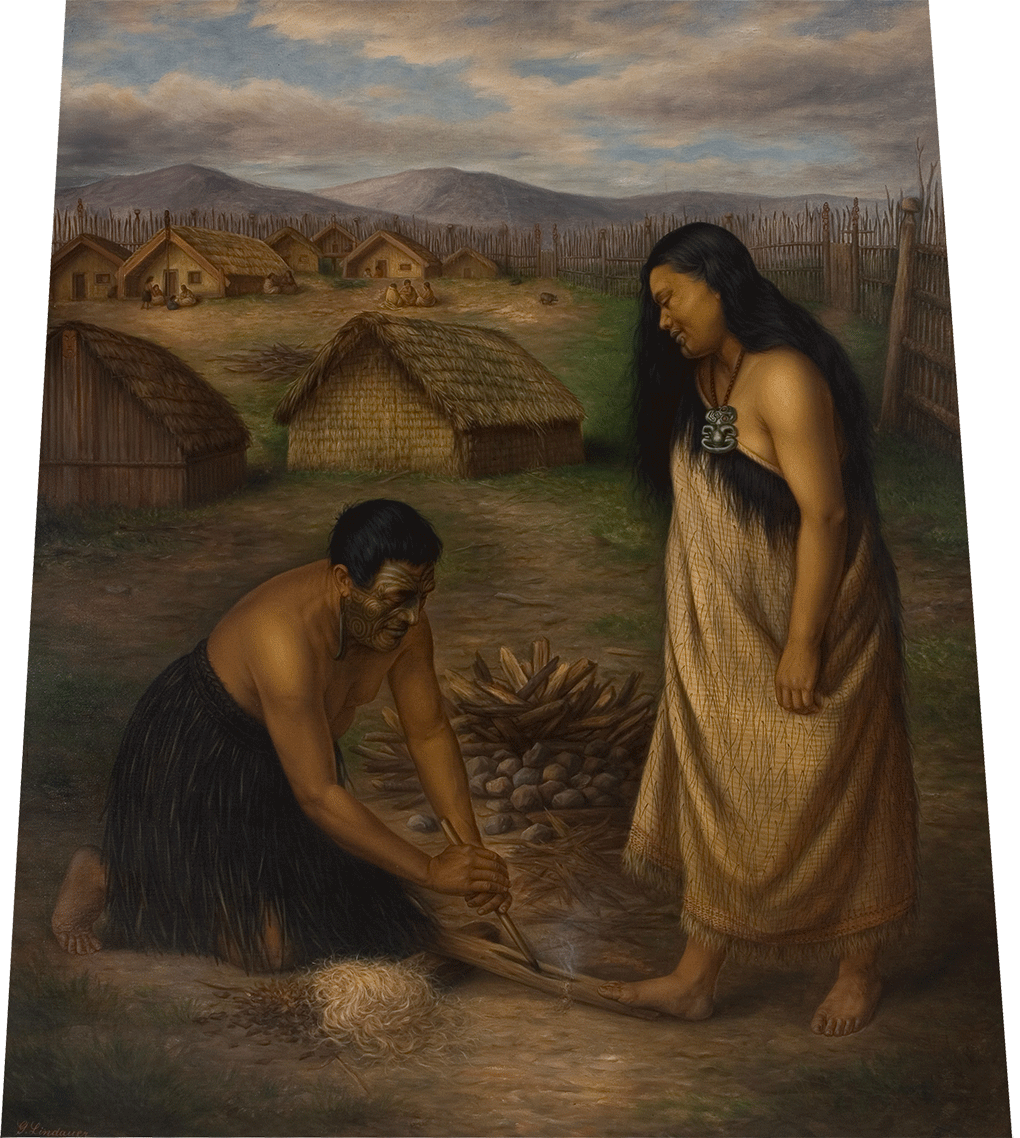
The rituals and processes relating to hika ahi (fire making) are the subject of this trapezoid-shaped painting. In Lindauer’s portrayal a man and woman are engaged in creating fire for a hāngī within a pā.
Understandings and rituals pertaining to fire often recall a collaboration between male and female in the practice and process of creating fire. Fire was created using a fire plough, usually made of the kaikōmako tree, a hardwood that is a great carrier and medium. Kaurima were rubbed vigorously by the male while the female held the plough in place. The kaurima were rubbed against kaunoti in the plough which would produce both sawdust and heat. When smoke appeared, the charred sawdust was placed on kindling and blown until it caught alight.
Oral narratives tell of the deity Māui who brought the knowledge of fire to this world from Mahuika, the female deity of fire. The kaikōmako tree is known as Mahuika’s tree because she threw her last fingernail of fire into it. However, fire and the practice of making fire have many levels of ritual relating to its use and function. For example, Elsdon Best notes more than 28 names for the ritual use of fire, for example:
Ahi taitai: a tapu fire over which a karakia is chanted to protect the life principle of man
Ahi torongu: a ritual fire to expel insects and pets from destroying food crops1
In the background is the vast landscape of the pā which is encircled by an impressive pā tūwatawata. ‘In days gone by’ Fire-Making, dating from 1910, was the last of the eight large scene paintings commissioned by Henry Partridge. Despite being a product of the early 20th century through its setting, clothing and depiction of customary practice the painting is intended to invoke ‘old-time’ or pre-colonial Māori traditions, rather than offering a scene of contemporary Māori life.
Te Rangi Hīroa, The Coming of the Maori, Māori Purposes Fund Board, Wellington, 1949, p 501.