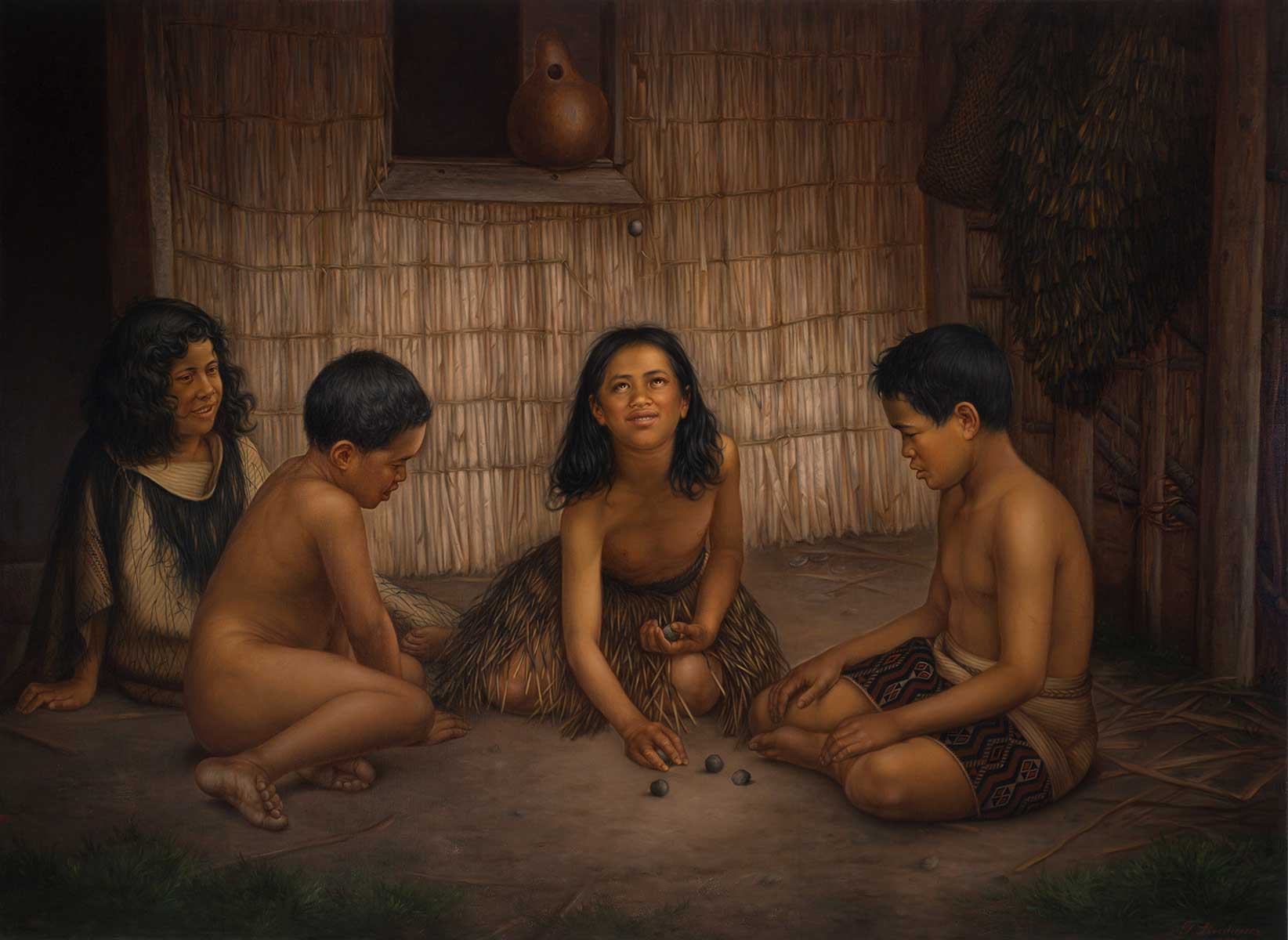
'Happy days' Playing Ruru or Fivestones
- Date
- 1907
- Medium
- oil on canvas
- Measurements
- 1356 x 1835 mm
- Other titles
- Maori Children playing Knucklebones, [title, pre-Sep 2026]Maori Children Playing Knuckle-Stones, [catalogue 1930]Happy Days: Playing Knuckle, or Jack Stones, [Deed of gift, 1915]Oil Painting "Happy days", [copyright certificate, 1907]
- Inscriptions
- Front, G. Lindauer 1907 (l.r.)
- Credit line
- Auckland Art Gallery Toi o Tāmaki, gift of Mr H E Partridge, 1915
- Accession no.
- 1915/2/21
The games and pastimes of Māori were diverse with children and young people playing games that required skill, wit and dexterity. Tītī tōrea, teka, mū tōrere, mahi whai as well as races on poutūturu were some of the most popular games.1 Most were accompanied with song and chants, which was an important element of play. The interactive and often competitive nature of games were popular with both children and adults. One game, pōtaka, was played exclusively by kaumātua, highlighting that such pastimes were shared activities in mastering strength, strategy and endurance.
Lindauer’s ‘Happy days’ Playing Ruru or Fivestones depicts another popular game, ruru, similar to knucklebones. In the mahau of the wharenui, four tamariki are engaged in a game of ruru. It is usually played with five stones: the player throws them into the air and attempts to catch them on the back of the hand, as demonstrated by the young girl at the centre of the painting. Lindauer captures the playful innocence of youth and perhaps the competitive nature of these games. We notice that the girls are smiling while the boys are not. Read into that what you will.
The scene is bathed in golden light. A hue is perched oddly on the corner of the window frame and a rain cape and kete hang on the side wall of the porch. All these elements help to frame the picture and the activity in the foreground. Despite being painted in 1907, they were also included to give the scene a pre-colonial or, to use the language of the time, an ‘old-time’ feel. Upon comparison, we can identify that the wharenui is based on the same reference image used to inform The Tohunga Tā Moko at Work and The Tohunga under Tapu.
Ross Calman, ‘Traditional Māori games – ngā tākaro’, Te Ara – the Encyclopedia of New Zealand, https://teara.govt.nz/en/traditional-maori-games-nga-takaro, accessed 21 July 2023.