Pāora Tūhaere
? – 1892Ngāti Whātua
- Date
- 1895
- Medium
- oil on canvas
- Measurements
- 677 x 563 mm
- Other titles
- Paora Tuhaere, [title, 2026]Paul Tuhaere, [1930 catalogue]Paora Tuhaere, [Deed of gift, 1915]Paul Tuhaere, [1901 catalogue]Oil Painting of Paora Tuhaere (Chief of the Ngatiwhatua) Orakei, [copyright certificate, 1898]Chief Paora Tuhaere in Orakei , [Lindauer's inscribed title]
- Inscriptions
- Front, LL: G. LindauerBack, LR: Chief Paora Tuhaere / in OrakeiBack, LR: G. Lindauer / 1895
- Takiwā / region
- Tāmaki Makaurau
- Credit line
- Auckland Art Gallery Toi o Tāmaki, gift of Mr H E Partridge, 1915
- Accession no.
- 1915/2/66
Pāora Tūhaere was paramount chief of Auckland iwi Ngāti Whātuaand well known as a peacemaker and intermediary between Māori and the government.1 Tūhaere became paramount chief in 1868; he was based in Ōrākei, on the shores of Ōkahu Bay. He was the nephew of esteemed rangatira Āpihai Te Kawau.2 His mother was Te Kawau’s sister, Ātareta Tūha, and his father was Whanararei of the Te Taoū hapū. He married twice, first to Tūpanapana, granddaughter of Ngāpuhi leader Te Wharerahi, and later to Harata Rewiri Tarapata, with whom he had a daughter, Mere.
Tūhaere was a Christian lay preacher, often speaking at intertribal gatherings and keen to promote peace. As an example of his ethos, to a group of Dalmatians arriving in Tāmaki Makaurau Auckland, he is quoted as having said, ‘The laws of England shield us from the hand of the aggressor, we live happy and at peace, and rejoice to welcome those who, like you, come to us on a mission of goodwill!’3
In the 1840s and 1850s, Tūhaere was involved in facilitating land sales for the settlement of Tāmaki Makaurau. After this time, however, Ngāti Whātua supported the Kīngitanga movement’s call for a ban on further sales of Māori land. Concerns over land were inflamed by the government’s apparent unwillingness to honour Te Tiriti o Waitangi, an issue that Tūhaere would face throughout his leadership.
In the 1870s, Tūhaere was a leading member of the Te Kotahitanga, Māori Parliament, which sought Māori control of Māori affairs.4 He also wrote on Ngāti Whātua history, genealogy and conflicts with other iwi.5
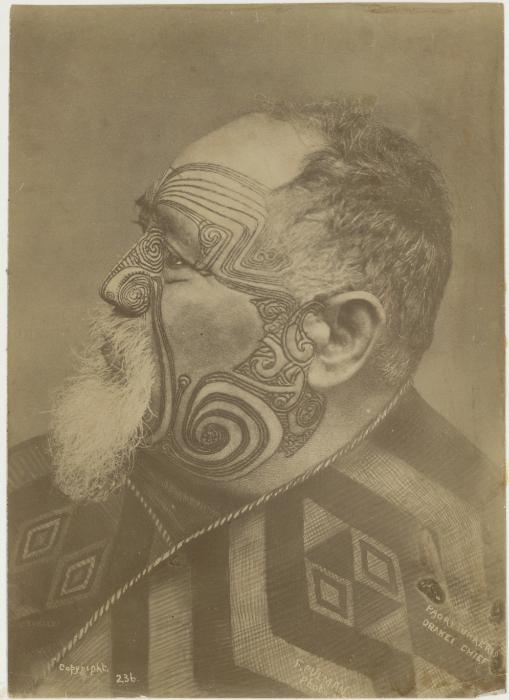
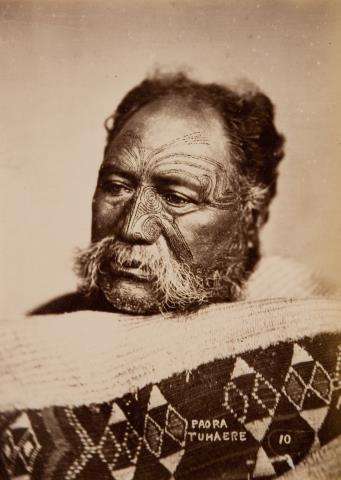
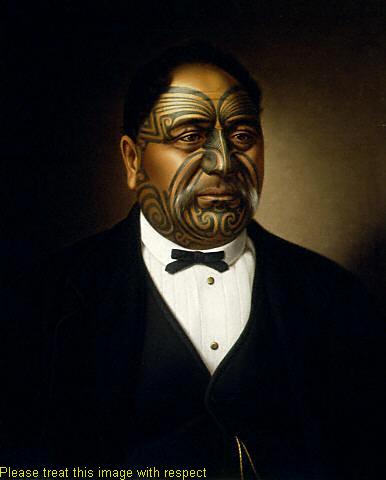
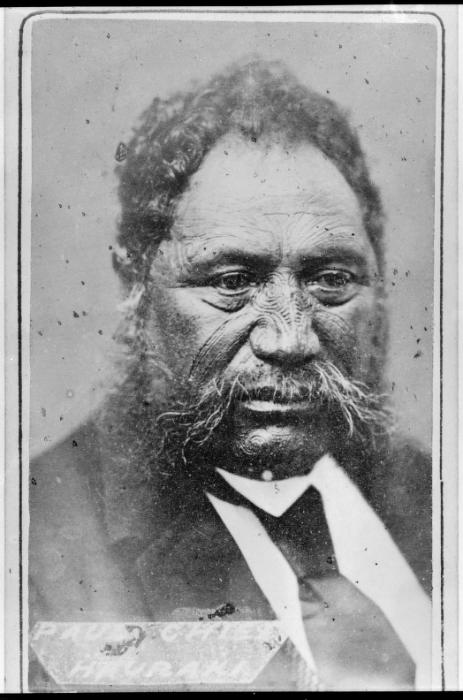
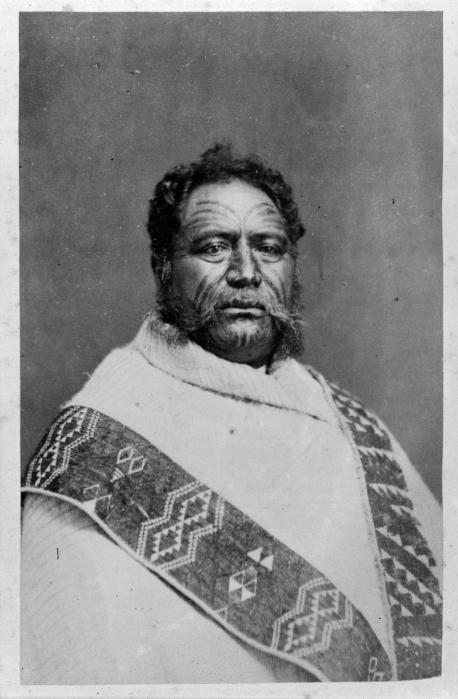
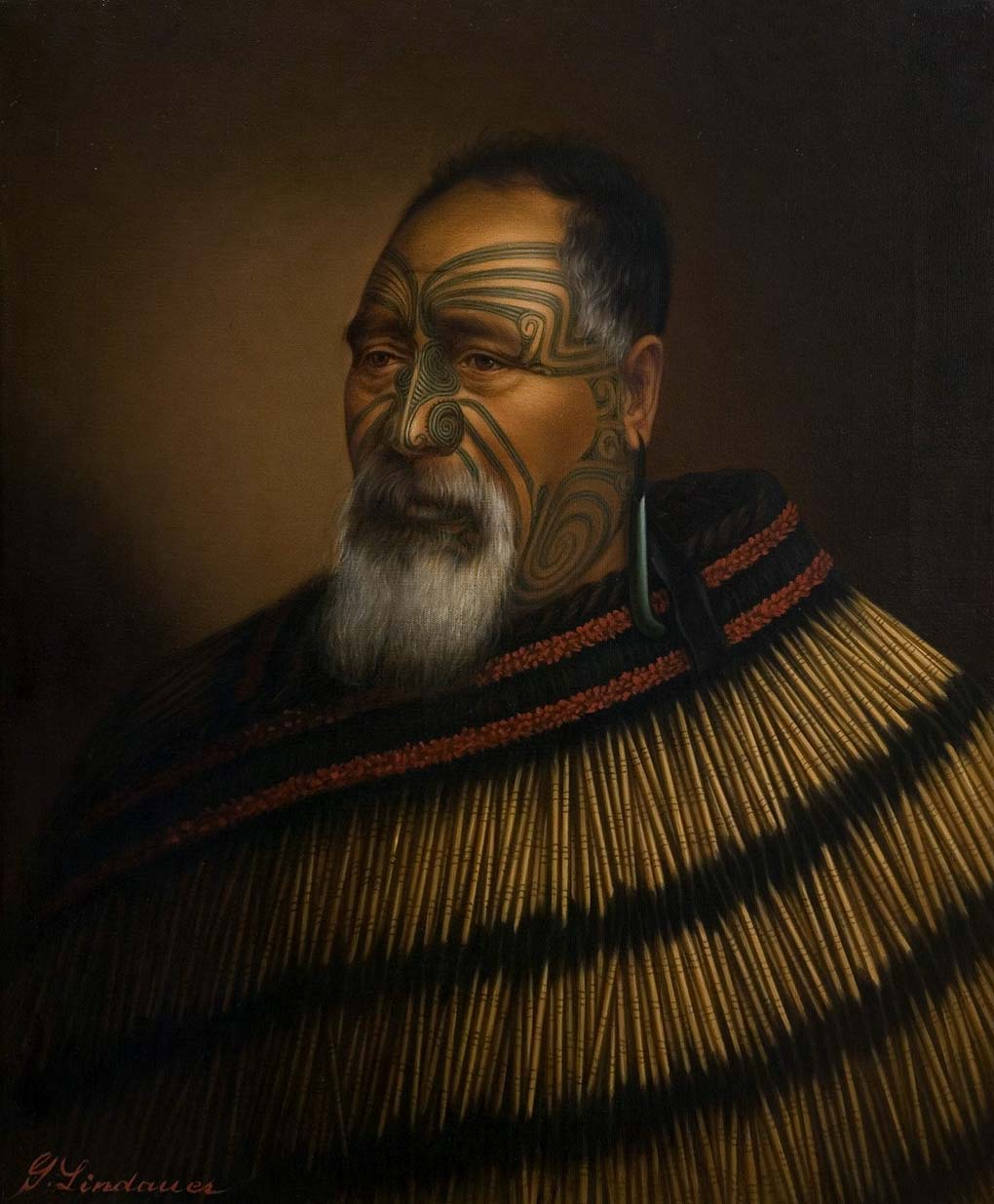
Lindauer’s painting is based on a photographic portrait of Tūhaere by the Auckland studio photographer Elizabeth Pulman for which she registered the copyright in 1889.6 In the photograph, Tūhaere wears a three-piece suit over a white shirt and a bow-tie. In the painting, Lindauer re-presents Tūhaere in ‘authentic’ customary garments. Tūhaere wears a piupiu across his shoulders, finished with a red and black collar, possibly incorporating dyed wool, and terminating in a dark whiri edge. A long kapeu pounamu is suspended from his left earlobe. His mataora is an accurate record of his carved chiefly full-face marking.
This work is not the only Lindauer portrait of Pāora Tūhaere. In 1934, Auckland Art Gallery Toi o Tāmaki was gifted a second portrait of Paora Tuhaere, painted in 1878 and commissioned by the rangatira himself. In it, he is depicted wearing European clothing. Lindauer also painted Tūhaere’s cousin, Te Hira Te Kawau.
Steven Oliver, ‘Tūhaere, Pāora’, Dictionary of New Zealand Biography, first published in 1990, Te Ara – the Encyclopedia of New Zealand, https://teara.govt.nz/en/biographies/1t109/tuhaere-paora, accessed 5 July 2023.
Ruby Kerei, Steven Oliver and Ani Pihema, ‘Te Kawau, Āpihai’, Dictionary of New Zealand Biography, first published in 1990, Te Ara – the Encyclopedia of New Zealand, https://teara.govt.nz/en/biographies/1t42/te-kawau-apihai, accessed 5 July 2023.
‘Extracts from the Novara’s circumnavigation 1857–1859’, compiled by George Mihaljevich, president, Dalmatian Genealogical and Historical Society, December 1999, updated October 2007.
Rāwiri Taonui, ‘Ngāti Whātua and the Treaty of Waitangi’, Te Ara – the Encyclopedia of New Zealand, http://www.TeAra.govt.nz/en/ngati-whatua/page-4, accessed 5 July 2023.
See, for example: GNZMZ 725, Grey NZ Manuscripts, Special Collections, Central City Library, Auckland; ‘An Historical Narrative Concerning the Conquest of Kaipara and Tamaki by Ngati-Whatua’, Journal of the Polynesian Society, vol 32, no 128, 1923, pp 229–37.
E. Pulman, ‘Copyright files: 11 Maori Portraits’, registered 1889, Archives NZ, R24024954.