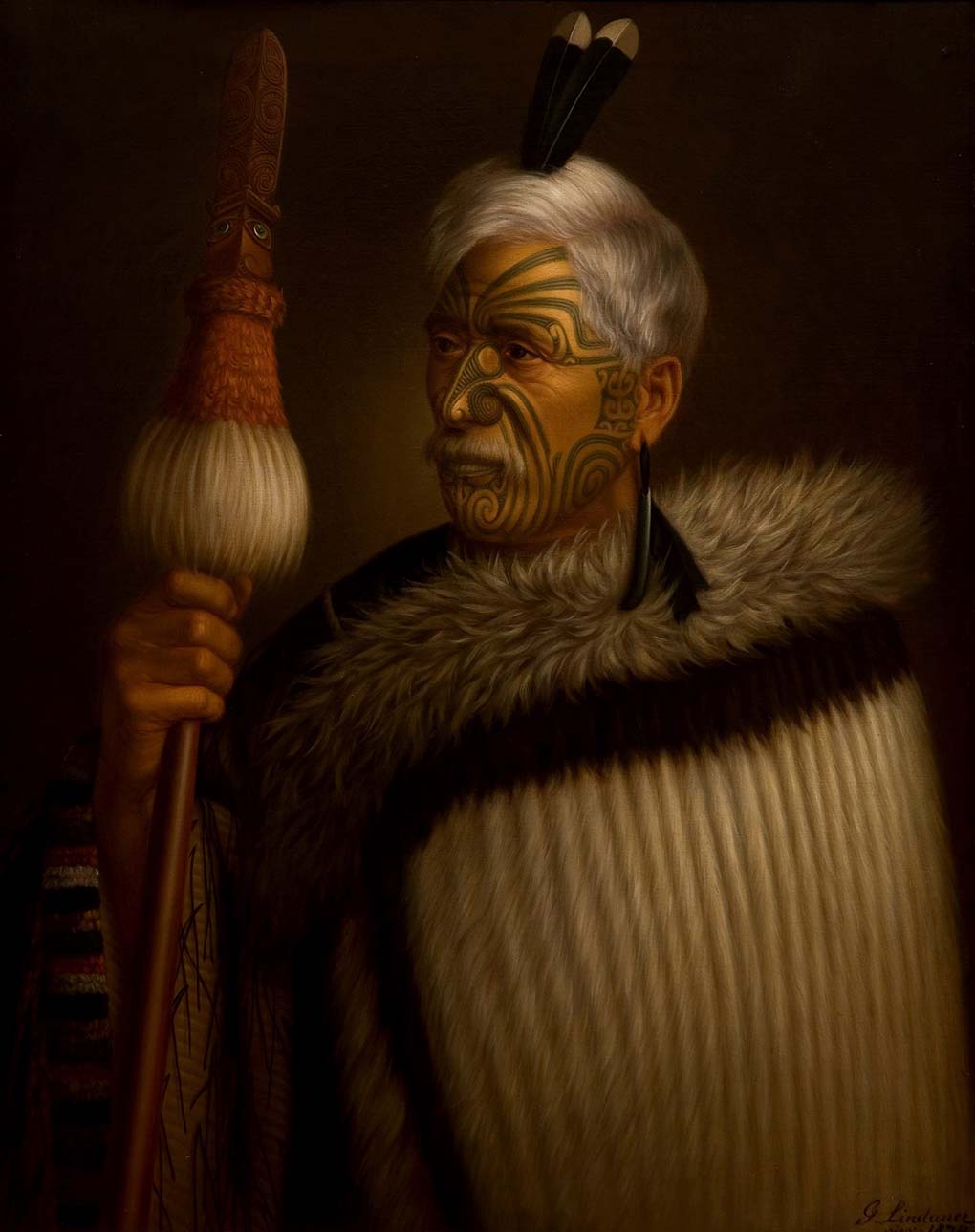
Te Hira Te Kawau
? – 1888Ngāti Whātua
- Date
- 1874 (backdated), possibly 1887 or 1897
- Medium
- oil on canvas
- Measurements
- 863 x 685 mm
- Other titles
- Te Hira Te Kawau, [title, 2026]Te Hira te Kawau, [1930 catalogue]Te Hira te Kawau, [Deed of gift, 1915]Te Hira Te Kawau, [1901 catalogue]Oil Painting. Portrait of the Chief Te Hira Te Kawau of Orakei, [copyright certificate, 1898]Chief Hira te Kawau , [Lindauer's inscribed title]
- Inscriptions
- Front, LR: G. Lindauer pinx 1874Back, LR: Chief Hira te KawauBack, LR: G Lindauer pinx - 1874
- Takiwā / region
- Tāmaki Makaurau
- Credit line
- Auckland Art Gallery Toi o Tāmaki, gift of Mr H E Partridge, 1915
- Accession no.
- 1915/2/69
Tracing his descent to the Māhuhu-ki-te-rangi waka, Te Hira Te Kawau was a high-born chief of Tāmaki Makaurau Auckland who took part in many land sales with the Crown.
Te Kawau lived most of his life at Ōkahu and was a rangatira of Ngāti Whātua. His mother was Kiripiro of Te Taoū and his father was Apihai Te Kawau, who signed Te Tiriti o Waitangi on 20 March 1840 on the shores of the Manukau Harbour.1
Te Hira is known for his role within a small group of chiefs, including his father Apihai and cousin Pāora Tūhaere Upon the death of Apihai Te Kawau, the mantle of paramount chief of Ngāti Whātua went to Tūhaere rather than Te Hira.2
Lindauer painted both Te Hira and Tūhaere, inscribing the reverse of Te Hira’s portrait, ‘Chief Hira te Kawau G Lindauer pinx 1874’. The portrait is also dated on the front 1874, but examination with infrared photography reveals that Lindauer amended the date and the likely original date was 1887 or 1897. Why he would do this is unclear, but it was probably at the request of Partridge as commissioner, wanting to own the ‘first’ of the artist’s Māori portraits – Lindauer only arrived in New Zealand in August 1874. Three other portraits are similarly back dated: Hūria Ngārongoā Kātene Mātenga, Tāraia Ngākuti Te Tumuhuia and Eruera Maihi Patuone.
Lindauer’s one surviving notebook includes an incomplete list of works he undertook ‘For Mr Partridge’. This portrait appears as number 17, ‘Hiroto te Kawau’.3 This misspelling was originally on the reverse of the work but was corrected by the artist at some point. The portrait was one of those sent to the Louisiana Purchase Exposition in St Louis, Missouri, in 1904.4
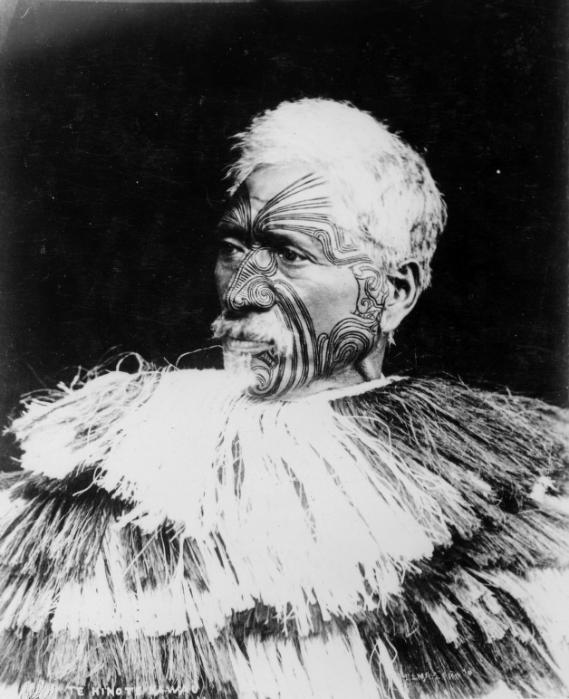
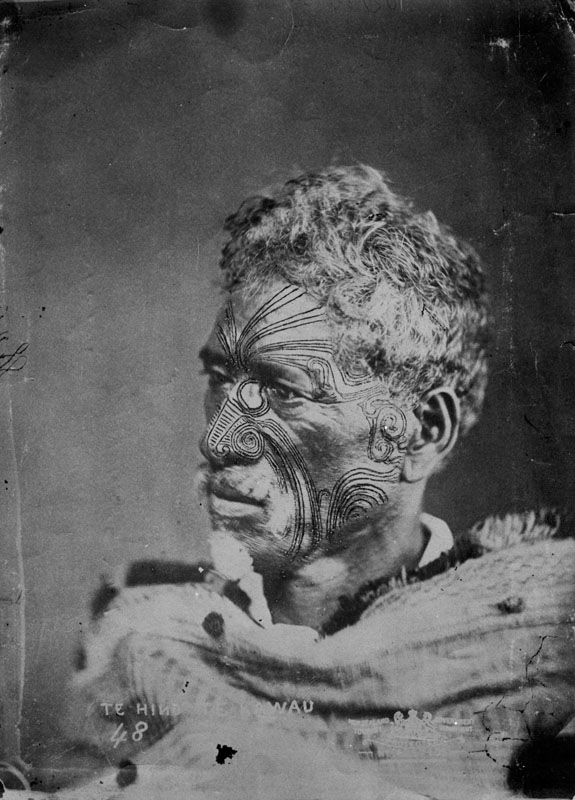
The portrait of Te Hira Te Kawau is based on an undated Elizabeth Pulman photograph. He is depicted by Lindauer in three-quarter profile with two white-tipped huia feathers tucked into his hair. His kapeu pounamu hangs from a black ribbon, resting on his majestic kahu kurī. In his right hand he holds a taiaha, a symbol of his training as a warrior. While highly skilled in martial warfare he was never called upon to fight.
‘Manukau-Kāwhia Treaty Copy’, https://nzhistory.govt.nz/media/interactive/manukau-kawhia-treaty-copy; and ‘Manukau, 20 March 1840’, https://nzhistory.govt.nz/politics/treaty/location/manukau/20-march-1840; both accessed 12 August 2026.
Steven Oliver, ‘Tūhaere, Pāora’, Dictionary of New Zealand Biography, first published in 1990, Te Ara – the Encyclopedia of New Zealand, https://teara.govt.nz/en/biographies/1t109/tuhaere-paora, accessed 21 July 2023.
Notebook of Gottfried Lindauer, Lindauer Family Papers, Alexander Turnbull Library, MSX-3092,.
‘Louisiana Purchase Exposition’, Wikipedia, http://en.wikipedia.org/wiki/Louisiana_Purchase_Exposition, accessed 21 July 2023.