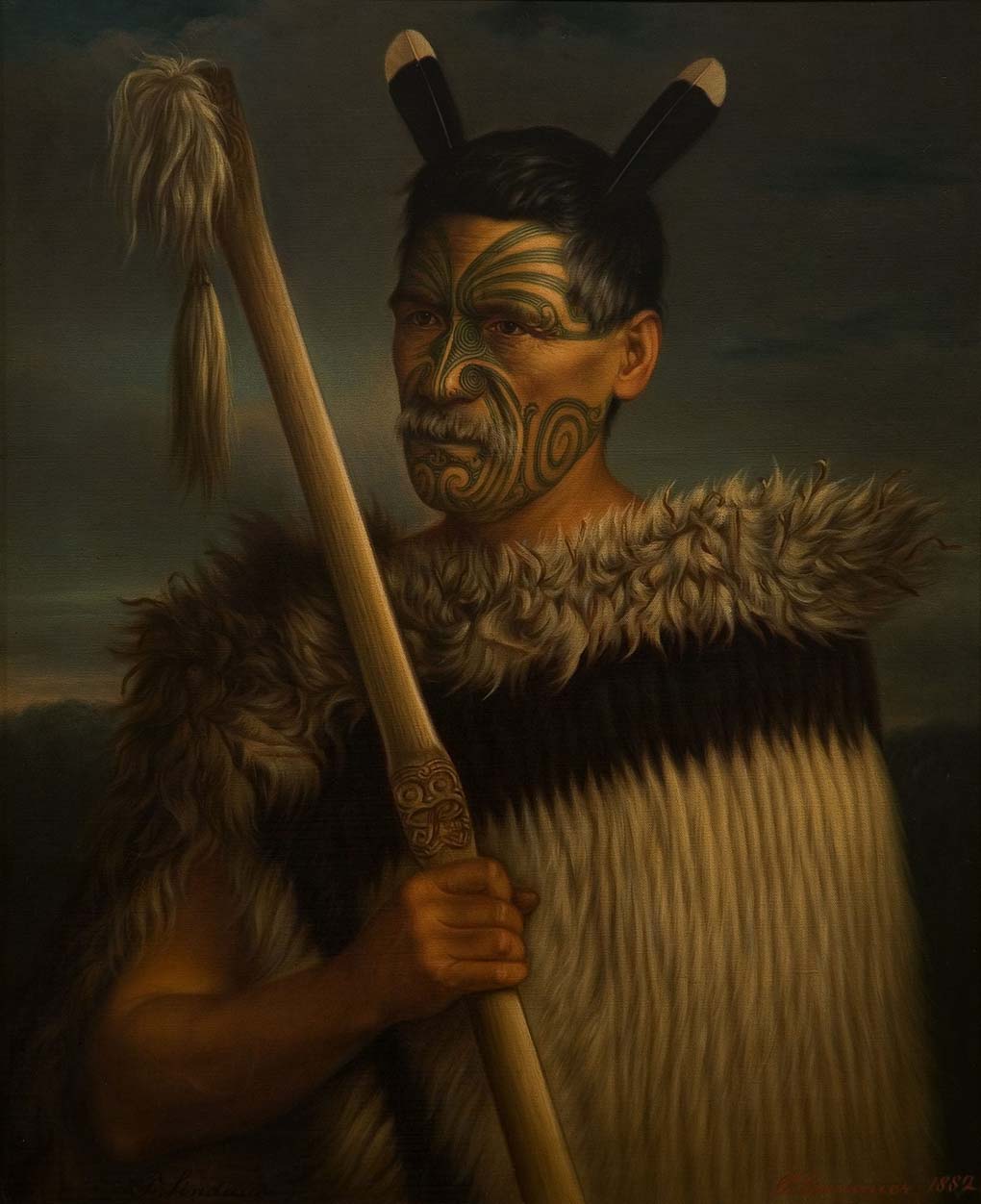
Rewi Manga Maniapoto
? – 1894Ngāti Maniapoto
- Date
- 1882
- Medium
- oil on canvas
- Measurements
- 860 x 700 mm
- Other titles
- Rewi Manga Maniapoto, [title, 2026]Rewi Manga Maniapoto, [1930 catalogue]Rewi Manga, [Deed of gift, 1915]Rewi Manga Maniapoto, [1901 catalogue]Oil Painting. Portrait of the Chief Rewi Maniapoto / The Hero of Orakau, [copyright certificate, 1898]Rewi Chief of the Ngati Maniapoto, [Lindauer's inscribed title]
- Inscriptions
- Front, LL: G. Lindauer LR: G. Lindauer 1882 [signed twice on recto]Back, LR: "Rewi" Chief of the / Ngati Maniapoto. / 1882
- Takiwā / region
- Waikato-Maniapoto
- Credit line
- Auckland Art Gallery Toi o Tāmaki, gift of Mr H E Partridge, 1915
- Accession no.
- 1915/2/32
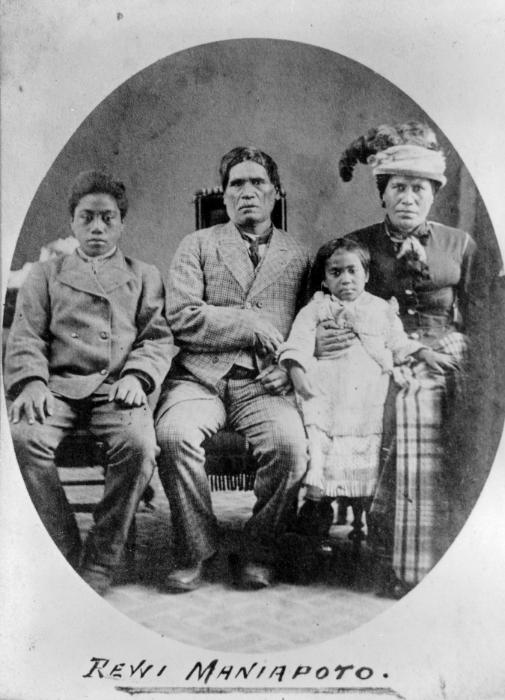
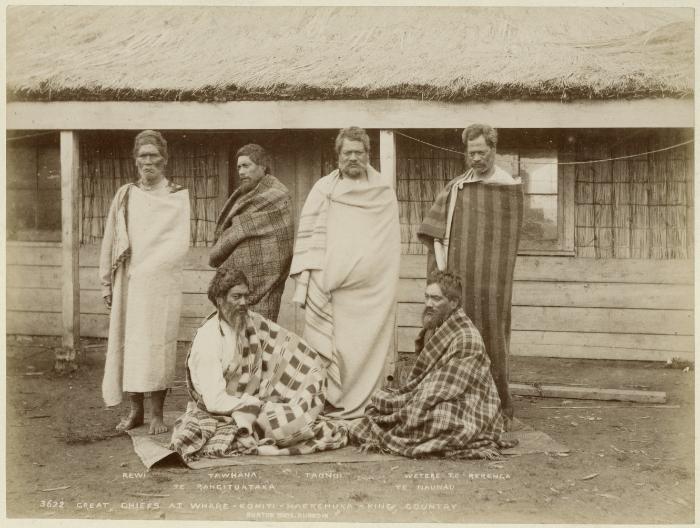
Ngāti Maniapoto and Ngāti Paretekawa fighting chief Rewi Manga Maniapoto lived at Ōtāwhao and Kihikihi, near Te Awamutu in the King Country. His father was Te Ngohi and his mother Te Kore. He married Te Rohu and they both survived their daughter, who died at Kihikihi around 1890-91.
Maniapoto was famed for his oratory skills, his tenacity in military campaigns, and his political acumen. His knowledge of Ngāti Maniapoto tradition and tikanga was significant.
Having earned a reputation as an effective leader during the New Zealand Wars of the 1860s – most notably in the battle at Ōrākau in 1864, when he is reputed to have cried out the now-famous line:
Ka whawhai tonu mātou, Ake! Ake! Ake!
We will fight on for ever and ever!
Maniapoto recognised by the end of the decade that violence would not resolve the differences between the Kīngitanga and the government. In November 1869, he made public his desire for peace, but it was not until 1878 that an agreement was reached with the government. In 1882, Maniapoto submitted to the jurisdiction of the Native Land Court, effectively breaching the policy of the Kīngitanga that he had previously championed.
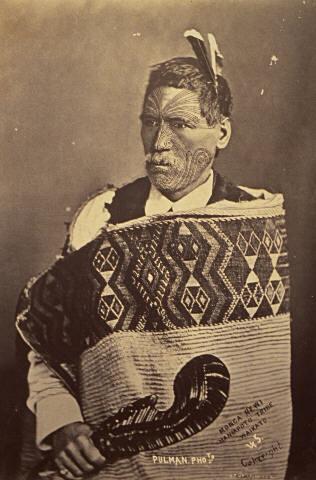
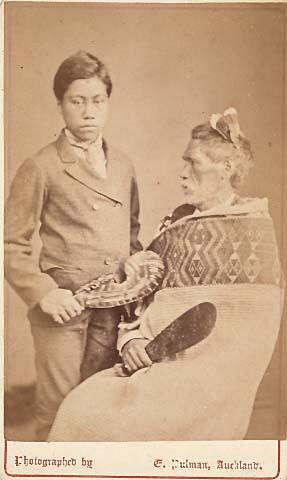
Maniapoto long resisted having his photograph taken, reportedly saying in 1875 ‘it was not proper for a great chief’s likeness to be sold for 1s [one shilling]’, as carte-de-visites were.1 He was nonetheless persuaded to sit not long after, as the source photograph for this portrait was taken by Elizabeth Pulman in 1879. There are two near identical photographs from this sitting where he assumes the pose repeated in the painting; in one Maniapoto holds a mere pounamu, and in another a wooden wahaika. In both he wears a kaitaka with an elaborate tāniko border, with a white collared shirt and waistcoat underneath.
By contrast in Lindauer’s painted portrait a striking kahu kurī is draped over his shoulders. These were constructed using a woven muka cloak as a base, onto which pieces of dog skin were arranged in patterns using a mixture of colours. This is seen in the dark border running beneath the tufted kurupatu of Maniapoto’s cloak. Further pieces of dog skin are seen ornamenting his hoeroa. This is the only instance in the Partridge collection in which a hoeroa is included and it was no doubt intended to indicate Maniapoto’s significant mana. Further, in his hair, he wears two tail feathers of the prized huia, which, as with his elaborate mataora and the valuable cloak, signal his high rank.
In April 1902, Te Ahipu Tukorehu, Maniapoto’s relative from Kihikihi, visited the Lindauer Art Gallery in Tāmaki Makaurau/Auckland and left a comment in the Māori Visitors’ Book:
He nui te koa o taku ngakau i toku ki tenga i taku tupuna i a rewi maniapoto me taku whakapai hoki ki a paateriti mo tana tiaki i nga whaka ahua o nga rangatira Maori.
I was so pleased to see my ancestor Rewi Maniapoto and my acknowledgements to Partridge for his work in taking care of these portraits of the Māori chiefs.
Tupotahi Tukorehu and Te Āroa, other uri of Maniapoto (noted respectively in another hand as his brother and cousin), visited the Lindauer Art Gallery a month later, leaving the following heartfelt comment:
Ko tā māua nei haere mai he hiahia kia kite i te whakaahua o Manga. heoi tangi ana maua ki nga whakaahua o Te Aa me Wahanui te tika o te whakaaro o te rangatira o nga whakaahua nei ki te whakaropu ia ratou ki te wahi kotahi
We are here because we wanted to see the painting of Manga. We wept at the images of Te Aa and Wahanui. The caretaker of these paintings was right to display them all at the same place]
Roger Blackley, ‘Taku Āhua I te Rākau Koura: Gottfried Lindauer’s Māori Portrait Commissions’, in Conal McCarthy and Mark Stocker, eds, Colonial Gothic to Māori Renaissance: Essays in Memory of Jonathan Mane-Wheoki , Victoria University Press, 2017, p 192.