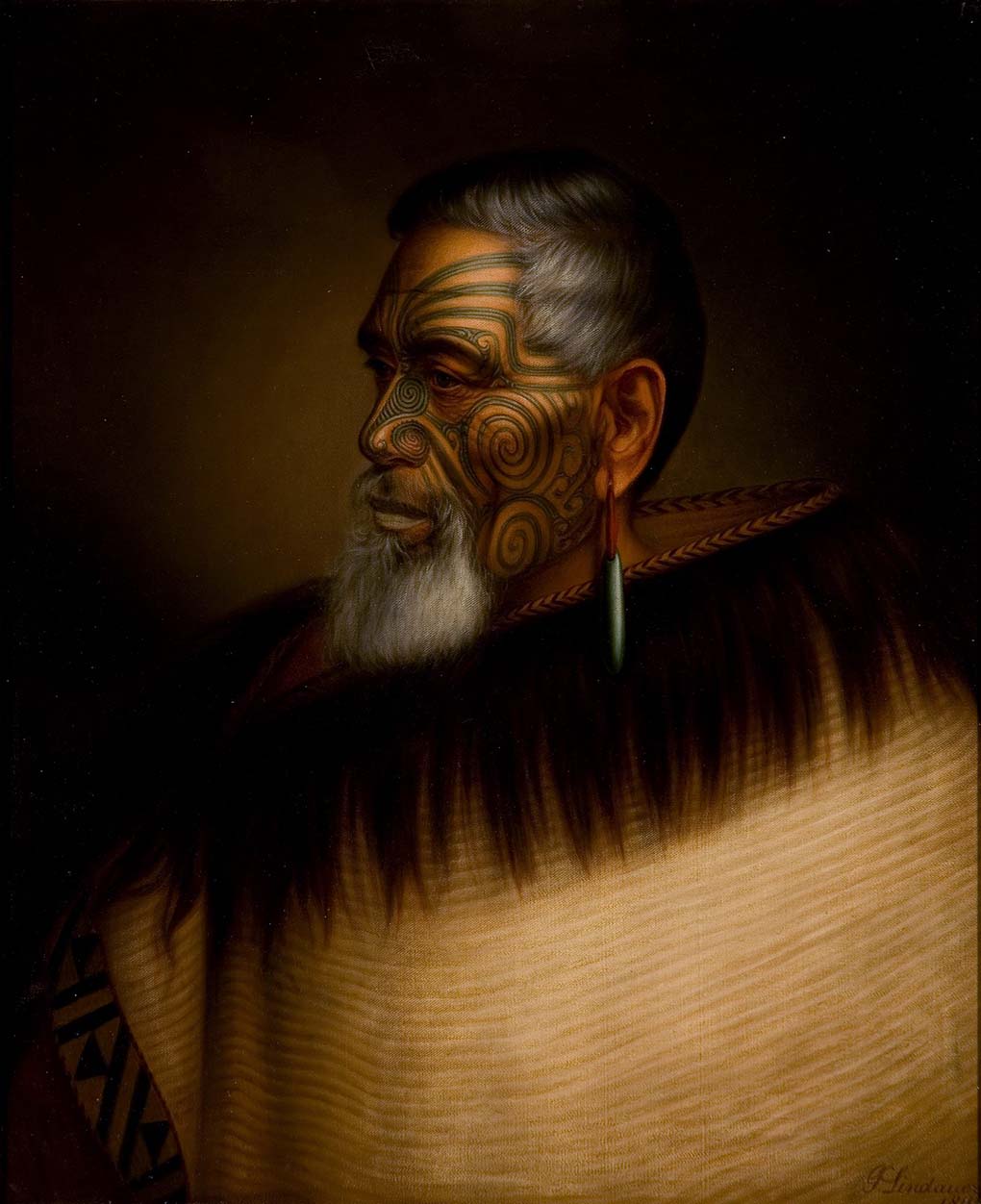
Retimana Te Mania
Ngāti Pāoa, Te Akitai
- Date
- 1895
- Medium
- oil on canvas
- Measurements
- 677 x 557 mm
- Other titles
- Retimana Te Mania, [title, 2026]Retimana te Mania, [1930 catalogue]Ritimana te Mania, [Deed of gift, 1915]Retimana Te Mania, [1901 catalogue]Oil Painting. Portrait of the Chief Retimana Te Mania, [copyright certificate, 1898]Chief Ritimana, Waikato, [Lindauer's inscribed title]
- Inscriptions
- Front, LR: G. Lindauer 1895Back, LR: Chief Ritimana, / Waikato
- Takiwā / region
- Waikato-ManiapotoTāmaki Makaurau
- Credit line
- Auckland Art Gallery Toi o Tāmaki, gift of Mr H E Partridge, 1915
- Accession no.
- 1915/2/31
Retimana Te Mania of Te Ākitai lived in the Manukau district. Until the commencement of the New Zealand wars in the Waikato, he was associated with kāinga at Māngere, Papakura, Tūākau and Pukekohe.1 Retimana and his people, including Mohi Te Ahi-ā-Te-Ngū, joined with King Tāwhiao and the Kīngitanga in 1863 to protect ancestral lands from confiscation by the Crown.2 At the conclusion of the Waikato conflict, however, the Kīngitanga forces were defeated and the lands seized.
In a biographical sketch sent to Henry Partridge, colonial administrator James Mackay commented that Retimana had ‘very little influence in his tribe’ – this diminishes him unfairly. While neither a fighting chief nor politician, Retimana instead supported the larger objectives of Māori at the time through negotiating authority over tribal lands and administration. We know that he belonged to a rūnanga of leading chiefs who sat at the table of the Kīngitanga.
Later in life, Retimana lived at Pūkākī, near present-day Māngere, and Ihumātao, close to what is now Auckland International Airport.
The exact source photograph has not been traced, but it resembles an Elizabeth Pulman image in which Retimana’s head is slightly turned, while Lindauer’s portrait presents him in near profile. In part shadow, the tīwhana lines are bathed in golden light. The incised markings of his mataora recede into the contours of his ageing, angular face. A pounamu ornament hangs from his left ear, resting at the top of a finely woven kaitaka, which features a thick fringe of black hukahuka.
‘Native Compensation Court’, Daily Southern Cross, 25 April 1865, p 5; ‘Compensation Court. – Monday. Before F. D. Fenton, Chief Judge; and J. Mackay, Esq.’, Daily Southern Cross, 16 May 1865, p5.
Tūhuatahi Tui Adams and Paul Meredith, ‘Ngāti Maniapoto – The Māori King movement’, Te Ara – the Encyclopedia of New Zealand, http://www.TeAra.govt.nz/en/ngati-maniapoto/page-4, accessed 13 July 2023.