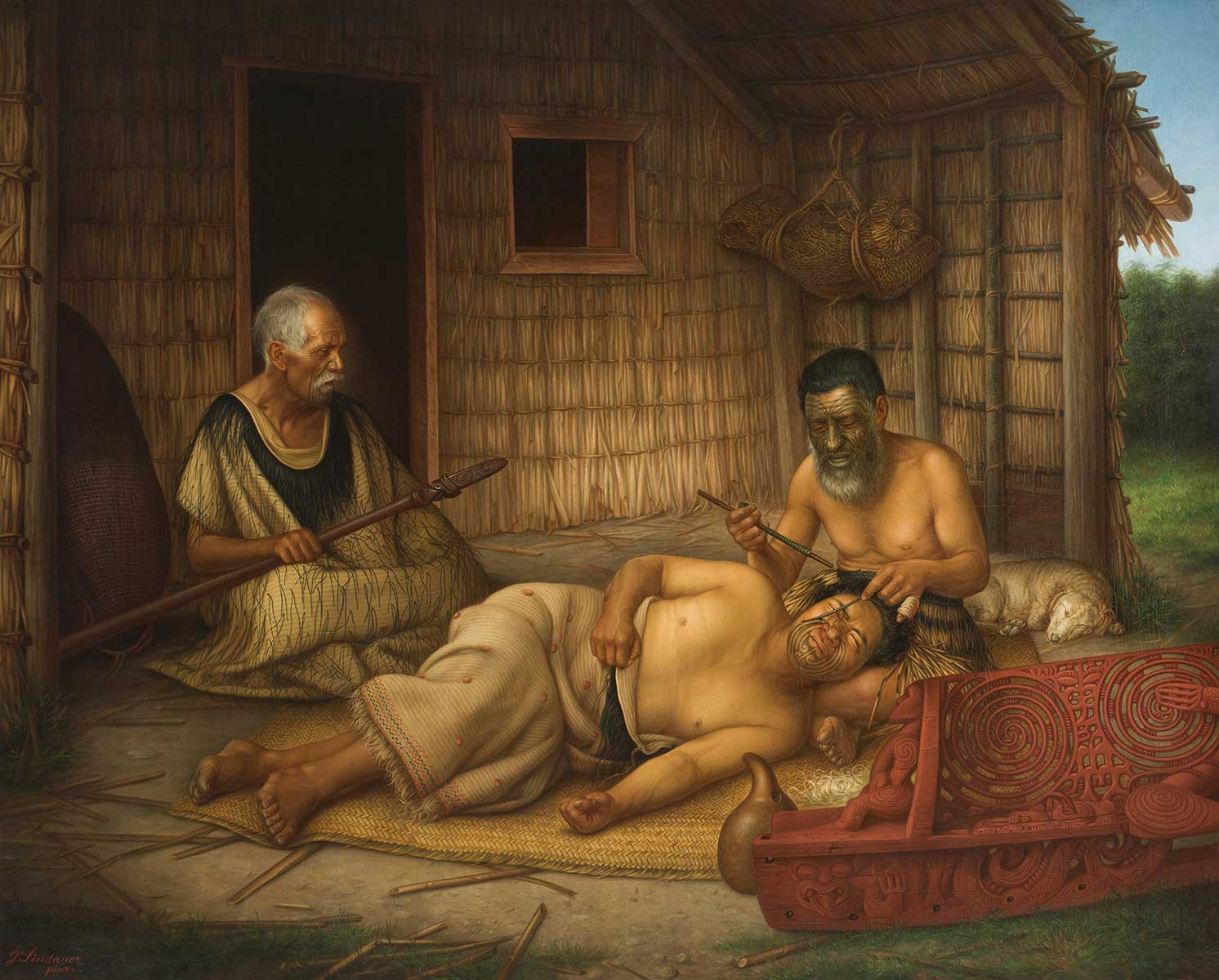
The Tohunga Tā Moko at Work
Tainui
- Date
- c 1904
- Medium
- oil on canvas
- Measurements
- 1886 x 2337 mm
- Other titles
- The Tohunga-ta-moko at Work, [title, pre-Sep 2026]Tattooing—The Tohunga-ta-moko at Work, [catalogue 1930]The Tohunga ta Moko at Work, [Deed of gift, 1915]Oil Painting of The Tohunga [Ta (in pencil in another hand)] Moko at Work, [copyright certificate, 1904]
- Inscriptions
- Front, G. Lindauer pinx (l.l.)
- Takiwā / region
- Waikato-Maniapoto
- Credit line
- Auckland Art Gallery Toi o Tāmaki, gift of Mr H E Partridge, 1915
- Accession no.
- 1915/2/49
Tā moko is the most distinguished of all Māori personal adornment practices. As captured in many of Gottfried Lindauer’s Māori portraits, the mataora and the moko kauae are some of the most striking features of the people in these paintings. They are important records of a unique tattooing knowledge that signifies nobility and authority in chiefs and distinguished people.
The Tohunga Tā Moko at Work is a large painted scene that offers a glimpse into the process and rituals associated with tā moko. Tohunga tā moko were esteemed by chiefs and leaders, set apart by their talent but also for their ability to maintain the integrity of the art form.
In the porch of a chief’s sleeping quarters, a tohunga tā moko is sitting above an anxious young chief whose head is resting on the tohunga’s lap as he receives his mataora. His hands are clenched and he is in obvious discomfort as he works through the pain and anticipates the next strike. The rhythmic tapping of the māhoe upon the uhi punctures the skin just enough to allow pigment to penetrate the surface, leaving lasting designs and symbolic patterns. These arrangements on the skin articulate a visual narrative that tells of the recipient’s lineage and status, personal accomplishments and social standing – information that crucially identifies the person’s place among others in society. Each area of the face – from the chin to the lower cheeks, from the forehead to the nose – carried a particular statement about that person.
The young chief is receiving the pāwaha, which are the long vertical lines that start at the top of the nostril and run along the cheeks to curve tightly under the top of the chin. He is halfway through the mataora process: we can see the full facial tattoo starting to take shape. He lies on a whāriki, a finely woven mat set aside especially for people of high rank. Scattered throughout the porch area are numerous outer shells of the raupō that was the favoured material for lining and cladding house structures. On the left is another tohunga holding a taiaha. This is Ngāti Maniapoto tohunga Winitana Tūpōtahi, residing over the ritual, offering incantations and chants for the safe and successful completion of the work.
By the time Lindauer painted this scene in 1904 the practice of applying mataora on young leaders had long ceased, and only men of an earlier generation wore full face markings.1 High-ranking young women still had moko kauae applied by tohunga tā moko however. In order to recreate the scene Lindauer must have turned to texts describing the practice as well as works by earlier artists including Louis-Auguste de Sainson, Augustus Earle and Louis Steele. A near exact model for this painting is seen in a watercolour by Horatio Robley who, despite living in New Zealand for only two years in the 1860s, spent his life devoted to researching tā moko, culminating in his 1896 publication Moko, or Maori Tattooing. A copy of his watercolour in the Alexander Turnbull Library, Wellington, includes the same basic compositional details of the three figures with a raupō whare behind, the white kurī adjacent to the tohunga tā moko, and the slightly unusual inclusion of a highly carved tauihu in the right foreground.2 Robley lived until 1930 but never returned to New Zealand, so whether he first chanced upon a photograph of Lindauer’s painting or Lindauer gained access to his watercolour is not clear, but The Tohunga Under Tapu by Lindauer also bears a close resemblance to another watercolour by Robley suggesting a direct association between the works and that one copied the other.
The practice of mataora stopped about 1865. David Simmons, The Art of Maori Tattoo, Reed, Auckland, 1986; revised edition 1999, reprinted 2002, p 150.
H G Robley, Moko and Whakairo, 1864 or later, watercolour, Alexander Turnbull Library, A-080-012 https://natlib.govt.nz/records/22724375.