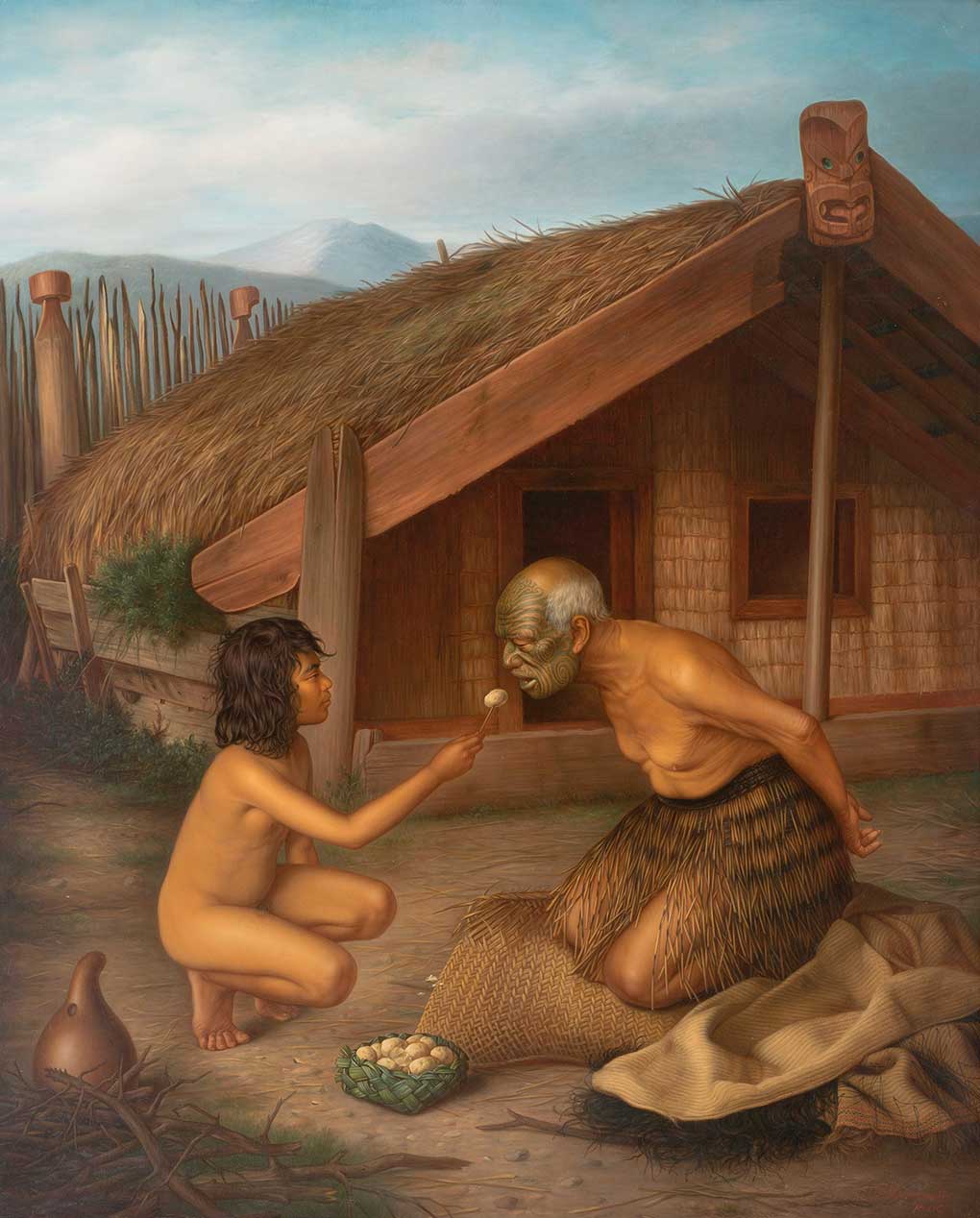
The Tohunga Under Tapu
- Date
- 1901
- Medium
- oil on canvas
- Measurements
- 2555 x 2080 mm
- Other titles
- Tohunga under Tapu, [title, pre-Sep 2026]The Tohunga Under Tapu, [catalogue 1930]The Tohunga Under Tapu, [Deed of gift, 1915]Oil Painting of Maori Maiden feeding Tohunga / Title Tohunga Under Tapu, [copyright certificate, 1902]The Tohunga Under Tapu, [1901 catalogue]
- Credit line
- Auckland Art Gallery Toi o Tāmaki, gift of Mr H E Partridge, 1915
- Accession no.
- 1915/2/50
The Tohunga Under Tapu was the first of the large scene paintings Lindauer completed for Partridge. It shows a tohunga ahurewa under a state of tapu. Lindauer made an earlier and smaller tohunga scene painting in 1898, which he titled ‘The Tohunga’; it is now known as Te Ao-katoa and is in the collection of the Whanganui Regional Museum. It depicts Waikato Tainui tohunga Te Aokatoa being fed cooked taewa on a stick.
Within te ao Māori the states of tapu and noa are complementary and of equal importance: one does not exist without the other. The observance of tapu and noa was integral to Māori society, making tohunga important figures; they were a small, elite group who were revered and feared, living apart from the community. In The Tohunga Under Tapu the tohunga is kneeling on a whāriki with his hands behind his back and is being tentatively fed cooked potato by a young girl using a bracken stalk. The tohunga was considered so tapu from the activities he was involved in that he could not touch food, which was considered noa, and feed himself. They are positioned in front of a small wharepuni with a carved koruru = at the gable apex. Behind them is the pā tūwatawata: the fortification is defined by the thick palisade posts. Beyond this a mountain range provides even greater depth and dimension to the image.
Like The Tohunga Tā Moko at Work this painting bears a close resemblance to a watercolour by Horatio Robley, simply entitled Tapu, in the Alexander Turnbull Library.1 All of the key compositional elements are in both works: from the poses of the two main figures and background raupō whare, to smaller details like the hue on the left and basket of steaming potatoes. Which artist copied the other is not entirely clear, but there is certainly an association between the two works.
H. G. Robley, Tapu [1863/4 or later], watercolour, Alexander Turnbull Library, A-080-003 https://natlib.govt.nz/records/22690532