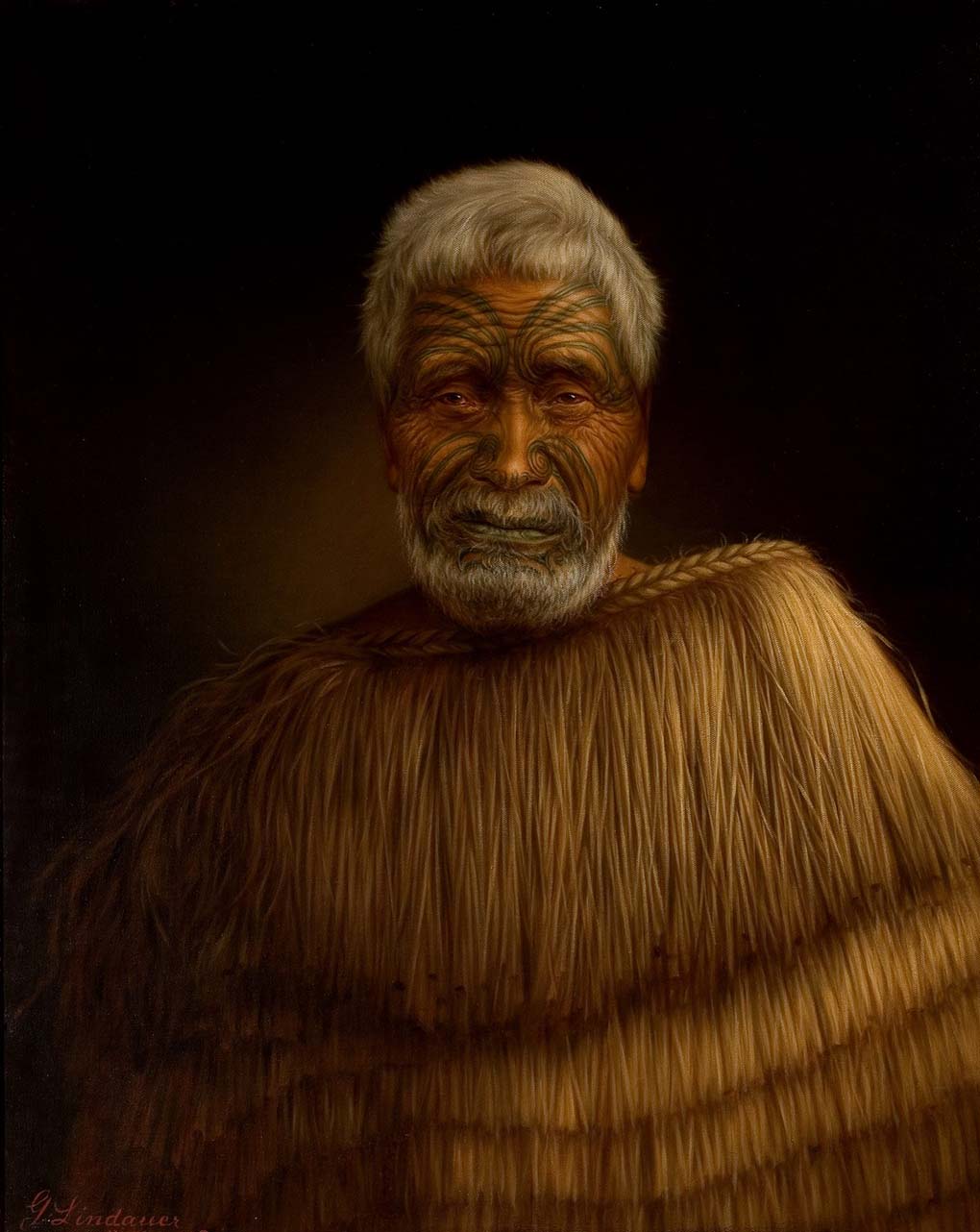
Tōkena Te Kerēhi
circa 1814 – 1904Ngāti Tūwharetoa
- Date
- 1903
- Medium
- oil on canvas
- Measurements
- 760 x 608 mm
- Other titles
- Tokena Te Kerehi, [title, 2026]Tokena te Kerehi, [1930 catalogue]Tokena te Kerehi, [Deed of gift, 1915]Oil Painting. Portrait of Maori Chief Tokena te Karetu [sic][copyright certificate, 1905]
- Inscriptions
- Front, LL: G. Lindauer pinx 1903Back, on lower stretcher bar, upside down in another hand, possibly McCahon: TOKENA TE KEREHI
- Takiwā / region
- Waiariki
- Credit line
- Auckland Art Gallery Toi o Tāmaki, gift of Mr H E Partridge, 1915
- Accession no.
- 1915/2/51
Ngāti Tūrumakina and Ngāti Tūwharetoa rangatira Tōkena Te Kerēhi was from the chiefly Te Heuheu line, the son of Herea Te Heuheu Tūkino I and the younger brother of Mananui Te Heuheu Tūkino II. Te Kerēhi was born at Pāmotumotu, near Tokaanu, and could trace his ancestry to Tamatekapua, leader of the Te Arawa waka.
Te Kerēhi also went by the names Karihi Te Kehakeha and Tōkena Te Kehakeha. He married Erina Te Huri and committed his life to Tūwharetoa business and politics, maintaining kinship ties and upholding traditional obligations between hapū and with iwi.
Te Kerēhi survived a great landslide at Te Rapa, Tokaanu, in 1846. The natural disaster struck on 7 May when torrents of earth swept down the Kākaramea mountain after heavy rain. His brother, Mananui, died in the event.1
In March 1891, Te Kerēhi gave evidence at the Native Land Courtwhere he stated: ‘I am an ancient man [pointing to the wrinkles on his face]. I want the Government to allow us to lease our lands, because if we are not allowed to lease, how can we pay the expenses incidental to subdividing the land and the surveys? It is because these sources of revenue are closed to us that we are compelled to cut off portions of land and give them to the Government.’2 He was referring to the process of forced surveys that required Māori to pay their costs. He described the offer of one shilling sixpence per acre of land as ‘a kōhuru’ of Māori people.
Te Kerēhi died in 1904 at Waihī, near Tokaanu, reputedly aged over 90 years old.3
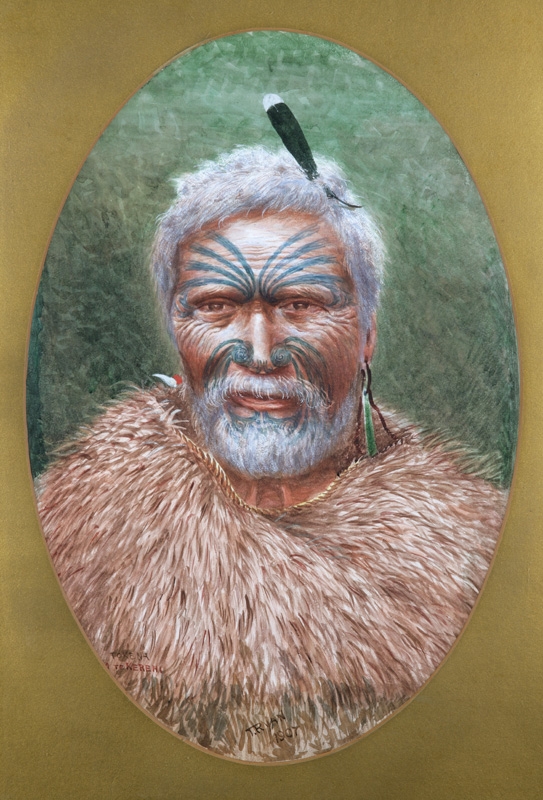
Lindauer’s portrait, painted just a year before Te Kerēhi died, closely resembles a hand-coloured photograph now in the collection of Auckland Museum which may have been the source.
Elizabeth Hura, ‘Te Heuheu Tūkino II, Mananui’, Dictionary of New Zealand Biography, first published in 1990, Te Ara – the Encyclopedia of New Zealand, https://teara.govt.nz/en/biographies/1t31/te-heuheu-tukino-ii-mananui, accessed 24 July 2023.
Tōkena Te Kerēhi, testimony recorded in the ‘Minutes of Meetings with Natives and Others’, Cambridge, 25 March 1891, in ‘Report of the Commission Appointed to Inquire into the Subject of the Native Land Laws’, Appendix to the Journals of the House of Representatives, session II, 1891, AG-1, p 13 [second set of numbering, following p 179].
‘News items’, Colonist, 27 June 1901, p 4.