Tūhoto Ariki
circa 1786 – 1886Tūhourangi, Ngāti Tarawhai
- Date
- 1894
- Medium
- oil on canvas
- Measurements
- 690 x 575 mm
- Other titles
- Tuhoto Ariki, [title, 2026]Tuhoto, [1930 catalogue]Tuhoto, [Deed of gift, 1915]Tuhoto, [1901 catalogue]Oil Painting. Portrait of Tuhoto (Tohunga of the Tuhourangi Tribe) Rotorua, [copyright certificate, 1898]Tuhoto, Tohunga Maori of the Tohourangi Tribe, Wairoa, aged 104 to 110 buried 5 days and nights in the mud, during the eruption of Mount Tarawera, 1886, [Lindauer's inscribed title]
- Inscriptions
- Front, LR: G. Lindauer pinx 1894Back, LL: G. Lindauer Pinx 1895 [note Lindaure has given different date on front and back]Back, LR: Tuhoto, Tohunga / Maori of the Tohouran/gi Tribe, Wairoa, aged / 104 to 110 buried 5 days & / nights in the mud, du/ring the eruption of Mt/ Tarawera, 1886.
- Takiwā / region
- Waiariki
- Credit line
- Auckland Art Gallery Toi o Tāmaki, gift of Mr H E Partridge, 1915
- Accession no.
- 1915/2/55
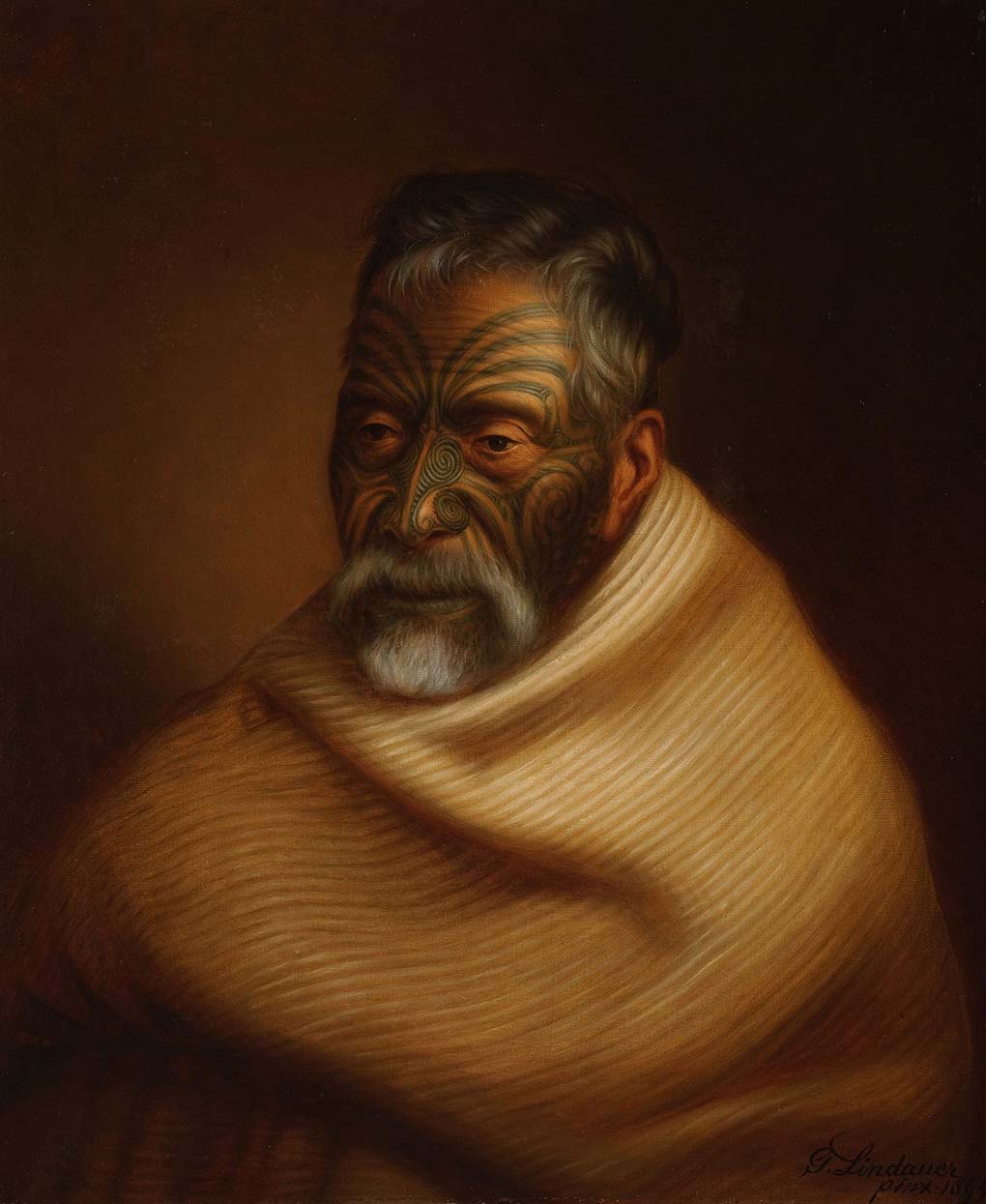
A tohunga of the Ngāti Tūhourangi and Ngāti Tarāwhai iwi, Tūhoto Ariki lived for some time on Mokoia Island in Lake Rotorua before making a permanent home at Te Wairoa, a village that at the time was the gateway to the Pink and White Terraces, known to Māori as Te Tarata.
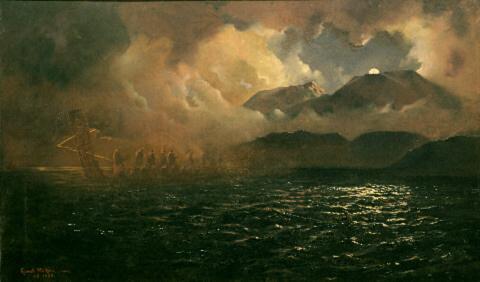
In mid-1886, Te Paea Hinerangi saw a ‘phantom waka’, which Tūhoto Ariki interpreted as a warning of impending disaster. This apparition was the subject of Kennett Watkins’ painting The Phantom Canoe: A Legend of Lake Tarawera, 1888, which is also in the Partridge Collection.
Just days later, on 10 June 1886, nearby Mt Tarawera erupted.1 The explosion was heard in Tāmaki Makaurau Auckland more than 200 kilometres away, and heavy showers of ash and pumice fell on the landscape as far as Whakatāne and Ōpōtiki 70 kilometres distant. The Pink and White Terraces were destroyed, vegetation was stripped away, and the village of Te Wairoa was completely devastated, with approximately 120 people losing their lives.
But on 14 June, four days later, a team of rescuers dug Tūhoto Ariki from his ruined whare, where he had been buried alive by ash and mud. He was treated at a hospital in Rotorua but died two weeks later.
In an obituary, Tūhoto Ariki was described as ‘the last of the ancient Maori priests, or tohungas, who, before the advent of Christian missionaries, had charge of all the religious concerns of the Maori race’.
Painted in 1894 Lindauer’s portrayal of Tūhoto Ariki is based on a photograph attributed to Elizabeth Pulman.
The painting closely follows the source image. Tūhoto Ariki is clad in a kaitaka, tightly wrapped around his shoulders. Interestingly, he is not adorned with any taonga tuku iho. However, befitting his status as a powerful tohunga, he wears a mataora extending from his chin to his forehead, where tīwhana radiate upwards and out from the bridge of his heavily tattooed nose. In the representation of Tūhoto’s tā moko, Lindauer must have taken some artistic license as the photograph did not manage to capture the lines and has been crudely retouched.
Eileen McSaveney, Carol Stewart and Graham Leonard, ‘Historic volcanic activity – Tarawera’, Te Ara – the Encyclopedia of New Zealand, http://www.TeAra.govt.nz/en/historic-volcanic-activity/page-2, accessed 25 July 2023. For more information on the Tarawera eruption, see the television documentary Tarawera, dir. Richard Riddiford, Messenger Films, 2000, http://www.nzonscreen.com/title/tarawera-2000, accessed 25 July 2023.