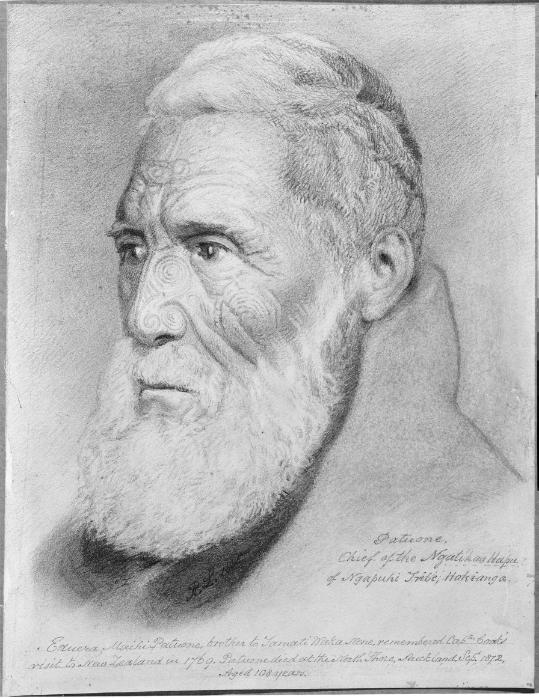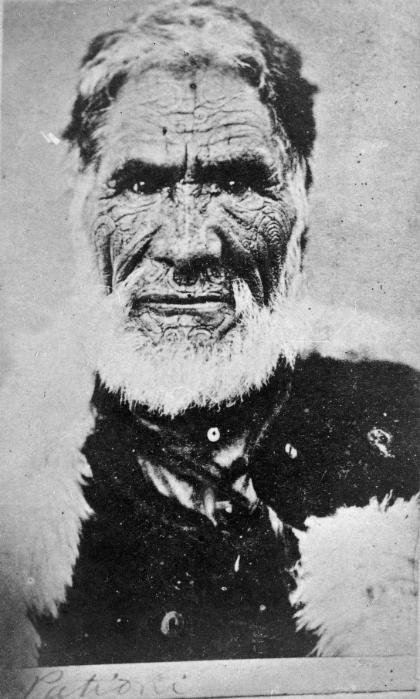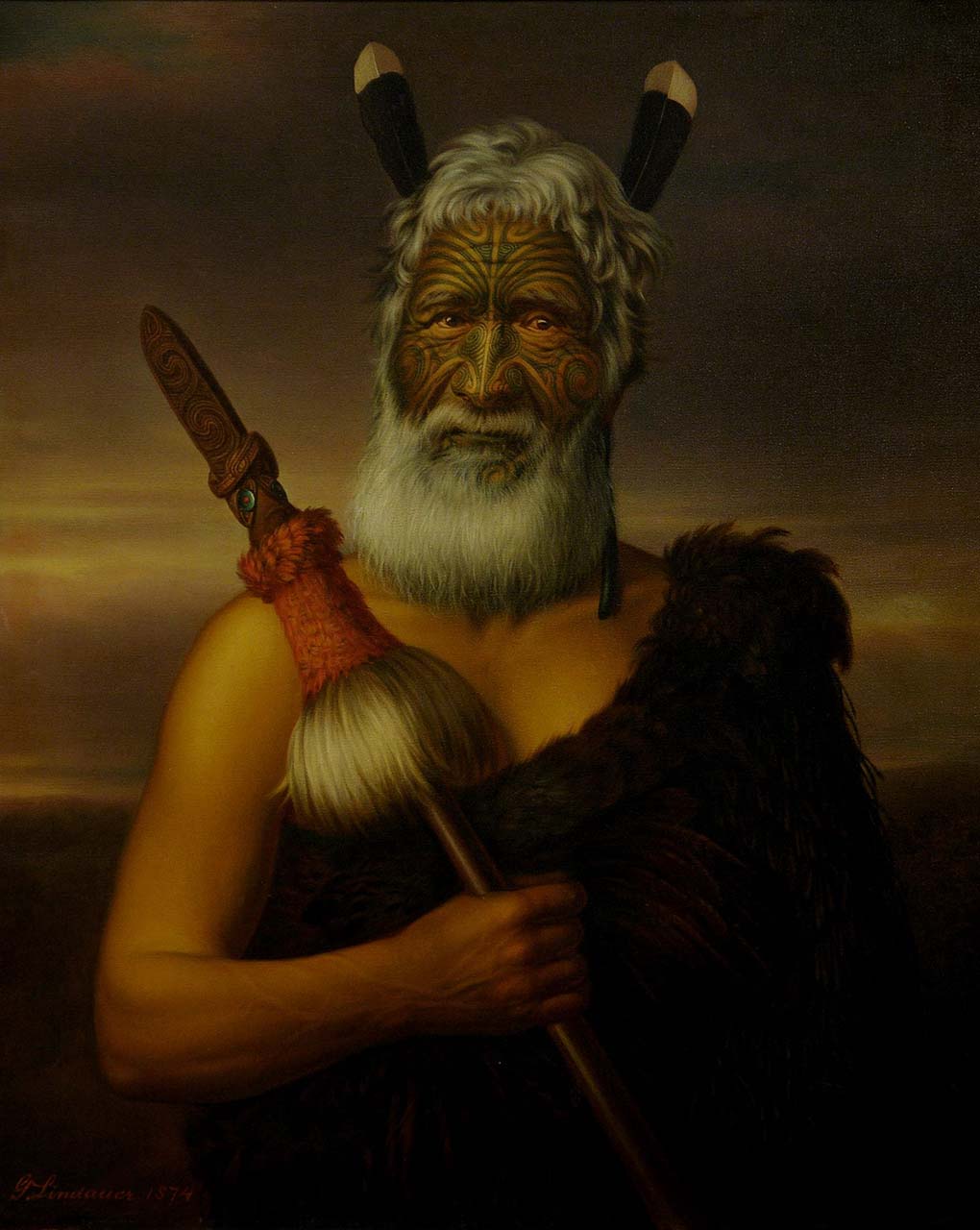
Eruera Maihi Patuone
? – 1872Ngāpuhi
- Date
- 1874 (backdated), possibly 1890
- Medium
- oil on canvas
- Measurements
- 838 x 692 mm
- Other titles
- Eruera Maihi Patuone, [title, 2026]Patuone, [1930 catalogue]Patuone, [Deed of gift, 1915]Patuone, [1901 catalogue]Oil Painting. Portrait of the Chief Eruera Maihi Patuone (Elder Brother of Tamata [sic] Waka Nene), [copyright certificate, 1898]Eruera Mahi Patuone Chief of the Ngapuhi Tribe. , [Lindauer's inscribed title]
- Inscriptions
- Front, LL: G. Lindauer 1874Back, LC: Eruera Mahi Patuone Chief of the Ngapuhi Tribe.Back, LR: G. Lindauer Pinx 1874
- Takiwā / region
- Te Tai Tokerau
- Credit line
- Auckland Art Gallery Toi o Tāmaki, gift of Mr H E Partridge, 1915
- Accession no.
- 1915/2/24
Eruera Maihi Patuone was the third son of Tapua, leader and tohunga of Ngāti Hao of Hokianga. Through his father, Patuone was descended from Rāhiri, ancestor of Ngāpuhi. Through his mother, Te Kawehau, he descended from Te Wairua, who was an ancestor of other significant Ngāpuhi rangatira: of Rewa (Mānu), Hongi Hika and Hone Heke. Patuone was also the elder brother of Tāmati Wāka Nene.1
Patuone’s name commemorates the deaths of his older brothers, Te Anga and Ruanui, who were killed on a beach in a skirmish, following Ngāpuhi expanding their boundaries. Patu is a close-combat weapon and can also mean ‘to be killed’. One is the beach or sand. Eruera Maihi was Patuone’s baptismal name – he was baptised as an Anglican on 26 January 1840. Eruera is the transliteration of Edward, as Maihi is for Marsh– Edward Marsh was missionary Henry Williams’ eldest son.2
Patuone’s first wife was Te Wheke. After her death in 1828, he married a second wife, Te Hoiia, whom he also outlived. His third wife was Riria Takarangi of Ngāti Pāoa. His fourth wife was Rutu of Ngāpuhi and Ngāti Hao.3
A noted warrior, Patuone fought in the Musket Wars during the early part of the 19th century, venturing as far south as present-day Wellington. He was also known as a skilled mediator. Patuone signed He Whakaputanga o te Rangatiratanga o Nu Tirene (the Declaration of Independence of the United Tribes of New Zealand) in 1836. He debated the merits of Te Tiriti o Waitangi with other rangatira on 5 February 1840, signing his name alongside an estimated 40 other chiefs the following day.4
Patuone died in 1872 at his residence on Tāmaki Makaurau’s North Shore and is buried on the slopes of Takarunga Mount Victoria at Devonport. At his tangi, it was observed that Pāora Tūhaere wore a mourning wreath of pōhue, and the wife of Chief Tionga of Ngāpuhi wore a wreath of kererū feathers.5 Estimates of Patuone’s age at his death varied between 96 and 112.
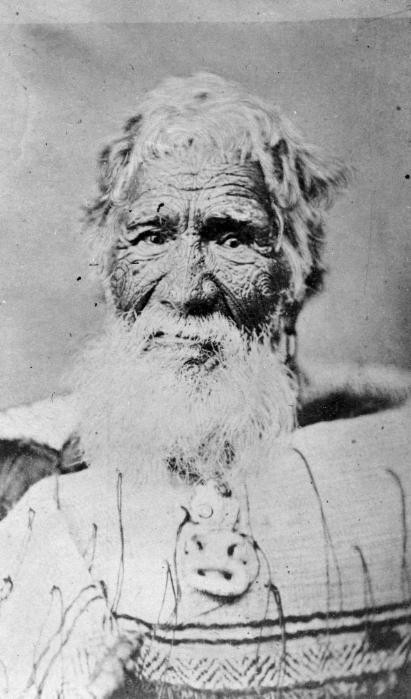
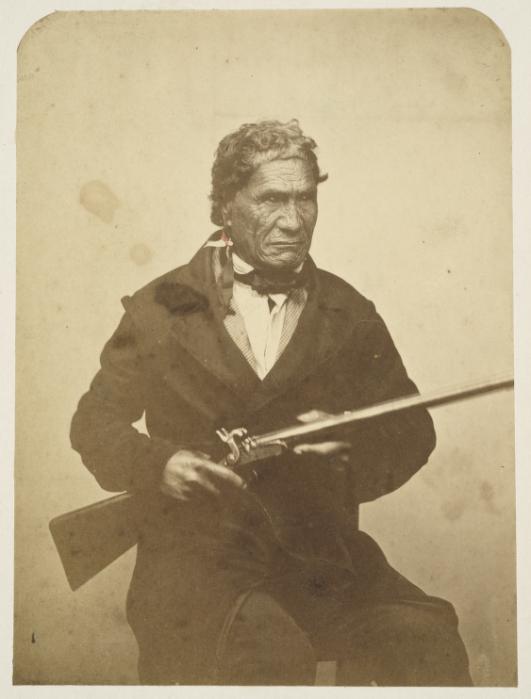
Lindauer’s posthumous portrayal of Patuone is based on a photograph by George Redfern taken in the year Patuone died. The background suggests a generalised landscape setting. Lindauer presented a venerable, resolute yet approachable rangatira with chiefly accoutrements – such as his two white-tipped huia feathers; his cloak with a kurupatu of red-brown feathers includes the wings of a bird laid flat on his chest; and a taiaha ornamented with white hair from the prized kurī and small orange feathers from the kākā. The painter has styled Patuone’s white hair and smoothed his white beard and moustache. Patuone’s aged face bears the ultimate chiefly symbol of a leader, his mataora.
- Angela Ballara, 'Patuone, Eruera Maihi ? - 1872', Dictionary of New Zealand Biography, updated 22 June 2007, accessed 2 March 2010.
- Personal communication with Benjamin Pittman, 23 November 2009.
- Personal communication with Benjamin Pittman, 23 November 2009.
- Rawiri Taonui, ‘Ngapuhi – Early European Contact’, Te Ara – The Encyclopedia of New Zealand, updated 4 March 2009, accessed 2 March 2010.
- Rawiri Taonui, ‘Ngapuhi – Early European Contact’, Te Ara – The Encyclopedia of New Zealand, updated 4 March 2009, accessed 2 March 2010.
- ‘Patuone’s Funeral’, Daily Southern Cross, vol XXVIII, issue 4706, 23 September 1872, p 2, Papers Past, accessed 2 March 2010.