Heta Te Haara
? – 1894Ngāpuhi
- Date
- 1896
- Medium
- oil on canvas
- Measurements
- 838 x 698 mm
- Other titles
- Heta Te Haara, [title, 2026]Heta Te Haara, [1930 catalogue]Heta te Haara, [Deed of gift, 1915]Heta Te Haara, [1901 catalogue]Oil Painting. Portrait of the Chief Heta Te Haara Ohaewai, [copyright certificate, 1898]Chief Heta te Haara / Ohaewai, [Lindauer's inscribed title]
- Inscriptions
- Front, LL: G. Lindauer Pinx 1896Back, C: "G. Lindauer Pinx 1896 Chief Heta te Haara | Ohaewai"
- Takiwā / region
- Te Tai Tokerau
- Credit line
- Auckland Art Gallery Toi o Tāmaki, gift of Mr H E Partridge, 1915
- Accession no.
- 1915/2/7
Ngāti Rangi rangatira Heta Te Haara was a prominent Ngāpuhi chief. He lived much of his life at Ōhaeawai, the site of one of the last significant battles between northern Māori and British forces, fought on 1 July 1845. In 1872, Te Haara initiated transferring the remains of the British soldiers killed in the battle. Disinterred from unmarked graves, their remains were relocated to a new gravesite within the bounds of the pā.
Te Haara was one of the final Ngāpuhi chiefs to sign Te Tiriti o Waitangi.1 In 1887, he joined other northern chiefs in asserting Māori rights guaranteed by Te Tiriti, urging the government to leave Māori to manage their own affairs. He became the chairman of the Ngāpuhi Kotahitanga congregation formed in Kaikohe on 15 April 1891, which sought to unify Ngāpuhi, Te Rarawa, Ngāti Whātua and Te Aupōuri.2 This movement was effectively the first effort to form a Māori parliament.
Te Haara was a man of considerable standing in the Far North and his 1894 funeral procession consisted of some 600 to 700 Māori mourners and was reported to have extended for more than one mile.
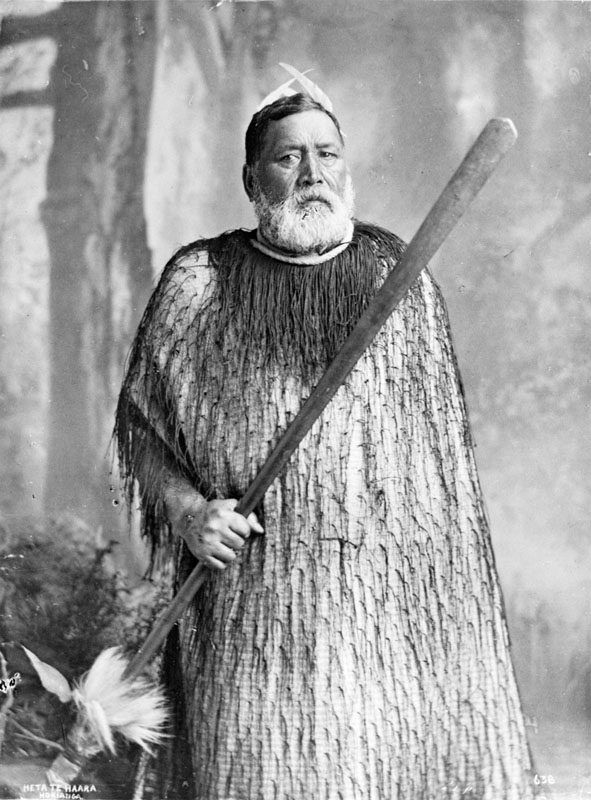
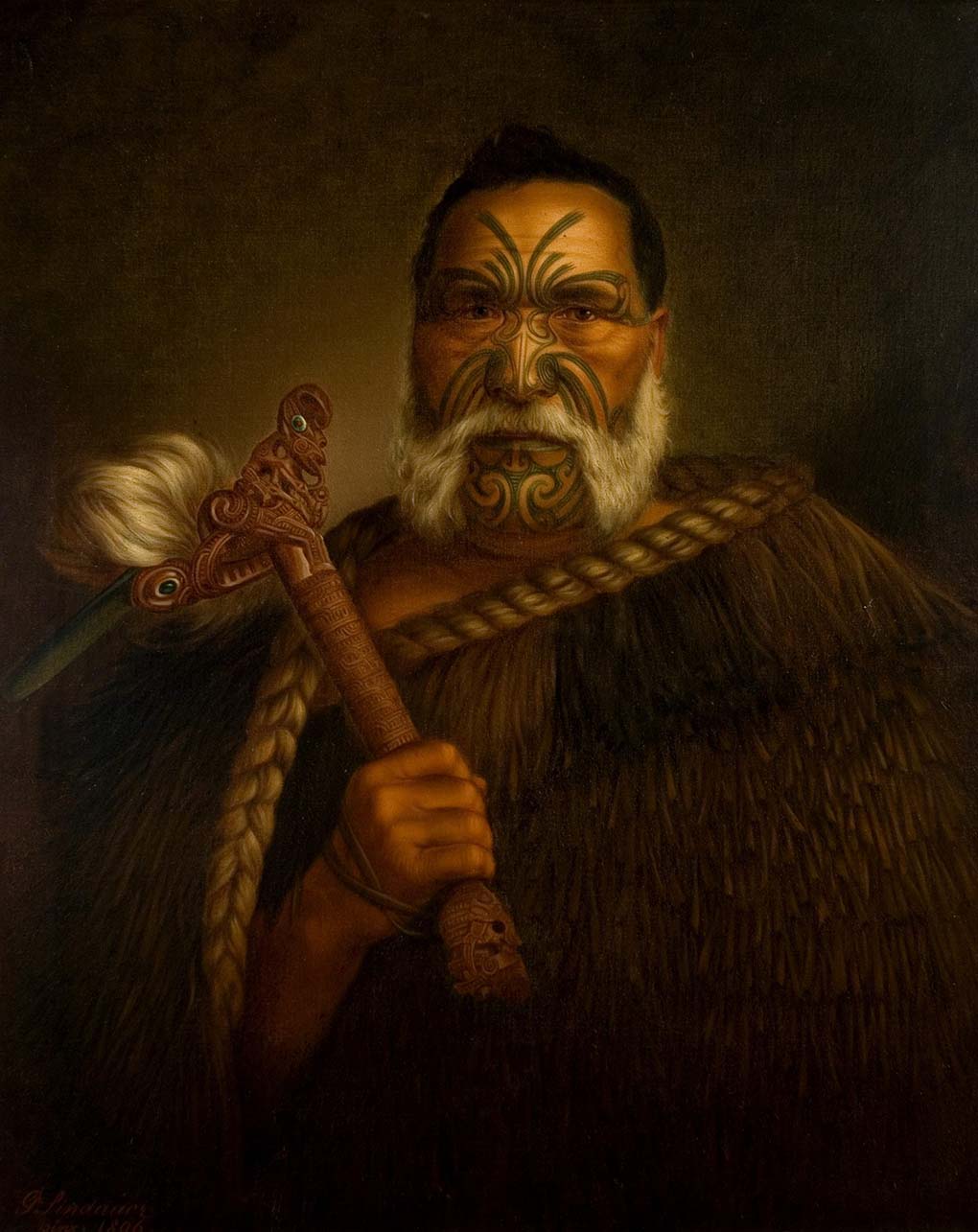
Based on an photograph from the Pulman studio in Auckland, likely taken about 1889 when its copyright was registered, Lindauer’s painting emphasises Te Haara’s chiefly status, most notably through his mataora. Though Lindauer’s rendering of it differs significantly from that seen in the Pulman portrait (itself retouched on the negative), particularly around the chin.3
Te Haara holds a splendid toki pounamu and is shown wearing a kahu tōī, a type of cloak reserved for warriors. This is similar to the cloak in the Pulman photograph, but also shows a thick kurupatu suspended from the woven and braided hem.
On 20 June 1902, Eru Tahere of Kaikohe visited the Lindauer Art Gallery in Tāmaki Makaurau Auckland and left this comment in the Māori Visitors’ Book:
- Ka nui taku whakapai i taku kitenga i enei tangata, i a Heta ara i a rātou katoa.
- I am very pleased to have seen these people, Heta and all the others.
John Wilson, ‘Nation and government – The origins of nationhood’, Te Ara – The Encyclopedia of New Zealand, http://www.TeAra.govt.nz/en/nation-and-government/page-1, accessed 8 June 2023.
‘The Kaikohe Native Meeting’, Northern Advocate, 22 April 1891, p 2.
E. Pulman, ‘Copyright files: 12 Maori Portraits’, registered 1889, Archives NZ, R24024952.