![James Carroll [Hon, MLC, later Sir]](https://cdn.aucklandunlimited.com/lindauer/assets/media/hon-sir-james-carroll-image.jpg)
James Carroll [Hon, MLC, later Sir]
1857 – 1926Ngāti Kahungunu ki te Wairoa
- Date
- 1901 or before
- Medium
- oil on canvas
- Measurements
- 510 x 434 mm
- Other titles
- Hon James Carroll, [title, 2026]Hon. Sir James Carroll, [1930 catalogue]Hon. James Caroll, [Deed of gift, 1915]The Hon. James Carroll, [1901 catalogue]Oil Painting of The Hon. J. Carroll. Native Minister, [copyright certificate, 1902]Hon: J. Carroll (Native Minister), [Lindauer's inscribed title]
- Inscriptions
- Front, LR: G. LindauerBack, LC: Hon: J. Carroll (Native Minister)
- Takiwā / region
- Takitimu
- Credit line
- Auckland Art Gallery Toi o Tāmaki, gift of Mr H E Partridge, 1915
- Accession no.
- 1915/2/10
No te ao te hua-ra-tanga
Riro ki te po
What tender thoughts of thee arise
My chieftain vanished in the night1
So began the waiata tangi chanted at the funeral in 1926 of Sir James Carroll, famed orator and much respected politician.
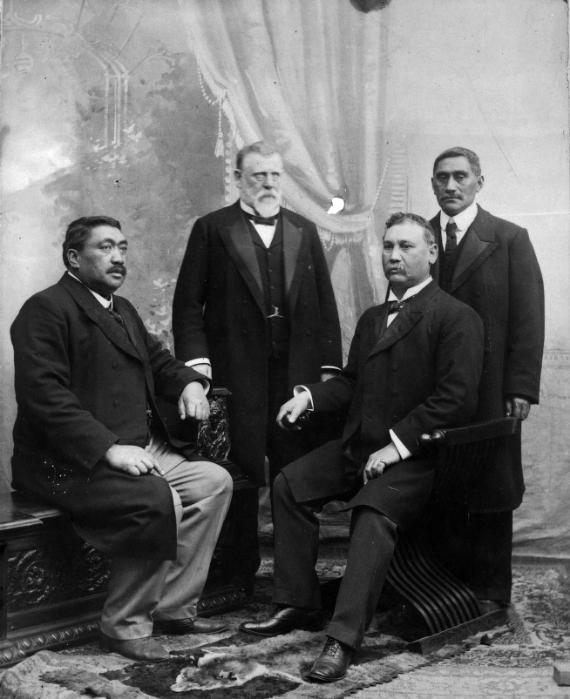
Known to Māori as Timi Kara, Carroll was born in Wairoa in the northern Hawke’s Bay. His father, Joseph Carroll, was an Australian immigrant of Irish descent, and his mother, Tapuke, a woman of mana from Ngāti Kahungunu. One of eight children and raised bilingual, Carroll was educated in mātauranga Māori by his mother and in English language at the native school in Wairoa. He married Hēni Materoa (Te Huinga) in 1881 and the couple settled in Tūranga Gisborne.
Carroll started his working life as a junior in the government’s Native Department. Between 1879 and 1883, he was an interpreter for the House of Representatives, beginning his lifelong involvement in politics. He gained the Eastern Māori seat in 1887, campaigning for the control of Māori land by Māori. In particular, he argued for leasing rather than selling to ensure a stable income for iwi.
Carroll became close to Premier Richard Seddon and supported his controversial legislation relating to the compulsory sales of Māori land. While holding the general seat of Waiapu (1893–1919), he was twice acting prime minister and managed the Native Affairs portfolio for 13 years.
Carroll stood for compromise and was highly regarded as a persuasive speaker. He opposed aspects of Te Kotahitanga, Māori self-government, for practical reasons and because his aim was ‘essentially . . . empowering Māori within modern economic life and securing their equality with Pākehā’.2
In the 1911 Coronation Honours, King George V appointed Carroll a Knight Commander of the Order of St Michael and St George (KCMG).
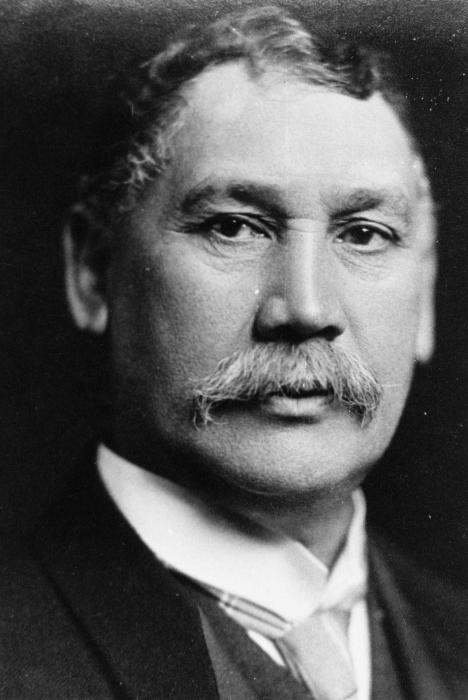
Lindauer’s portrait of Carroll, likely based on a formal portrait taken in his early to mid-parliamentary career, shows him as a statesman. Greying hair swept back, he is depicted in attire that is elegant but simple, reflecting his pragmatic, hands-on character.
Maui Pomare and James Cowan, Legends of the Maori, vol 1, Southern Reprints, 1987, p 318, New Zealand Electronic Text Collection Te Pūhikotuhi o Aotearoa, Victoria University of Wellington, https://nzetc.victoria.ac.nz/tm/scholarly/tei-Pom01Lege-t1-body3-d5.html#n318, accessed 24 July 2023.
Alan Ward, ‘Carroll, James’, Dictionary of New Zealand Biography, first published in 1993, Te Ara – the Encyclopaedia of New Zealand, https://teara.govt.nz/en/biographies/2c10/carroll-james, accessed 14 June 2023.