Kai Time
- Date
- 1907
- Medium
- oil on canvas
- Measurements
- 1795 x 2000 mm
- Other titles
- The Time of Kai, [title, pre-Sep 2026]The Time of Kai, [catalogue 1930]Kai time, [Deed of gift, 1915]Oil Painting Kai Time or the modern Maori at home, [copyright certificate, 1913]
- Inscriptions
- Front, G. Lindauer 1907 (l.r.)
- Credit line
- Auckland Art Gallery Toi o Tāmaki, gift of Mr H E Partridge, 1915
- Accession no.
- 1915/2/48
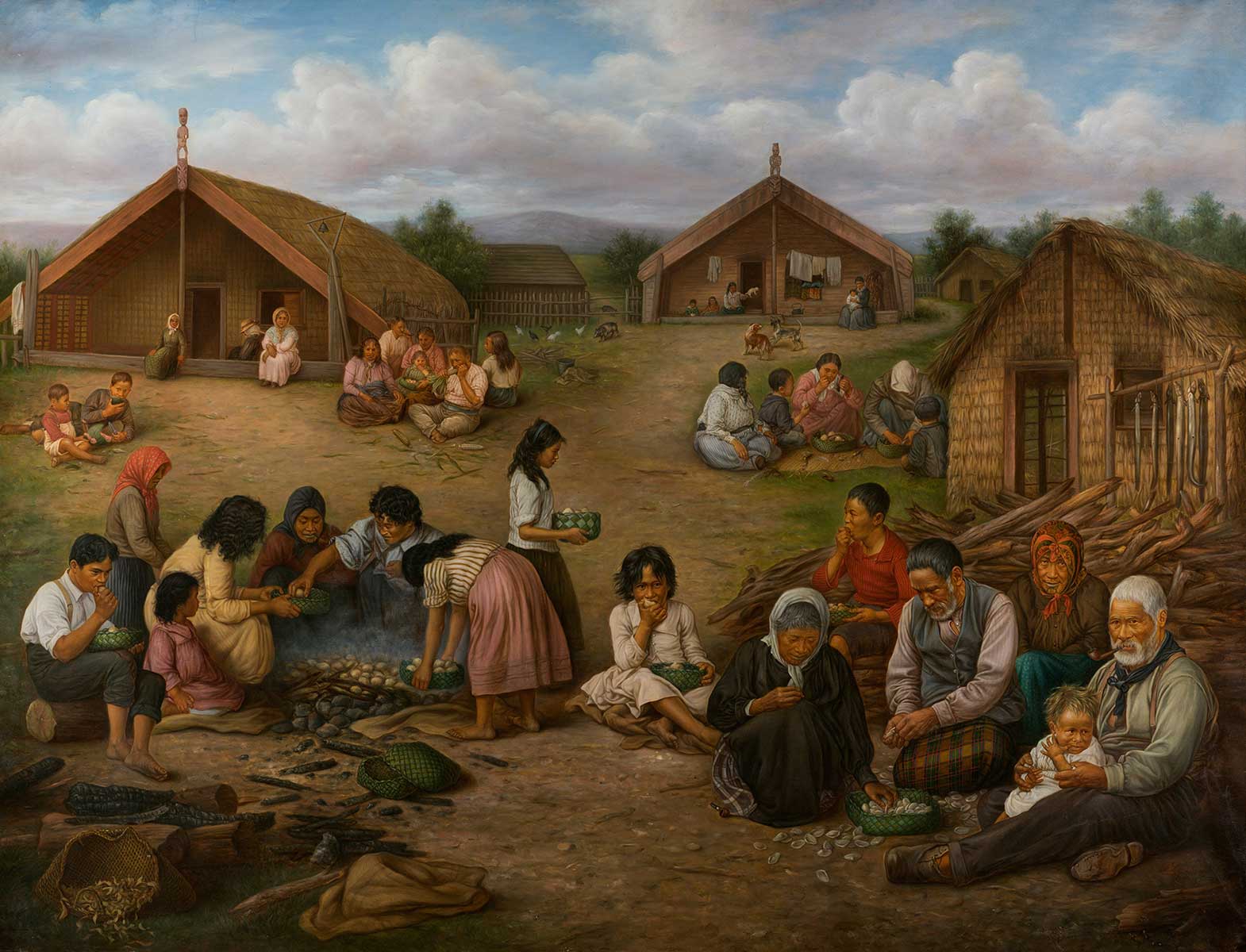
Kai Time is one of Lindauer’s more ambitious scene paintings, and one of three commissioned by Henry Partridge in 1907. It illustrates pā life in which family and kin groups gather for kai: everyone is depicted in activities focused around food. The steam rises from an open hāngi, signalling the kai is cooked and ready to distribute. Individuals gather, and small woven kono of the type illustrated in Lindauer’s earlier painting Wāhine and Kōhine Making Kete s are used to distribute the evening’s kai to whānau groups. A wide range of food is depicted: corn cobs, cooked pipi and tuatua, taewa and ika. There is even merengi being sliced and shared between two young boys sitting in the top left, while a line of tuna are drying by the kāuta to the far right. Elsewhere washing is drying in the mahau of the meeting house at the centre back and kunekune pigs chase hens and kurī play in the courtyard in front.
Lindauer presents a busy scene that is somewhat reminiscent of a 16th-century Bruegel genre painting with its arrangement of activities and characters, and its muted colours. Interestingly, everybody in Kai Time is shown wearing European clothing exclusively, unlike the other genre paintings in which Lindauer uses customary Māori dress and attire to support his narrative. Kai Time takes a different approach. It presents Māori society in a time of transition: life and customs are very much in a time of change here. Next to the wharenui at top left is a bell hanging in a belfry which would be used to signal religious services, illustrating the influence of Christianity and missionary contact.
Lindauer’s use of source photography is again evident in this work. However, it takes on a new element here. A photograph of his son Hector was the source image for the young boy seated on a log eating a potato from a kono, and his wife Rebecca was the model for the kuia wearing a red scarf around her head and looking directly at the viewer. These source photographs are held by Lindauer’s descendants. It is intriguing that the painter has put these portraits into the painting but historically it was common for artists to use family members as models.