Keeta Te Kani
Te Atiawa
- Date
- c 1910
- Medium
- oil on canvas
- Measurements
- 935 x 470 mm
- Other titles
- Keeta, [title, 2026]Keeta (Kate), [1930 catalogue]Keeta (Kate), [Deed of gift, 1915]Painting Portrait of Chieftainess Keeta, [copyright certificate, 1913]Keeta Oukiora [sic TBC][Lindauer's inscribed title]
- Inscriptions
- Front, LR: G. LindauerBack, Keeta Oukiora [TBC]
- Takiwā / region
- Te Tai Hauāuru
- Credit line
- Auckland Art Gallery Toi o Tāmaki, gift of Mr H E Partridge, 1915
- Accession no.
- 1915/2/16
Very little is known about Keeta Te Kani, other than she was from Ōākura on the south side of Ngāmotu New Plymouth. She married Aterana Te Kani of Manukorihi from northern Taranaki and died at Arapāoa Island in Queen Charlotte Sound Tōtaranui, near Waitohi Picton. Her Te Atiawa people from Waitara had lands that stretched from Taranaki to Waikanae to Whakatū Nelson.
According to James Cowan, Keeta took part in the disruption of surveying, ploughing and fencing on land in Waitara, delaying the mapping of Māori land for Pākehā purchase. In 1860 the dispute set off the New Zealand Wars in Taranaki with consequent Crown land confiscations, which continued until 1881.1 Wider Te Atiawa resistance to raupatu led to the historic legacy of passive resistance at Parihaka.
Lindauer settled briefly in Taranaki, sent there in September 1874 as a ‘gardener’ under the Government’s assisted migrant scheme that brought him to New Zealand, but he did not remain long.2 It therefore seems highly unlikely he met Keeta, especially as a copy of the exact source image of her portrait is found in an album that can be dated to 1863–64. The album belonged to Spencer Nicholl, an ensign in the 43rd Oxfordshire Light Infantry; it includes other photographs of people and places in Taranaki including ‘Oakura Redoubt’ and other military encampments.3 Inscribed beneath the portrait of Keeta is the description ‘Taranaki Maories [sic] owners of several 100 Turkeys’.
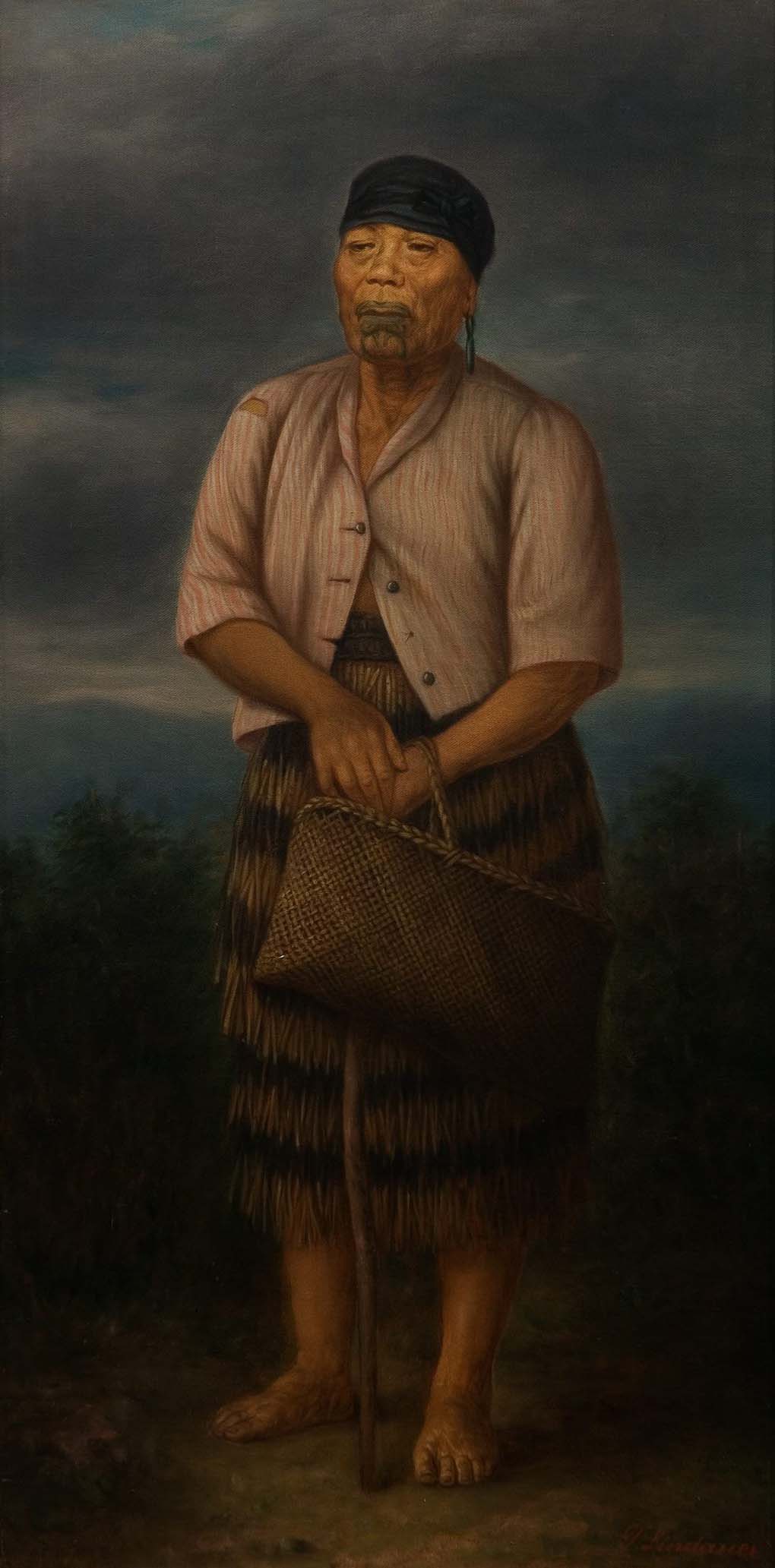
Keeta is painted as a full-length portrait, leaning forward on her tokotoko, holding a kete and looking into the distance. Her hair is held in place by a headscarf and she wears a European shirt. In the original photograph she appears to wear a type of pake around her lower half , which Lindauer interpreted as a piupiu (waist garment made of flax strands). Her moko kauae cannot be seen in the source photograph but its inclusion in the painting suggests she was a woman of standing.
John Wilson, ‘History – War, expansion and depression’, Te Ara – the Encyclopedia of New Zealand, https://teara.govt.nz/en/history/page-4, accessed 7 June 2023.
‘Immigrants Per “Reichstag”’, Taranaki Herald, 2 Sep 1874, p 2.
Spencer Perceval Talbot Nicholl album 2, Alexander Turnbull Library, PA1-Q-177, p 32.