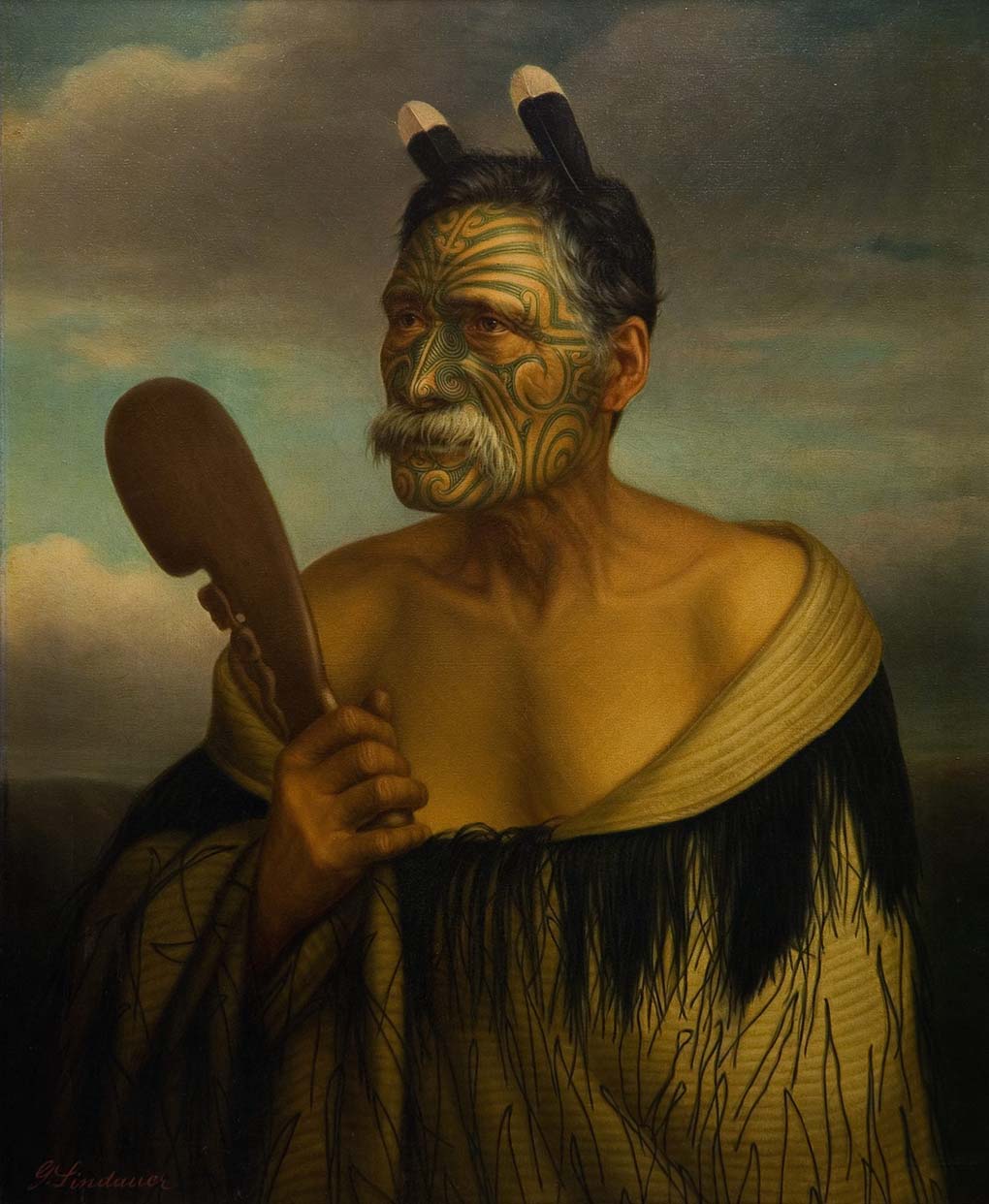
Kewene Te Haho
? – 1902Ngāti Whāwhākia, Ngāti Hauā, Ngāti Naho
- Date
- 1901 or before
- Medium
- oil on canvas
- Measurements
- 850 x 700 mm
- Other titles
- Kewene Te Haho, [title, 2026]Kewene te Haho, [1930 catalogue]Kewene Te Haho, [Deed of gift, 1915]Kewene Te Haho, [1901 catalogue]Oil Painting of the Maori Chief Te Kewene Te Aho, [copyright certificate, 1902]"Te Kewene te Aho" Raglan, Waikato., [Lindauer's inscribed title]
- Inscriptions
- Front, LL: G. LindauerBack, LC: "Te Kewene te Aho" Raglan, Waikato.
- Takiwā / region
- Waikato-Maniapoto
- Credit line
- Auckland Art Gallery Toi o Tāmaki, gift of Mr H E Partridge, 1915
- Accession no.
- 1915/2/17
Kewene Te Haho was a member of the Ngāti Naho iwi, and also affiliated to Ngāti Hauā and Ngāti Whawhakia. He is reported to have died in July 1902, aged nearly 90, at his home at Mākākā, on the shores of Aotea Harbour.1
Te Haho fought in the 1830 Taumatawiwi battle between Te Waharoa of Tainui and Ngāti Maru of Hauraki. In 1835 and 1836, he accompanied Te Waharoa on a fighting excursion to Rotorua and Maketū.2
Although Te Haho remained neutral during the New Zealand Wars in the Waikato between the British and the Kīngitanga, he later accepted King Tāwhiao’s invitation to join his council.
As a member of the Wesleyan congregation, Te Haho acted as a lay reader in his local church. Seeing the harmful influence of alcohol, in 1876 he encouraged a temperance movement among his people and urged them to embrace education. In 1893, with other chiefs, Te Haho travelled to Wellington and met with the governor, Sir David Boyle Earl of Glasgow, to voice their concerns about new legislation affecting Māori land rights.
Lindauer’s portrait shows Te Haho as a dramatic figure against a brooding sky, wearing a korowai hukahuka around his shoulders. His mataora is comprised of many lines which are each individually named, for example the tīwhana are the forehead lines that radiate from the centre of his brow across his temple. In his hair, Te Haho wears two white-tipped tail feathers of the prized huia. In his right hand is a large wooden wahaika, decorated along one edge with a tupuna figure – a taonga reflecting his standing in his community.
This portrait was exhibited at the Louisiana Purchase Exposition in 1904.3
Te Haho signed the Māori Visitors’ Book at the Lindauer Art Gallery on 30 January 1902, some six months before his death, but did not leave a comment.
‘Death of a Noted Maori Chief’, West Coast Times, 22 July 1902, p 3.
‘News and Notes’, Hawera & Normanby Star, 25 July 1902, p2.
Waikato Museum Te Whare Taonga o Waikato hold a version of this portrait but it was determined to be a forgery in 2012 with the attribution changed to unknown artist. https://collection.waikatomuseum.org.nz/objects/21604/kewene-te-haho, accession number 2001/2/3. Chris Gardner, ‘The $120k Art Mystery’, Waikato Times, 15 October 2012.