![Pakewa [previously identified as Te Rangipikinga]](https://cdn.aucklandunlimited.com/lindauer/assets/media/kuinioroa-daughter-of-rangi-kopinga-te-rangi-pikinga-image.jpg)
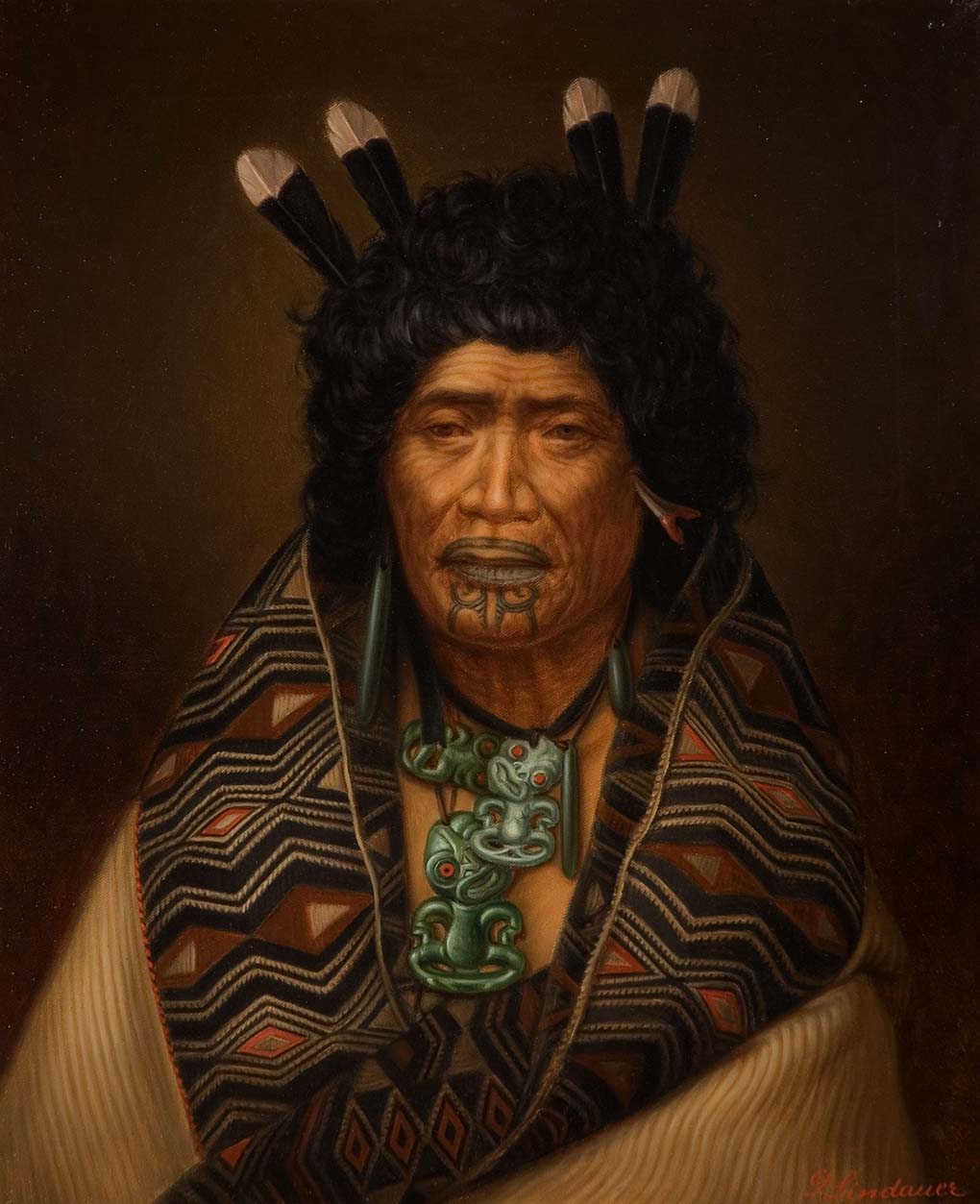
Pakewa [previously identified as Te Rangipikinga]
Te Atiawa
- Date
- c 1910
- Medium
- oil on canvas
- Measurements
- 614 x 514 mm
- Other titles
- Kuinioroa, Daughter of Rangi Kopinga – Te Rangi Pikinga, [title, pre-2026]Te Rangi Pikinga, [1930 catalogue]Kuinioroa (Rangihaeata's wife), [Appended in pencil] Te Rangi Pikinga, [Deed of gift, 1915]Painting Portrait of Chieftainess Kuinioroa (daughter of Rangi Kopenga Ariki[)][copyright certificate, 1913]Daughter of Rangikopinga, Queenieroa - Ariki - Ngatiraukawa, [Lindauer's inscribed title]
- Inscriptions
- Front, LR: G. LindauerBack, LC: Daughter of Rangikopinga / Queenieroa - Ariki - NgatiraukawaBack, LR: G. Lindauer pinx
- Credit line
- Auckland Art Gallery Toi o Tāmaki, gift of Mr H E Partridge, 1915
- Accession no.
- 1915/2/19
This portrait was previously identified as Te Rangipikinga, a member of a high-ranking family from Ngāti Apa.
Research undertaken by whanau researcher Stephanie Niederberger (Te Atiawa) uncovered that Lindauer and Henry Partridge were mistaken in identifying her as Te Rangipikinga. The portrait in fact depicts a kuia named Pakewa, also known as Ihipera or Isabella Nukaiahu from the Puketapu hapū of Te Atiawa. She migrated from Puketapu land in Taranaki with her husband Rawiri Nukaiahu to the Kāpiti Coast in the 1820s or early 1830s. Pakewa is said to have signed Te Tiriti o Waitangi at Port Nicholson on 29 April 1840, although there is some uncertainty whether she has been correctly connected with this signature.1
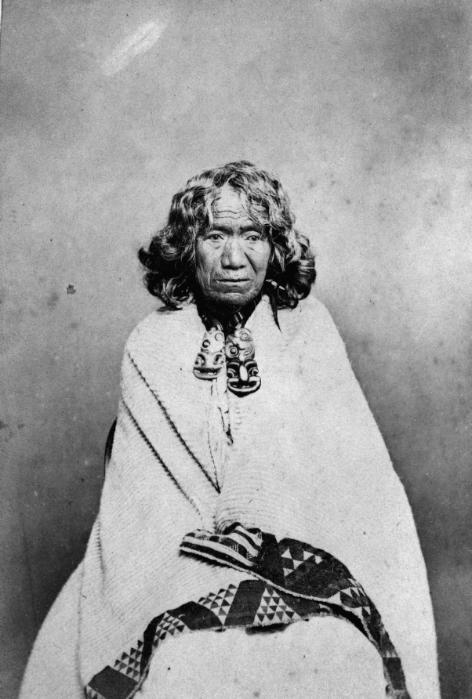
Lindauer’s portrait is based on a carte-de-visite (CDV) photograph taken by E S Richards in Wellington between September 1862 and November 1864. Stephanie Niederberger discovered a copy of this image in the Hocken Collections, at the University of Otago, which is inscribed on the back ‘Grandmother of the Jenkins family’.2 Pakewa and Nukaiahu’s daughter Pairoke (c1823–1853) married English whaler William Jenkins (1813–1902). Pairoke died in 1853 leaving behind seven young children. Pakewa, who was recently widowed, became a key caregiver to the children. In the Kāpiti region, she consequently became known as ‘Grandmother of the Jenkins family’. Later, Pakewa was vocal in support of her granddaughters as they fought for their share of a land block they had been excluded from by the courts.
There are at least five known photographs of Pakewa’s granddaughters also taken by photographer E S Richards found in various collections. Three of these images are inscribed on the back in the same distinctive handwriting suggesting it originates from the Richard’s photographic studio.
There are other copies of this CDV in public collections identified as Te Rangipikinga, but these have relied on Lindauer’s portrait to identify the subject. If the Hocken CDV is accepted as representing Pakewa, it follows that Lindauer’s portrait was misidentified as Te Rangipikinga.
The biography of Te Rangipikinga (Ngāti Apa, 1800/5–1850/5) supports this view. According to Ngāti Apa historian Grant Huwyler she died before 1855, so it cannot be Te Rangipikinga in the CDV (and the subsequent Lindauer portrait) as the wet plate collodion process used for such photographs was only introduced to New Zealand in 1858.3 Representatives of Ngāti Apa have been consulted about these findings and agree with the conclusion that the portrait is not of their tupuna.
Another of the portraits Lindauer undertook for Partridge at this time was of Te Rangi Topeora, Te Rangipikinga’s sister-in-law. This portrait was also based on a CDV by E S Richards. There are circumstantial similarities between the photographs of Topeora and Pakewa: both show elderly high-born kuia wrapped in kaitaka and wearing multiple heitiki. It seems likely that an assumption was made by Lindauer, Partridge and their advisers that these two subjects were related because of these similarities and the fact their portraits were taken by the same photographer.
In addition, the title of the portrait has also changed significantly over time. This suggests that there may have been some uncertainty about who was represented when it was first painted, at least. It was inscribed on the back by Lindauer: ‘Daughter of Rangikopinga / Queenieroa – Ariki – Ngatiraukawa’. In the copyright assignment letter, Lindauer refers to the painting as ‘Chieftainess Rangi Kopenga-ariki’, hand-annotated with insertions ‘Kuinioroa’ and ‘daughter of’ before the name Rangi Kopenga.4 The 1915 deed of gift refers to the painting as ‘Kuinioroa (Rangihaeata’s wife)’.5 Only in 1930 in James Cowan’s publication Pictures of Old New Zealand, does the portrait become known as ‘Te Rangi-Pikinga’.6
The sympathetic portrait closely follows the source photograph. Pakewa wears two large heitiki pounamu, the eyes of which are set with red sealing wax, and which are suspended from a cord of black and red twisted twine. The original photograph presents the seated Pakewa enveloped in at least one large kaitaka, and shows the fine tāniko decorating the lower edge. However, in Lindauer’s painting, Pakewa wears a korowai hukahuka about her shoulders. Together with her moko kauae and ngutu pūrua, Pakewa is immediately identified as a woman of high rank and considerable prestige.
Stephanie Niederberger, Pakewa ‘Grandmother of the Jenkins family’ and the misidentification of Gottfried Lindauer painting ‘Kuinioroa, daughter of Rangi Kopinga’ Te Rangi Pikinga, self-published, 2025, p 58.
Hocken Collections, Uare Taoka o Hākena, University of Otago, P1971-005/1-019b.
Grant Huwyler, Te Rangipikinga, Whakapapa Research, Project Series: Matriarch (Whanganui: Te Atawahai o Te Ao Charitable Trust, 2022), 6.
Lindauer, letter assigning copyright to Partridge, 18 May 1910, RC2009/4/64, EHM.
Deed of gift, 25 May 1915, ‘photostat of the original document’, in Eileen Clayton [Partridge’s daughter], correspondence with the Department of Maori Affairs concerning the Partridge Collection, 1965, R19526411, Archives New Zealand.
James Cowan, Pictures of Old New Zealand: The Partridge Collection of Maori Paintings by Gottfried Lindauer (Auckland: Whitcombe & Tombs, 1930), 188.