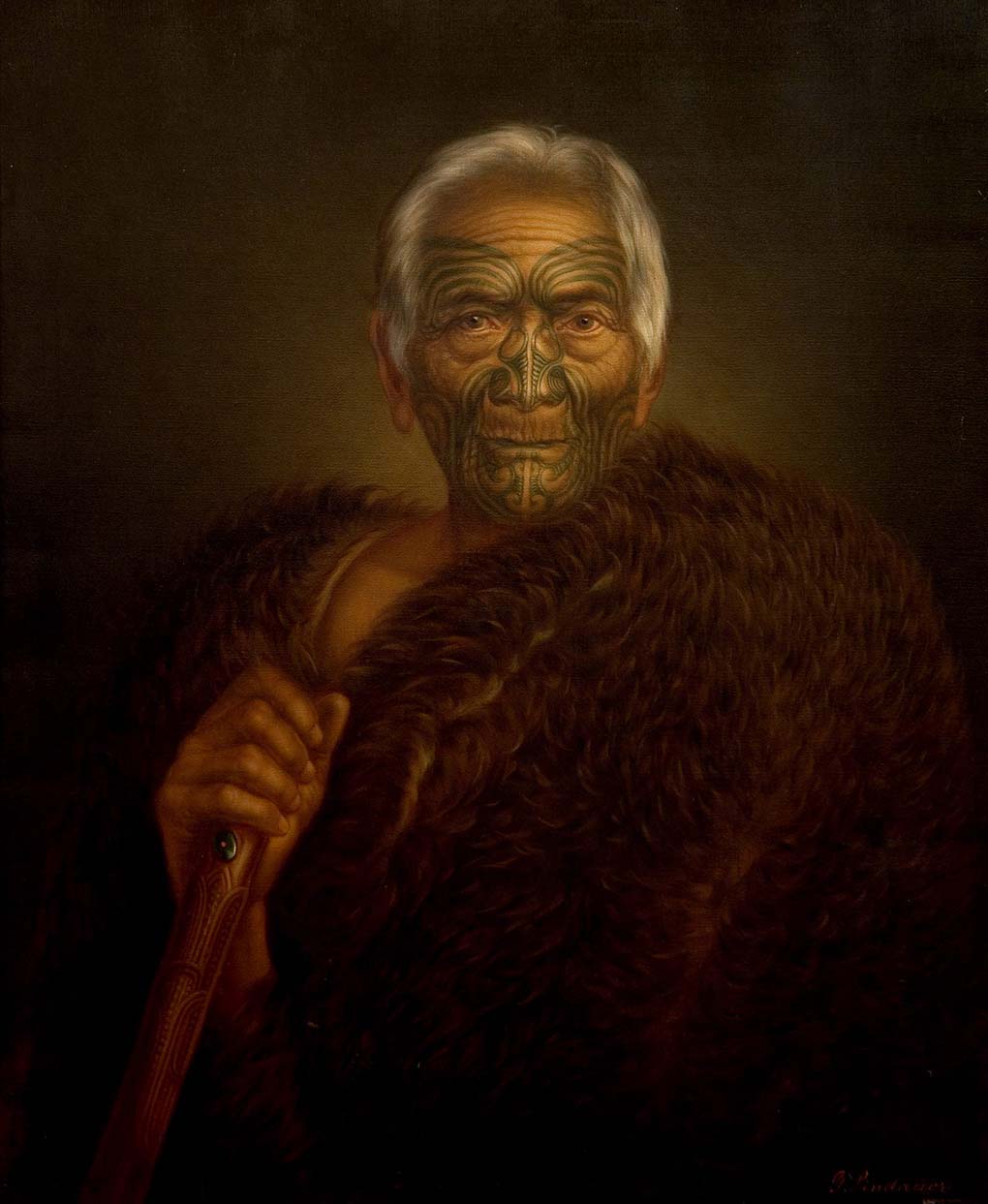
Pera Te Rangituatahi Tūtoko
? – 1897Te Aitanga-a-Māhaki, Tūhoe, Rongowhakaata
- Date
- 1901 or before
- Medium
- oil on canvas
- Measurements
- 850 x 702 mm
- Other titles
- Pera Tutoko, [title, 2026]Pera Tutoko, [1930 catalogue]Pera Tutoko, [Deed of gift, 1915]Pera Tutoko, [1901 catalogue]Oil Painting of the Maori Chief Pera Tutoki, [copyright certificate, 1902]Chief Pera Tutoko of Kaitara, P.B., [Lindauer's inscribed title]
- Inscriptions
- Front, LR: G. LindauerBack, LC: Chief "Pera Tutoko" of Kaitara" P.B.
- Takiwā / region
- Te TairāwhitiWaiariki
- Credit line
- Auckland Art Gallery Toi o Tāmaki, gift of Mr H E Partridge, 1915
- Accession no.
- 1915/2/25
Rongowhakaata chief Pera Te Rangituatahi Tūtoko from Tūranganui-a-Kiwa lived at Kaitara, a fighting pā at Poverty Bay. He was also known as Te Pera Te Rangituatahi Tūtoko Uatuku, the name honouring a Te Aitanga-a-Māhaki and Tūhoe ancestor.
Tūtoko was one of the first group of Māori prisoners incarcerated at Wharekauri Chatham Islands in 1866. Leading up to his imprisonment, Tūtoko was part of a 200-plus group of Pai Mārire Māori who vowed to defend their land from imminent confiscation by the government and to maintain independence. Their resulting stand-off with a besieging force of about 300 Māori, largely Anglican Ngāti Porou, and 200 Europeans (including discharged British servicemen) occurred on 16 November 1865. It is now famously referred to as the one-week ‘hinge of fate’attack on Waerenga-a-Hika Pā.1 The battle ‘was as much a clash of rival faiths as a result of traditional tribal animosities. Ngāti Porou had rejected Pai Mārire in favour of Anglicanism. To the south, Pai Mārire had made inroads among Rongowhakaata and Te Aitanga-a-Māhaki at Poverty Bay.’2
Following the siege, Tūtoko, together with other Māori including Te Kooti Te Tūruki Arikirangi (who, ironically, was part of the besieging side), was sent first to Ahuriri Napier, then exiled to Wharekauri. Tūtoko eventually escaped on board the Rifleman, with Te Kooti and others, and reached Whareongaonga, south of Poverty Bay, on 10 July 1868.
Around 1886 and1887, Tūtoko was in Tūranga Gisborne with the elders of the day, all of whom were followers of Te Kooti’s new Ringatū religion, when they decided to visit Te Kooti at Te Tokanganui-a-Noho Marae at Te Kūiti, seeking spiritual advice. Te Kooti’s directive was for Rongowhakaata Māori to ‘whakahaungia i te rongopai i runga i te aroha, me te ngawari’ – ‘proclaim the gospel, the gentler faith and the love of God’. They honoured Te Kooti by building four major wharenui named Whakahau, Rongopai, Ngāwari and Te Aroha.
According to his descendant George Parekowhai, Tūtoko was a practitioner of spirit-based ideology, believing in the power of Māori to prophesise their future. His worldview was inspirational to his people and his ideologies continue to motivate his descendants.3
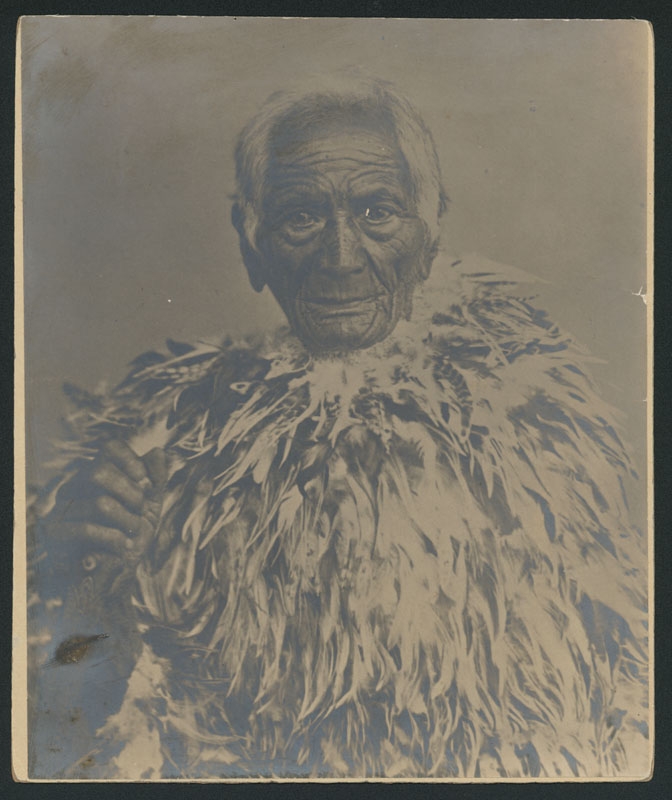
Lindauer’s undated depiction of Tūtoko is drawn from an 1880 photograph by an unknown photographer, now in the archives of Auckland Museum. In the painting, Lindauer replaces Tūtoko’s striking kahu huruhuru made with long feathers with an impressive kahu kiwi. The aged rangatira rests his right hand on a carved tokotoko.
Lindauer inscribed the painting with the words ‘Chief Pera Tutoko of Kaitara, P.B. [Poverty Bay]’.
W H Oliver and Jane M Thomson, Challenge and Response: A study of the development of the Gisborne East Coast Region, East Coast Development Research Association, Gisborne, 1971. The term ‘hinge of fate’ was coined by these authors.
‘Waerenga-a-Hika pā’, https://nzhistory.govt.nz/media/photo/wairenga-hika-pa, (Manatū Taonga — Ministry for Culture and Heritage), updated 26-Oct-2021, accessed 10 Aug 2026.
Personal communication, George Whakataka Parekowhai to Ngahiraka Mason.