Gottfried Lindauer: A Career in New Zealand
Roger Blackley
Gottfried Lindauer’s reputation peaked in the first decade of the 20th century. No other artist in Aotearoa New Zealand had achieved a definitive monument such as the Lindauer Art Gallery on Queen Street in Tāmaki Makaurau Auckland. Opened in 1901, the gallery of Māori portraits amassed by collector and businessman Henry Partridge was displayed to the delight of Māori visitors, tourists and locals alike. How had Lindauer succeeded in gaining such status as the premier painter of Māori?
"Herr G. Lindauer, the clever little Bohemian artist whose lifework has been the painting of Māori portraits and scenes of Māori life, is still painting away in his quiet studio at Woodville. He must have turned out a couple of hundred pictures during his life in New Zealand. He has had two patrons in particular, Mr. H. E. Partridge, of Auckland, and the late Sir Walter Buller. Mr. Partridge has kept the artist busy for twenty or thirty years past, painting one portrait after another of Māori notabilities, the tattooed man-eaters and warriors, and so forth, and the fine rangatira women of the past. The Partridge Gallery of Māori portraits is a wonderful collection, and yet is little known." 1
Portraiture had long been the most profitable of artistic genres and this was especially the case in a distant colony where European-trained artists were few and far between. Initially occupied with commissions from Pākehā settlers, including leading churchmen, local politicians and the mercantile elite, Lindauer also explored the possibilities of Māori portraiture. This led to a lucrative income from commissions that flowed from the Māori world, where in the later 19th century, life-sized oil portraits enjoyed a particular prestige. Indeed, it is the bicultural nature of this patronage – and the working practices that achieved it – that set Lindauer apart from other painters of the period who depicted Māori subjects.
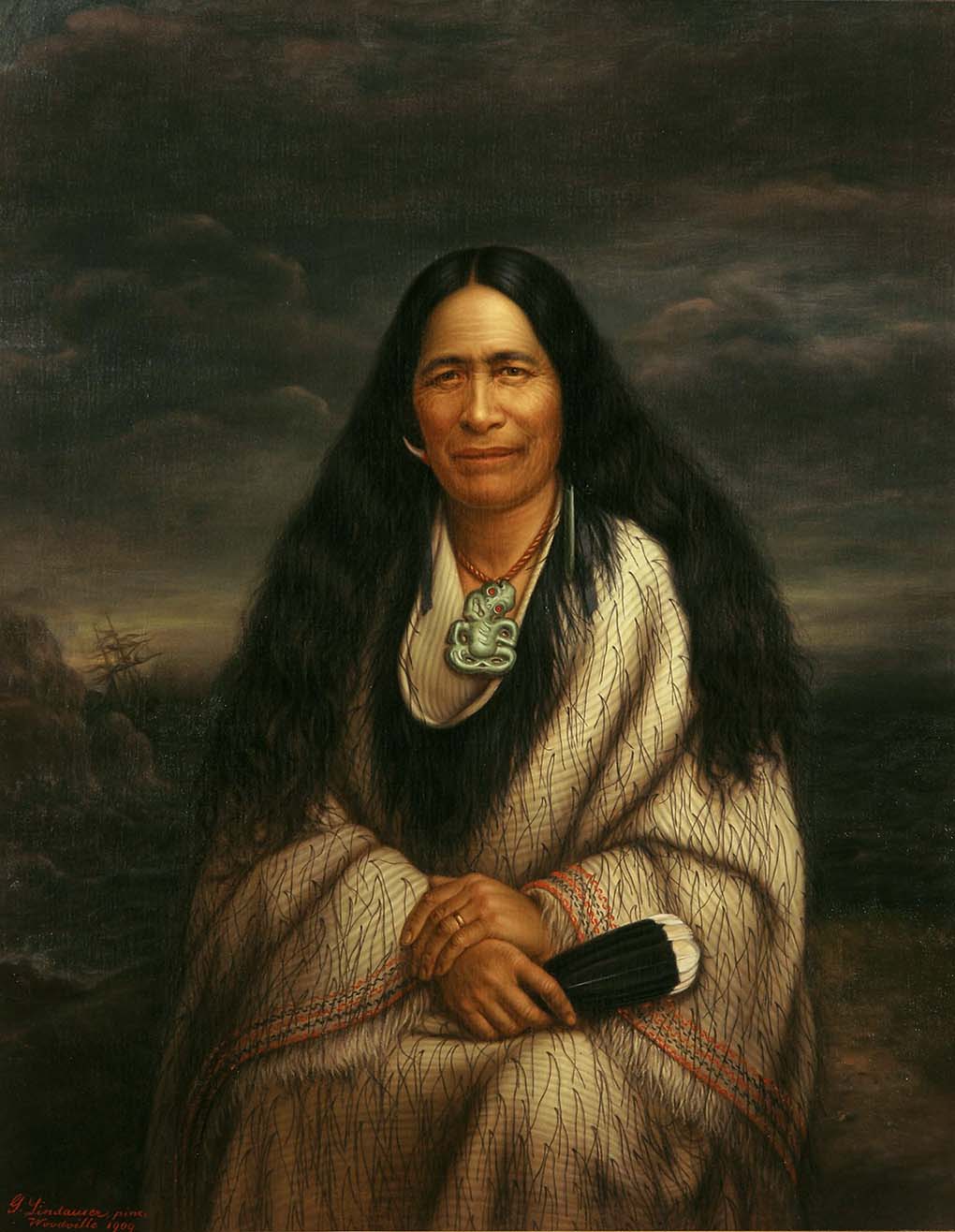
Lindauer’s supremacy in the genre is underlined by a commission he received in 1909. The citizens of Whakatū Nelson, one of the earliest settlements of the colonising New Zealand Company, subscribed funds for a portrait memorialising the Ngāti Tama chieftainess Hūria Mātenga (Fig 1), a famous Māori citizen who had recently died. On 3 September 1863, when the brigantine Delaware was wrecked on rocks at Wakapuaka near Nelson, it was the local Māori community who came to the rescue. Mātenga, with her husband Hēmi Mātenga, and Hohapata Kahupuku, swam through thunderous seas and succeeded in securing the rope from the ship to shore that saved the lives of all but one of those on board. At the time, her achievement was honoured with a public dinner and the presentation of a gold watch and chain.²
Four and a half decades on, Mātenga’s heroism was posthumously declared in the form of a grand oil painting (based on a studio photograph) destined for Nelson’s new Bishop Suter Art Gallery. The presentation ceremony on 8 March 1910 included Māori representatives who, through an interpreter, informed the Governor-General how they appreciated the honour and respect they felt had been paid to the Māori people by this gesture.³ While other civic bodies around New Zealand occasionally commissioned an oil portrait of a mayor or local founding father, this initiative by Nelson was extraordinary for its time.
Nevertheless, there were critics who argued that Lindauer, by now in his sixties, already belonged to history. Commenting on a recent addition to Partridge’s gallery, the Observer noted in 1903 that ‘Herr G. Lindauer is a name better known to the last generation, perhaps, than it is to the present’.⁴ The writer observed how the previous exhibition of the Auckland Society of Arts showed that ‘[p]ictures of Maori life have been fashionable of late’. The definitive star of that exhibition was Charles Goldie, whose two large paintings of elderly Māori women in melancholic poses were selected for presentation to the departing wife of a governor.⁵
Aged in his early thirties and wielding an impressive hyperrealist technique honed over several years at the Académie Julian in Paris, Goldie exemplified a new breed of locally born New Zealand artists who looked overseas for their training. Goldie’s elderly Māori subjects included a number who had been depicted by Lindauer but the younger artist took his work beyond straightforward portraiture. On top of the superlative technique, Goldie injected a sentimental narrative quality that marks his work as a form of colonial orientalism. Still, the nature of his specialism in Māori depictions meant that, to Goldie’s continued annoyance, his name would be forever coupled with that of Lindauer. Another link between the artists was the increasing critical neglect they faced in the course of the 20th century, as Pākehā art history struggled to evaluate the heritage of Māori portraiture.
A portrait painter in New Zealand
While Goldie debuted in the turn-of-the-century art-society exhibitions and soon saw his work represented in New Zealand’s nascent art galleries, Lindauer launched his colonial career in less auspicious times. With a fixed studio practice along traditional lines, scarcely feasible in a thinly populated colony, Lindauer embarked on the itinerant practice that would reap a regular crop of portrait commissions. These were achieved through newspaper advertisements and by exhibiting recently completed work in shop windows – a prime mode of placing work before the public but also of securing critical notice. In late 1875, after a year in Nelson, he shifted to Auckland where he showed three portraits in the window of Isidore Alexander’s jewellery shop ahead of their inclusion in the forthcoming exhibition of the Auckland Society of Artists.⁶ Eye-catching exhibitions of recently completed portraits were staged throughout 1876 in the show-window of Phillips’ paint and paperhanging shop on Queen Street.
These early portraits, almost exclusively depictions of Pākehā notables, were received with huge enthusiasm. ‘The likeness is a capital one,’ noted the New Zealand Herald of William Motion’s portrait, ‘and is brought out with almost the fidelity and detail of a photograph; the figure stands out on the canvas with startling life-like reality, and the artist’s genius with “tints”, and “lights” and “shadows” has fully brought out the “poetry of motion”.’⁷
A poignant side of the practice was Lindauer’s facility for posthumous portraiture, including that of the four-year-old Isa Watson, whose portrait, taken from a photograph, was shown at Phillips’ in October 1876.⁸ The sole Māori portrait shown was his depiction of Hūria Mātenga, the ‘Grace Darling of New Zealand’, indicative of an early awareness of Māori celebrity as a marketable category of work.⁹ Accorded a rapturous reception, Henry Partridge subsequently acquired a version of this portrait for his collection of Māori celebrities.
Lindauer next shifted to Te Whanganui-a-Tara Wellington which, as the seat of central government, promised rich pickings for a portrait painter. It was in Wellington in 1877 that the democratic nature of the shop-window exhibition was emphatically revealed by the magnetic attraction that Lindauer’s portraits exerted on Māori viewers, and where his Māori portrait practice began in earnest. The artist’s recollections of the situation that unfolded on the principal thoroughfare of Lambton Quay, when visiting Māori were electrified by the exhibited portraits, surface in an obituary written by his son, Victor Lindauer: ‘Such crowds of Maoris persisted in dancing haka in front of the shop in their excitement, and thus obstructing the road, that the police sergeant declared in jest that Mr Lindauer would be held responsible for the salaries of extra policemen on duty there.’¹⁰
A celebrated libel case in the Supreme Court, hinging on the sale of Māori land, had brought Te Hāpuku (Ngāti Kahungunu, Ngāti Te Whatuiāpiti) and other leading Te Matau-a-Māui Hawke’s Bay chiefs to Wellington. In another brief reminiscence of his father’s career, Victor claimed that Te Hāpuku commissioned three versions of his portrait, and that the artist ‘painted Hapuku later again for Partridge’.¹¹ The Partridge Collection portrait is clearly dated 1877 and hence is revealing on two counts. First, we see how Lindauer’s portrait formula was firmly established in these early years. Set within an indeterminate darkness and illuminated from above, the venerable Te Hāpuku directly confronts both artist and viewer of the portrait, a mode deployed in many later Māori commissions. Second, replication of the portraits of celebrated individuals – with strategic retention of either the ‘original’ or a replica – had become part of his business practice.
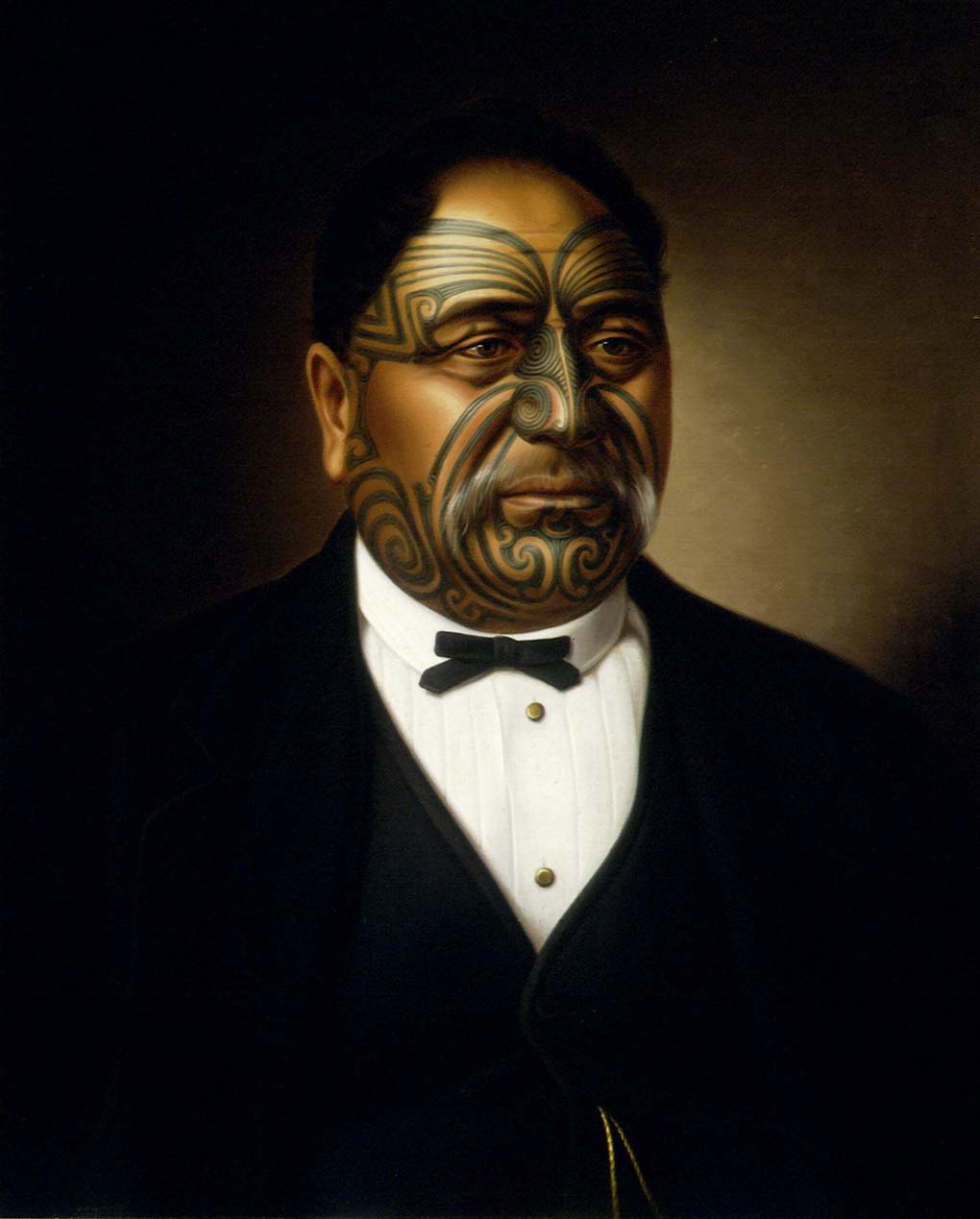
During Lindauer’s residence in the goldfields town of Thames in the summer of 1878, an exhibition in the window of the Foy Brothers’ photographic studio included two of his Wellington portraits, Wi Tako Ngātata (Ngāti Ruanui, Te Atiawa) and Te Hāpuku, the historic nature of the latter depiction underscored by recent news of the chief’s death. He showed these with another made earlier that same year, depicting the leading Auckland chief Pāora Tūhaere (Te Taou, Ngā Oho, Te Waiohua, Ngāti Whātua) (Fig 2) in formal European attire.
The Thames Star had already informed its readers that Lindauer was ‘bringing a rather lengthened tour of the Colonies to a close’ in order to take his Māori portrait collection back to his homeland of Austria, while a further notice indicated that the exhibition ‘attracted much attention, especially that of the Maoris’.¹² Persistent threats to abandon the colony were undoubtedly calculated to solicit further portraits but there is also a sense of Lindauer’s growing awareness that his unique Māori portrait collection represented a commodity of particular value.
Lindauer’s restless peregrination encompassed a spell in Ōtautahi Christchurch, where in October 1879 ‘three life-like portraits of Maori men and women’, displayed at the Philosophical Institute on the occasion of Rev J W. Stack’s lecture on ‘The Maori’, received admiration ‘as works of art’.¹³ By December of that year, he was back in Wellington, showing Māori portraits in the window of Thomas Myers’ picture-framing shop on Lambton Quay that included the first appearance of ‘a Hauraki chieftainess, Hanne Rupena [today known as Heeni Hirini], with her infant daughter’.¹⁴ Based on a Foy Brothers photograph, this winsome mother and child portrait would become the most replicated of all Lindauer’s works, securing prizes and seducing raffle-ticket purchasers in various parts of the country.¹⁵
In a further show at Myers, ‘the Maori woman and the chubby little “pickanniny” [sic] appeared alongside portraits of Wi Tako Ngātata and ‘another of a young Maori belle, apparently not very long “out”’.¹⁶ Courtesy of Myers, the works appeared in ‘handsome and massive frames – of a kind which it has hitherto been found necessary to import from Melbourne’, which suggests that the frames were intended to enhance their commodity value.
Lindauer moved to Hawke’s Bay in 1880 at the invitation of Peti Karaitiana, who commissioned eight paintings.¹⁷ These included one of her late husband, Karaitiana Takamoana (Ngāti Kahungunu), who had served in the House of Representatives as a delegate for Eastern Māori, one of the four ‘Native’ electorates. Beginning in Wellington in 1877, Lindauer recorded his Māori portrait commissions in numbered sequences in a small notebook.¹⁸ In Hawke’s Bay, he reached number 46, against a combined revenue standing at £934 – an average of £20 per portrait. It was Napier’s leading photographer, Samuel Carnell, who introduced Lindauer to the lawyer and collector Walter Buller, whose professional milieu was the Native Land Court.
We can thank Buller’s desire to patronise the artist for Lindauer’s decision to remain in New Zealand, as Victor’s reminiscences record that around 1882, Carnell discovered that Lindauer had sold his possessions and was preparing to return to Europe. Instead, Carnell persuaded him to join Buller and seek commissions from Māori claimants in the Native Land Court. This was the point at which Lindauer’s career as a painter of Māori portraits finally became viable, and when Buller’s and Partridge’s collections of Lindauer’s work grew in tandem with a flood of commissions from Māori.
Walter Buller and Gottfried Lindauer
The 1882–83 sittings of the Native Land Court in the frontier town of Cambridge (formerly Horotiu) brought together an enormous throng of claimants to the Waikato tribal lands that, until recently, had remained largely inaccessible to Europeans. Deploying his traditional technique of street-front display, Lindauer’s exhibition of the Wi Tako Ngātata portrait in the window of Hughes’ chemist shop had immediate impact: ‘The natives assembled en masse in front of the shop to offer their greeting and to sing a waiata composed years ago in honour of this chief. The portrait of Wi Tako is so realistic that when first exhibited here old Hakariwhi, of the Ngatihaua, could not resist the temptation to rub noses with the picture, giving expression at the same time to the usual mihi’.¹⁹
Lindauer’s temporary studio also showed a portrait of Rēnata Kawepō (Ngāi Te Ūpokoiri, Ngāti Hinemanu, Ngāti Kahungunu), a leading Hawke’s Bay chief, and his young wife, Puketapu. The display of portraits of great chiefs such as Ngātata and Kawepō was undoubtedly designed to tempt Waikato chiefs into similar commissions. Three months later, Lindauer provoked a temporary depletion of attendance at the Land Court with his ‘counter-attraction’ of a portrait of King Tāwhiao (Ngāti Mahuta) in full regalia, painted to the order of Buller, alongside another of the celebrated tohunga, Te Aokatoa (Ngāti Raukawa, Waikato), to the order of a certain Major Jackson.²⁰ The aged Te Aokatoa was a particularly feared tohunga and had officiated at the ceremonies of the Hauhau movement that arose during the colonial wars of the 1860s.
Interestingly enough, it was Māori desire that ensured his depiction: ‘The venerable man is blind from sheer old age, and his tribe were so anxious to preserve his likeness that they brought him down from Aotearoa [likely Aotea Harbour, on the west coast] expressly for that purpose.’²¹ This commentator measured Lindauer’s success by the ‘unbounded delight [given] to the natives from all parts of the district’, while he mused on the undoubted value of a permanent collection of such works:
"The Maoris of the old type are passing away, and nothing could possess more interest for future generations than a gallery of such pictures as these. In a very few years it will be impossible to obtain them. None of the local museums being in a position to incur the cost of a proper series of such portraits, the Government ought, in the interests of the colony, to take advantage of this opportunity of securing so valuable a collection of historical paintings."²²
Buller’s importance in facilitating such a collection cannot be overestimated. Benefiting from lucrative retainers and extravagant daily fees, he was the leading lawyer and effective grandee of the hearings.²³ When King Tāwhiao visited the town on 16 May 1883, attended by 150 horsemen, the court adjourned for the day in order that Tāwhiao could be hosted by Buller at Kirkwood’s Hotel; Tāwhiao’s followers meanwhile received gifts of food and were billeted with Ngāti Raukawa.²⁴ Soon afterwards, Lindauer was working on life-size portraits of one of Tāwhiao’s wives, Ngahuia, and of his close associates, Tāmati Ngāoira Manuhiri and Wahanui Reihana Te Huatare.²⁵
That Buller enriched himself at the expense of Māori land claimants was evident to the claimants themselves, including Hitiri Te Paerata (Ngāti Raukawa), who in February 1883 denounced Buller for dragging out the cases in order to enhance his fees.²⁶ Nevertheless, by deciding to commission a portrait from Lindauer, Te Paerata ensured that his portrait would enter Buller’s collection. A celebrated hero of the defence of Ōrākau in the Waikato War two decades earlier, Te Paerata donned the Māori attire that accorded perfectly with Buller’s desire for ethnographic authenticity. Another uncompromisingly frontal depiction of Te Paerata was created two years later by Joseph Gaut, a mysterious itinerant painter who also sought Māori patronage in this period.
Victor Lindauer’s reminiscences record that Buller exacted a half-length portrait worth £30 in exchange for every £200 worth of commissions that he helped to secure for the artist.²⁷ Not only does this explain the frequent appearance of Buller’s name in Lindauer’s notebook, listed alongside the subjects’ names and the prices they were paying, but it further suggests that Buller accumulated his portrait collection completely free of charge. That the system was susceptible to abuse is revealed by a letter dated 2 November 1885, sent to Buller by Anihera Reina, who disputes the £20 she is being asked to pay for a portrait that does not resemble her. ‘This portrait is not at all like me, because you did not invite me to come to the place where the portrait was begun, so that you two could know what I looked like.’²⁸ Anihera’s letter suggests that Lindauer’s prowess in working from photographs had its limits.
The significant rewards accruing from engagement in this field are revealed by the page in Lindauer’s notebook that computes the impressive amount he received for his Māori portrait production – a grand total of £4474, inclusive of £1421 contributed by Henry Partridge. This income not only provided the means for Lindauer and his wife Rebecca to visit London at the time of the Colonial and Indian Exhibition of 1886, where Buller’s collection of portraits formed an eye-catching central display of the New Zealand Court, but also allowed them to settle in the peaceful north Wairarapa junction town of Woodville.
The ethnographic artist: abroad and at home
As early as 1876, during Lindauer’s first sojourn in Auckland, it was suggested that he depict a leading Tauranga chief Hōri Tūpaea (Ngāi Te Rangi), in a portrait to be sent to the upcoming Philadelphia Centennial Exhibition.²⁹ Though the portrait was not realised, this is an early recognition of Lindauer’s status as the producer of ethnographic art – a genre that, alongside ethnological collections of artifacts, was achieving recognition at international exhibitions. Buller’s formation of a Māori portrait collection was closely connected to his accumulation of an immense artifact collection, which in turn was facilitated by his close relationships with Māori clients. As he later explained to a London journalist, ‘I have many personal friends among the leading chiefs whose language, of course, I speak fluently. I am also the possessor of no fewer than seven of their greenstone meres – the badge of chieftainship – given me by representative chiefs on different state occasions.’³⁰
That the ‘state occasions’ in question comprised real estate transactions, with Buller taking profitable retainers and daily fees from more than one party, was neither here nor there to him. Like the portraits, many of his chiefly ‘curios’ must have arrived as additional perks in a business that, in 1882, Buller estimated was earning a staggering £6000 to £8000 per year.³¹
Buller’s collection provided the mainstay of ‘the Maori Court’ in the Colonial and lndian Exhibition, a succession of cases of carved greenstone and woven fabrics presided over by a gallery of portraits. Some portraits presented Māori ‘celebrities’ – Tāwhiao, the Māori King; Wahanui, the Māori Orator; Hitiri Te Paerata, the Hero of Ōrākau – attired in customary dress and carrying traditional weapons. Others showed ‘handsome native girls and half-breeds’, said by The Times ‘to have always a little crowd of admirers’.³² It was one from the latter category, an alluring portrait of Terewai Horomona (Fig 3) as a poi dancer, that helped to secure what Buller craved more than anything – a knighthood.³³ Buller was fond of retelling the story of when the Prince of Wales visited the New Zealand Court:
"The Prince glanced politely, but wearily, at the kauri gum and wool and flax and other exhibits, and was apparently about to go when he caught sight of a picture on the wall – Lindauer’s painting of a pretty Hawke’s Bay Māori girl, with a wreath of clematis thrown carelessly over her head. The Prince asked for a chair, and he sat there looking at the picture for several minutes. At last, as he rose to go, he said to Sir Somers Vine and Dr Buller: ‘Do you know, that is one of the most beautiful pictures I have ever seen!’³⁴"
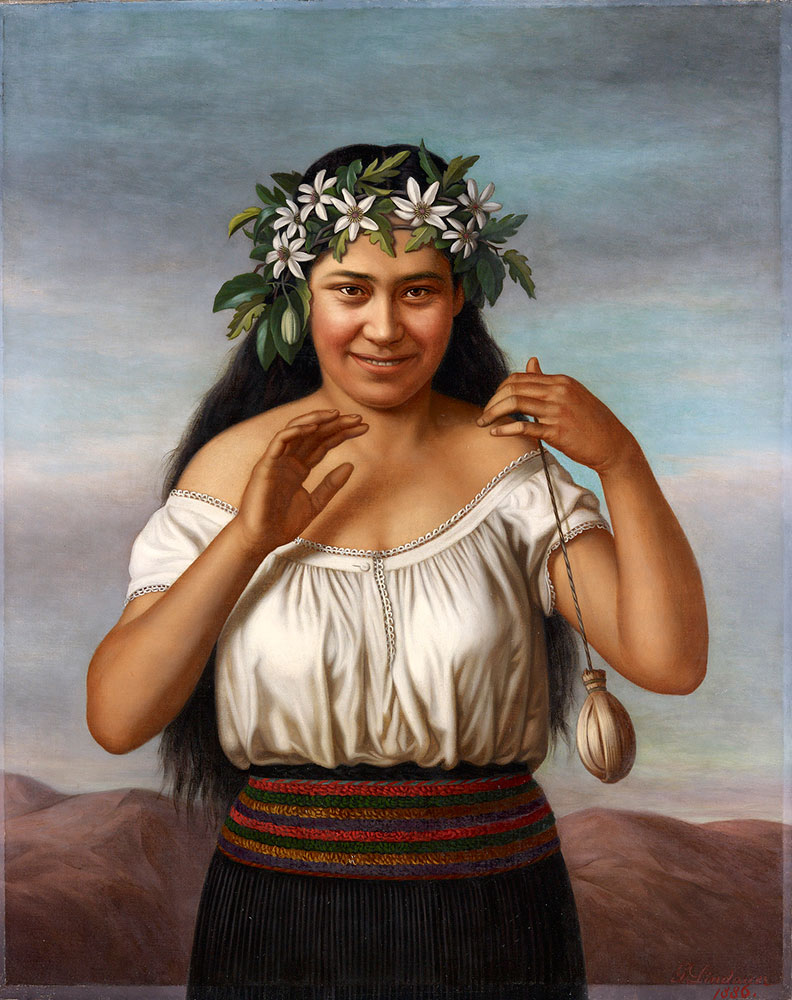
Buller hastily dispatched the painting to the palace, asking the prince to accept it as a ‘memento of his visit’, and the gesture in turn returned a dividend in the form of his Knight Commander of the Order of St Michael and St George.35 The exhibition in London certainly helped to seal Lindauer’s fame back in New Zealand but news of Buller’s metropolitan apotheosis was less warmly received. One commentator refused even to recognise the first colonial-born knight, referring scornfully to ‘Dr Buller, who has grown rich on the spoils of poor simple Maoris, and now wears these after the manner of an American Indian chief, who decorated him-self with the scalps of his victims’.³⁶
Lindauer’s most important exhibition by far was the monumental installation of the Lindauer Art Gallery opened by his principal collector Henry Partridge in May 1901. From Māori citizens, in particular, the response was immediate:
"The crowds of Maori visitors there never require any key or catalogue, thus proving the excellence of the portraits – and it is noticeable that they take little or no interest in the pictures of chiefs other than those of their own particular tribe; but these, once spotted, come in for rounds of applause, delivered in Maori fashion, thus: ‘By golly!’ ad lib., they say, and then rush into the street to bring in friends or relations that may be anywhere near.³⁷
Partridge maintained two visitors’ books in the gallery, one with the title ‘Pukapuka Mo Nga Manuhiri Tangata Matakitiki’ (which translates as ‘book of the viewing visitors’). The very existence of the Māori Visitors’ Book, in which the Māori-language letterpress invites viewers to contribute, is evidence that Māori access to the collection was central to the planning of the Lindauer Art Gallery.³⁸
It was the Lindauer Art Gallery that also encouraged the bilingual journalist James Cowan to become the leading historical biographer of Māori. Perhaps inspired by a fulsome appraisal of his new gallery that appeared in the Auckland Star in September 1901, Partridge commissioned Cowan to compile the text for a biographical guide to the 39 portraits that, with the large historical canvas of Tohunga under Tapu, 1901, then formed the collection.³⁹ Cowan adapted texts already collected by Partridge from government agent James Mackay and others, while also conducting his own interviews with ‘[t]he chiefs themselves, sons, daughters, and relatives’.⁴⁰
The modest 68-page booklet of 1901 was revisited in 1930 as a fully illustrated, 220-page biographical catalogue of the Partridge Collection.⁴¹ Pictures of Old New Zealand deserves recognition as the first New Zealand art monograph.⁴² Cowan’s book documents all 70 Lindauer works in the Partridge Collection, providing information on the depicted individuals, though relatively little on the circumstances of production. Perhaps the most remarkable feature is the appendix of translated excerpts from the Lindauer Art Gallery’s visitors’ books, which makes Cowan’s book the first monograph on a New Zealand artist to take account of the bicultural reception of Lindauer’s work.
Lindauer’s status as an artist
The aesthetic status of Lindauer’s paintings was never entirely secure, for the ‘photographic’ qualities that delighted many early commentators would quickly become a liability and an all-too-evident pointer to their origins. Writing in 1890 to Captain Gilbert Mair, lender of important Māori works to the New Zealand and South Seas Exhibition staged at Dunedin over the summer of 1889–90, collector and curator Thomas Hocken referred to the arrival of Lindauer’s enormous painting, The Maori at Home, 1885. Owned by Mair’s brother-in-law Walter Buller, the work had provided a centrepiece at the Colonial and Indian Exhibition: ‘Buller’s picture has long ago been safely erected and, as he requested, an insurance of £600 put on it. Opinions differ – I would not give him £30 for it. To my mind it is uninteresting, most typical, and like all Lindauer’s pictures, deadly flat.’⁴³
Another leading New Zealand bibliophile and artefact collector of the period who spurned Lindauer’s work was Alexander Turnbull.⁴⁴ In 1918, this proud possessor of Māori portraits by a range of colonial artists informed a London dealer: ‘I do not care to purchase any of this artist’s work. They are really coloured photographs, and of little, if any, artistic value.’⁴⁵
Despite the achievement of Partridge’s portrait gallery on Auckland’s Queen Street, Lindauer’s declining artistic status is suggested by a 1908 competition in the Weekly Graphic and New Zealand Mail to name ‘the six best New Zealand artists, living or dead, including not only those who are natives of the country, but also those of any nationality who have resided in the Dominion and produced New Zealand pictures in Oil or Water Colours’.⁴⁶ Hands-down winner was Charles Goldie, nominated by 90 per cent of the voters, followed by several leading landscape painters, with Lindauer languishing in eighth place and cited by less than 25 per cent of the voters.⁴⁷ Lindauer’s only consolation was that Louis John Steele, the ‘Meissonier of Maoriland’, trailed behind him in 11th place.
Lindauer’s 20th-century reception can be tracked through the fortunes of the Partridge Collection, which, triumphantly acquired for the Auckland Art Gallery in 1915, suffered a gradual and seemingly inexorable decline in prestige, as an expanding collection of European and local paintings placed pressure on the Gallery’s display spaces. By the 1930s, the Lindauer display was relegated to an upstairs gallery adjacent to the Old Colonists’ Museum, where the pioneering Māori film actress Ramai Hayward recalled regular groups of Māori visitors attending a space that still functioned as a type of ancestral shrine.⁴⁸
For many Pākehā art lovers, however, the Lindauer collection represented an embarrassing relic of a colonial heritage that some thought should realise its ‘ethnological value’ through a transfer to Auckland Museum.⁴⁹ While debates concerning the status and appropriate housing of the Partridge Collection dragged on into the 1960s, the nadir of Lindauer’s reputation can be dated at 1956, when the recently arrived Auckland Art Gallery director Peter Tomory infuriated many local admirers of Lindauer and Goldie by pronouncing, ‘Lindauer was no Gauguin. His work is of social and historical importance but it is not great art . . . Goldie, on the other hand, is a second-rate Lindauer.’⁵⁰
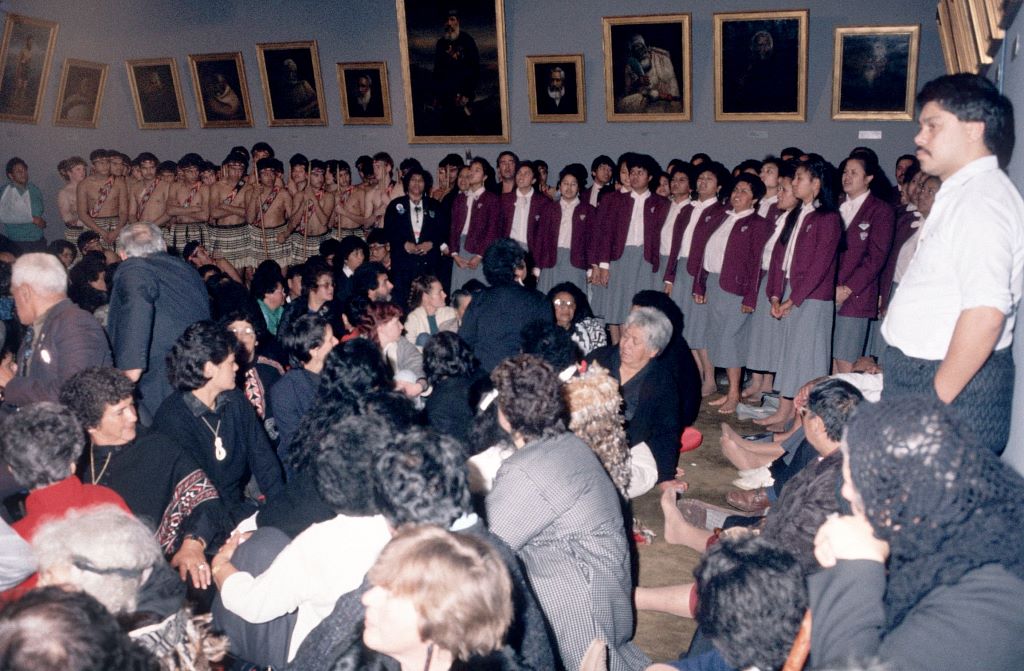
A sample of Lindauer’s portraits was usually to be found among the New Zealand art on display but evidence of a significant re-evaluation of the Partridge Collection came when it was displayed in its entirety alongside Te Maori: Te Hokinga Mai The Return Home at the Auckland Art Gallery in 1987.⁵¹ All 62 portraits of the collection lined the walls of the gallery that was used by tribal groups to welcome visitors to the exhibition – the first time for decades that the entire collection had been displayed within a single space. Despite expressing a conviction that Lindauer’s work had ‘tenuous connections with high art’, art historian Michael Dunn was impressed by the exhibition: ‘It was interesting to note how well they functioned, by contrast, when hung in the paepae room of the Te Maori exhibition at the Auckland City Art Gallery …. There, in the context of Maori ceremony, they took on a deeper meaning which stirred some life from their severe, formal demeanour.’⁵²
The entire collection returned to view in 1997 in conjunction with the retrospective Goldie, when the Gallery again hosted tribal delegations with speakers addressing the pictures, just as their ancestors had at the Lindauer Art Gallery earlier in the century. Also contributing to a growing awareness of the special status signalled by the bicultural origins of Lindauer’s work was the Whanganui Regional Museum’s inauguration in 1993 of a gallery showcasing the Buller Collection, alongside a number of beautifully preserved portraits on loan from local Māori collections, works that Buller had helped to bring into existence.
It is the shared nature of the Māori oil portrait tradition that offers a truly distinctive feature of New Zealand art history, with few parallels to be found in other British settler societies.⁵³ In Australia, Aboriginal and Torres Strait Islander peoples have been almost completely excluded from the category of heroic portraiture and there is little or no evidence of historical Indigenous engagement with portraits.
The North American ‘Indian Galleries’ formed by the painters Charles Bird King and George Catlin earlier in the 19th century, enacting in paint the ‘preservation’ of a doomed people, offer certain parallels with Partridge’s Lindauer Art Gallery⁵⁴ a colonising culture, appropriating the lands of another people, memorialises the picturesque and noble appearance of the vanquished chiefs. But again, what seems to be missing in the American context is any significant patronage on the part of the Indigenous world, or continuing engagement with the genre, to match the widespread Māori co-option of colonial-era portraiture in New Zealand that is evidenced in the work of Gottfried Lindauer.
First published in Gottfried Lindauer: Die Maori-Portraits for the Nationalgalerie, Staatliche Museen zu Berlin in collaboration with Auckland Art Gallery Toi o Tāmaki; edited by Udo Kittelmann und Britta Schmitz. Verlag der Buchhandlung Walther König, 2014, updated 2026. Reprinted online with the kind permission of the author and publishers.
- Free Lance, 11 June 1910, p. 4.
‘Herr Lindauer’, Nelson Evening Mail, 28 October 1879, p 4.
‘Unveiling of the Memorial Portrait of Julia’, Colonist, 9 March 1910, p 2.
‘Pars about People’, The Observer, 3 October 1903, p 4.
Leonard Bell, ‘Two Paintings by C. F. Goldie: Their Brilliant Careers’, in: Roger Blackley, Goldie, Auckland Art Gallery & David Bateman, Auckland, 1997, pp 115–20.
Daily Southern Cross, 15 November 1875, p 2.
- New Zealand Herald, 19 June 1876, p. 2.
Daily Southern Cross, 27 October 1876, p 2. One of the earliest references to Lindauer in New Zealand refers to his facility in taking portraits from miniature photographs – see ‘Portrait Painting’, Nelson Evening Mail, 15 March 1875, p 2.
- New Zealand Herald, 20 May 1876, p. 2.
[V. W. Lindauer], ‘The Late Mr. Lindauer’, Woodville Examiner, 18 June 1926, p 2.
Victor Wilhelm Lindauer, ‘How Papa Painted His First Maori Portrait’, E M Lindauer Papers (MS-Papers-4369), Alexander Turnbull Library, Wellington.
Thames Star, 22 June 1878, p 2 and 16 July 1878, p 2.
‘Philosophical Institute’, Press, 17 October 1879, p 2.
- Evening Post, 15 December 1879, p. 2.
Commenting on a version on exhibition at Partridge’s shop on Queen Street, an Auckland journalist noted that ‘the picture has been considered so good that eight copies of it have been taken, one of them being in the possession of Major Mair’ – New Zealand Herald, 15 July 1882, p 4.
- Evening Post, 22 May 1880, p. 2.
My thanks to Rose Mohi for identifying her forebear’s commissions.
Gottfried Lindauer, Notebook, E M Lindauer Papers (MSX-3092), Alexander Turnbull Library, Wellington.
‘Maori Sayings and Doings’, New Zealand Herald, 31 October 1882, p 6.
‘The Native Gathering at Cambridge: Mr Lindauer’s Portraits’, New Zealand Herald, 29 January 1883, p 6.
‘The Native Gathering at Cambridge: Mr Lindauer’s Portraits’, New Zealand Herald, 29 January 1883, p 6.
‘The Native Gathering at Cambridge: Mr Lindauer’s Portraits’, New Zealand Herald, 29 January 1883, p 6.
‘Brief Mention’, The Observer, 4 November 1882, p 124.
Tawhiao at Cambridge’, New Zealand Herald, 17 May 1883, p 5.
Bay of Plenty Times, 12 June 1883, p 2. Both subjects are represented in the Partridge Collection, with Wahanui alone joining the Buller Collection.
‘The Natives and the Lawyers’, New Zealand Herald, 10 February 1883, p 5.
Victor Wilhelm Lindauer, ‘How Papa Painted His First Maori Portrait’.
Anihera Reina (or Rema) to Walter Buller, 2 November 1885, Sir Walter Buller Papers (MS-Papers-0048-0020), Alexander Turnbull Library, Wellington; transcribed and translated by Angela Ballara in: Frances Porter and Charlotte Macdonald (eds), ‘My Hand Will Write What My Heart Dictates’: The Unsettled Lives of Women in Nineteenth-Century New Zealand as Revealed to Sisters, Family and Friends, Auckland University Press & Bridget Williams Books, Auckland, 1996, pp 52–3.
New Zealand Herald, 3 May 1876, p 2.
‘The Future of New Zealand: An Interview with Sir Walter Buller’, Sala’s Magazine, 1893, Buller scrapbook (qMS-0327, vol 1), Alexander Turnbull Library, Wellington.
Ross Galbreath, Walter Buller: The Reluctant Conservationist, GP Books, Wellington, 1989, p 130.
‘The Colonial and Indian Exhibition: New Zealand’, The Times, 24 July 1886, p 4.
Genevieve Silvester, ‘Lifting the Shadows from Gottfried Lindauer’s “Maori Girl with Poi”’, Journal of New Zealand Art History, vol 32, 2001, pp 52–61.
New Zealand Free Lance, 11 June 1910, p 4.
In addition to the gift of the painting, Buller made a £5000 contribution towards the prince’s project of an Imperial Institute. See Galbreath, Walter Buller, pp 156–8.
‘Mixed Pickles’, The Observer, 30 April 1887, p 9.
‘The Social Sphere’, The Observer, 15 June 1901, p 16.
See Roger Blackley, ‘The Visitors’ Books at the Lindauer Art Gallery’, accessed 24 June 2026.
‘Maori Portrait Gallery’, Auckland Star, 2 September 1901, p 3; James Cowan, Maori Biographies: Sketches of Old New Zealand: Descriptive Catalogue of Maori Portraits Painted by Herr G Lindauer, Brett Printing and Publishing Company for H E Partridge, Auckland, 1901.
‘Lindauer Collection’, New Zealand Herald, 1 April 1915, p 8.
James Cowan, Pictures of Old New Zealand: The Partridge Collection of Maori Paintings by Gottfried Lindauer, Whitcombe & Tombs, Auckland, 1930..
Janet Paul (ed), Eric Lee-Johnson, Paul’s Book Arcade, Hamilton, 1956, pp 1–44.
Hocken to Mair, 28 March 1890, ‘Letterbook of the Early History, Maori and South Seas Committee’ (MS-103), Hocken Collections Uare Taoka o Hākena, Dunedin, pp 86–9.
In 1899, Turnbull refused a Lindauer portrait offered for £55 – see E H McCormick, Alexander Turnbull: His Life, His Circle, His Collections, Alexander Turnbull Library, Wellington, 1974, p 182. That he owned at least one Lindauer is evidenced by his 1916 gift of an 1880 portrait of Wi Tako Ngātata to the Dominion Museum in Wellington, whose collection belongs to the Museum of New Zealand Te Papa Tongarewa today.
McCormick, Alexander Turnbull, p 287.
The “Graphic’ Readers” Own Page: Competitions for our Readers’, Weekly Graphic and New Zealand Mail, 20 May 1908, p 43. The prize was a year’s subscription to the Graphic.
The “Graphic’ Readers” Own Page: Competitions for our Readers’, Weekly Graphic and New Zealand Mail, 20 May 1908, p 43. The prize was a year’s subscription to the Graphic.
Personal communication with Ramai Hayward, 1997. Hayward recalled that if one Māori group was already visiting, another would wait their turn outside.
Eric Lee-Johnson, ‘Goldie and Lindauer’, New Zealand Herald, 17 August 1960, p 6; cited in Blackley, Goldie, p 38.
Peter Tomory, ‘Introduction’, New Zealand Painting, Auckland City Art Gallery, Auckland, 1956, p [5].
This was the final venue for Te Maori, a blockbuster exhibition of Māori treasures that toured four US museums in 1984 to 1986 and four New Zealand museums in 1986 to 1987.
Michael Dunn, A Concise History of New Zealand Painting, Craftsman House, Sydney, 1991, p 31.
While Hawaiian royalty and other Indigenous elites utilised portrait painters, such patronage was limited by comparison with the Māori example. David W Forbes, Encounters with Paradise; Views of Hawaii and its People, 1778–1941, Honolulu Academy of Arts & University of Hawai‘i Press, Honolulu, 1992.
Brian W Dippie, Catlin and His Contemporaries: The Politics of Patronage, University of Nebraska Press, Lincoln and London, 1990.