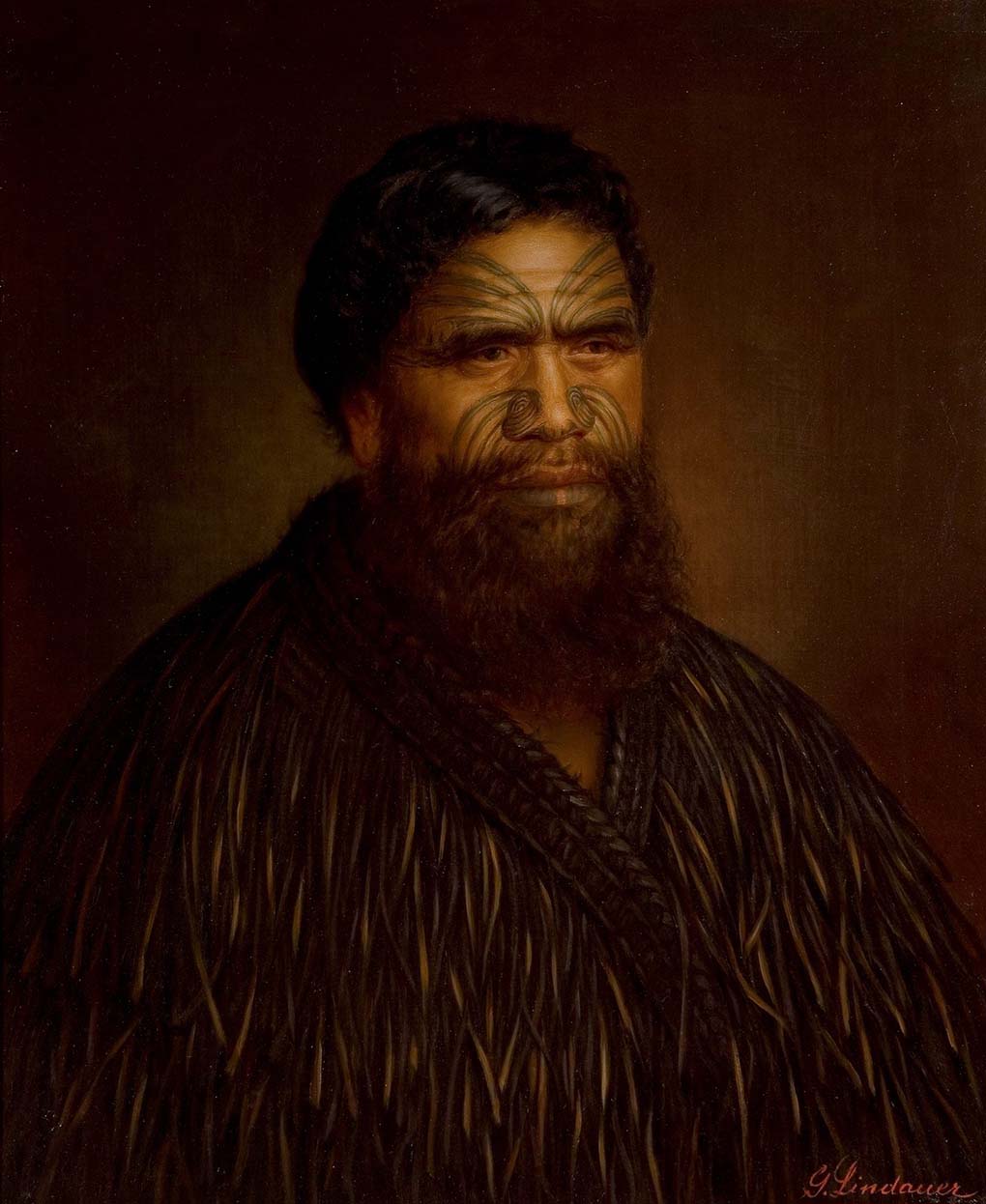
Whitiora Te Kumete
? – 1897Ngāti Mahuta
- Date
- c 1910
- Medium
- oil on canvas
- Measurements
- 614 x 512 mm
- Other titles
- Whitiora Te Kumete, [title, 2026]Whitiora Te Kumete, [1930 catalogue]Whitiora Te Kumete (The Prophet), [Deed of gift, 1915]Oil Painting Portrait of Chief Whitiora Te Kumete, [copyright certificate, 1913]Chief Te Kumete, [Lindauer's inscribed title]
- Inscriptions
- Front, LR: G. LindauerBack, LC: Chief Te Kumete
- Takiwā / region
- Waikato-Maniapoto
- Credit line
- Auckland Art Gallery Toi o Tāmaki, gift of Mr H E Partridge, 1915
- Accession no.
- 1915/2/57
Ngāti Mahuta fighting chief Whitiora Te Kumete was also known as Wī Kumete and Wiremu Kumete Te Whitiora. Before the Waikato War of 1863–64, he was based at Kāwhia and, later, when he joined Tāwhiao’s advisory council, he lived at Pirongia.
In 1863, he was taken prisoner after the battle at Rangiriri, along with Tākerei Te Rauangaanga, also of Ngāti Mahuta, and sent to Kawau Island.1 When he and his fellow inmates escaped to the mainland near Mahurangi in 1864, they were visited by a government agent and urged to return to captivity.2 This whakataukī was his response:
He manu ka motu i te māhanga e kore e taea te whai.
A bird that has once escaped from the snare will not be caught again.
Te Kumete dressed in both European and Māori dress. On 8 June 1869 the special correspondent for the Daily Southern Cross, reported hearing Te Kumete speak when pastoralist Josiah Firth met with members of the Kīngitanga in the Waikato:
He was dressed in a native mat [woven muka cloak] made with sleeves like a coat, and called a kouru, moleskin trousers, and knee boots; and while he spoke he held his cap in his hand. His commanding figure and manly intelligent features, no less than the deep, energetic tones in which he spoke, were sufficient to strike the observer with admiration.3
The probable source photograph for this portrait captured Te Kumete seated wearing shirt sleeves with a tartan blanket wrapped around his waist and checked fabric worn as a sash over one shoulder. Lindauer’s depiction avoids Te Kumete’s personal sense of style, instead painting him in a dark pākē. His hair is well groomed and his untrimmed beard partially conceals the lower section of his mataora.
While his face is picked out in golden light, Te Kumete appears pensive, even melancholic – understandable when one considers what he and his people had endured. As Te Kumete argued to Firth (in the Waikato as an emissary of the governor while also seeking to increase his own land holdings):
We do not want any particular part of Waikato; we want all Waikato and all New Zealand back; for this is Waikato and there is Waikato (meaning the confiscated line through the country). The Taranaki land belongs to its own people; the Manukau land belongs to its own people; the Whanganui and Waikato lands belong to their own people. Let the Governor call back all you Europeans, who are sojourners (ie., living on the confiscated land) merely, throughout the colony, and not until then will we meet the Governor to talk about peace.4
‘Wiremu Kumete Te Whitiora (Person)’, New Zealand Electronic Text Collection Te Pūhikotuhi o Aotearoa, Victoria University of Wellington, http://www.nzetc.org/tm/scholarly/name-134231.html, accessed 26 July 2023.
James Cowan, The Maori: Yesterday and To-day, Whitcombe and Tombs, Christchurch, 1930, p 110, New Zealand Electronic Text Collection Te Pūhikotuhi o Aotearoa, Victoria University of Wellington, http://www.nzetc.org/tm/scholarly/tei-CowYest-t1-body-d1-d9.html, accessed 26 July 2023.
‘Mr Firth’s Visit to the King Party’, Daily Southern Cross, 8 June 1869, p 4.
As above.